Navigation
Part 1: Initial impressions and preliminary review after 35 hours of playtime
Interlude: Game Navigation Overview
Part 2: Campaign write-up / Let's Play
I think I read about Winning Post for the first time a few months
back, from one
of Kimimi’s old posts and I’ve been kind of curious about it since
then, in the way I sometimes am for ephemera from The Silent Abyss; I
say, looking at the copies of Herdy Gerdy and Goblin Commander and Ford
Mustang on my shelf. Now, while Kimimi did ultimately conclude the games
were well-made I think the review still came off a bit undercooked, and
I mean, I get that. As far as I understand it horse racing games are to
Japanese game shops what old copies of Madden are to American game
shops. Immersed in the milieu of game discussions they can slide off the
mind as completely and utterly unremarkable even if you’re doing your
best to engage with them. Kimimi’s review stayed pretty surface-level so
I didn’t quite get what was going on there beyond “It has a good core
loop”.
Now I’ve been reading up on Japanese horse racing a bunch recently
because of Umamusume so I think if I sit down with one of these horse
racing games I could maybe delve a bit deeper into the appeal than
Kimimi did there and maybe add something real to the conversation, even
as my Japanese reading level remains in roughly the sort of dismal state
you usually only see in American third-graders who were taught to read
wrong. But I think I have enough domain experience now to scrape by.
Part 1: Initial impressions and preliminary review after 35 hours of playtime
So, first and foremost: Winning Post is a Koei Tecmo game – from the
Koei end of the company at that – and I think by starting there we can
get an idea of the kind of place it’s coming from. As with most of the
rest of Koei’s original series, Winning Post is a historical simulation
game, though the histories it’s simulating are the horse racing eras of
the late 1970s onward instead of Nobunaga’s conquest of Japan. But even
though the subject matter is different, the core appeal is pretty
similar. We’re going to put you in the shoes of a horse farm and ask you
if you can get a better outcome for your favorite actors of that era.
It’s not too uncommon for horses to get injured and retired, which
creates an infinite well of what-ifs to pull from. What if Ines Fujin
didn’t get hit with tendonitis after the Derby? What if Agnes Tachyon
got to finish running the Classics? Could King Halo have beaten Special
Week and Seiun Sky if he’d been trained differently? Could Kitasan Black
have picked up a few more major wins if he hadn’t retired after the
Arima Kinen? Could you do it better?
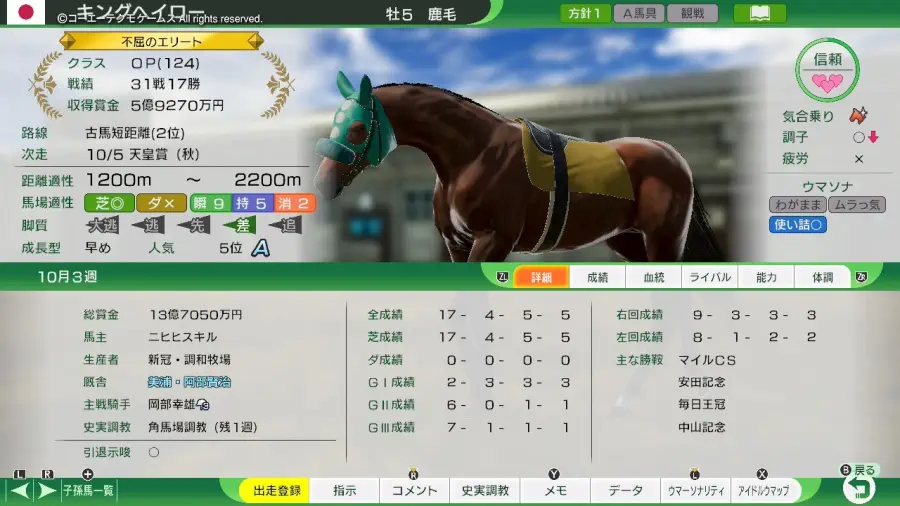
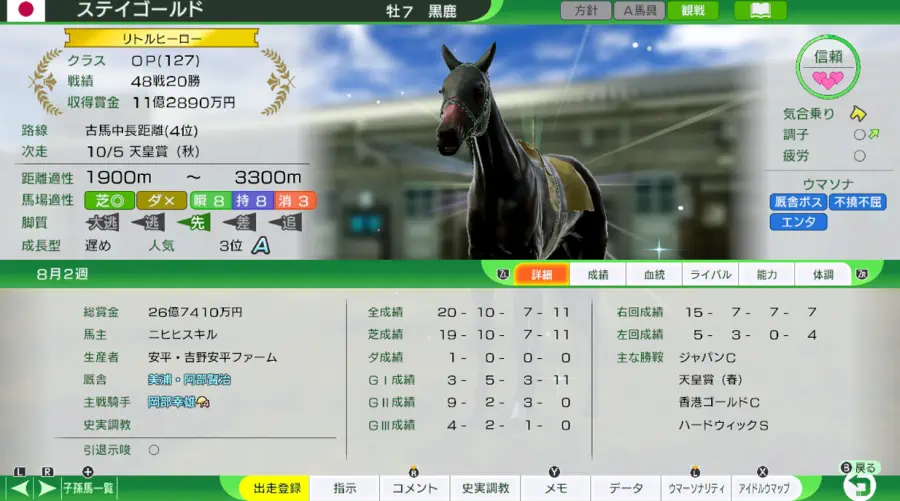
These sorts of questions are at the
core of the appeal of the game, and if you don’t know any of those names
it can be hard to care. But this is true of any sports game. If you
don’t know the athletes or the teams it’s hard to make judgement calls
or get invested. If you’re not already invested in horse racing to some
degree it’s hard to look down the list of names and hear anything but
gibberish.
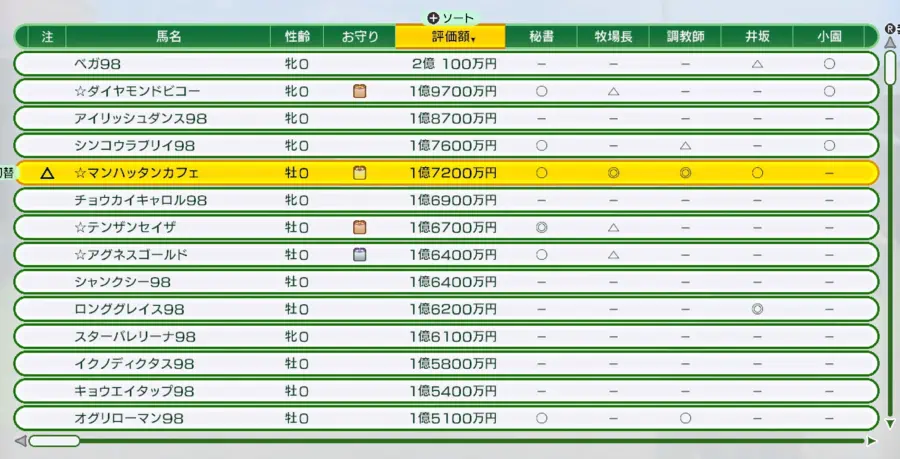
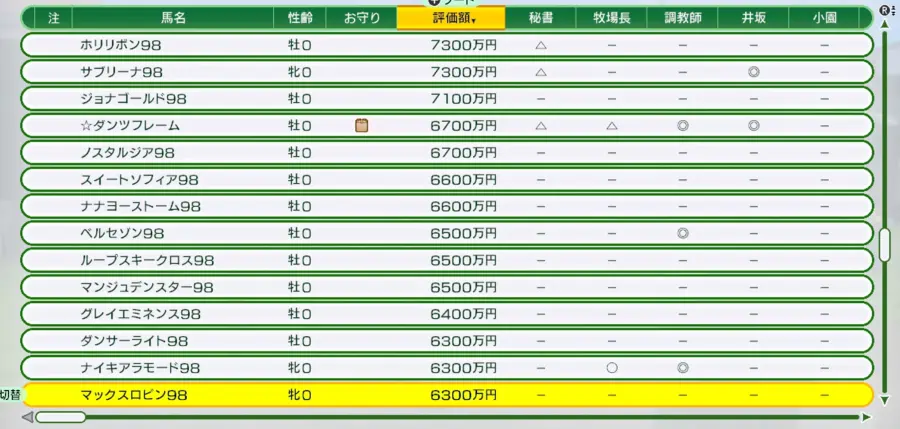
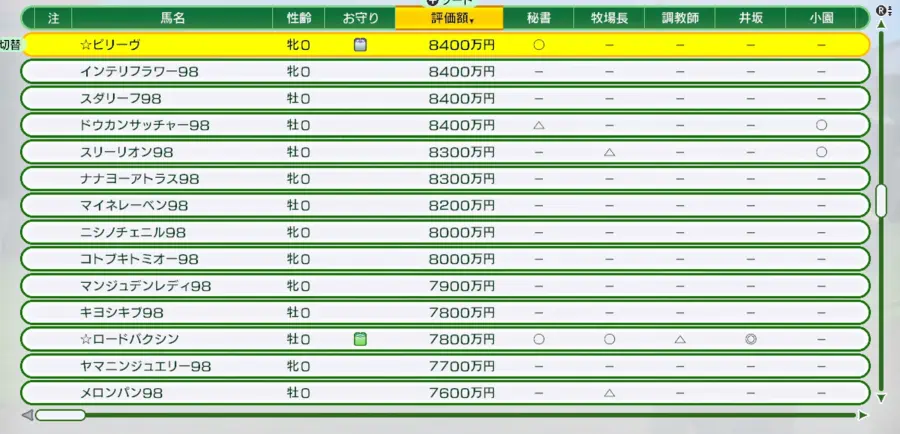
Parsing
through a sea of katakana is a pain at the best of times, and if you’re
not into horse racing it’s like. Who are these? What am I looking at?
ehh sure I’ll try to buy the gold one I guess? Manhattan Cafe’s pretty
good, after all. But if you are a bit deeper into horse racing it’s
like, Dantsu Flame is my GOAT and they’re starting the bidding at 6700??
They’re sleeping on Dantsu Flame; I’ll make him a Triple Crown winner.
Agnes Tachyon ain’t shit. They’re starting the bidding for
Believe for only 8400 are you out of your mind?
Believe’s one of the best sprinters to ever do it get me Believe right
now.
That’s kind of the difference in how it feels, anyway.
There are a ton of systems in Winning Post and, in the 35 hours I’ve
played of it so far, I’ve only just barely scratched the surface. The
horse breeding system is deep, and I don’t understand it well enough
yet. The training system has you working to increase their stats within
some limits, and it gets a bit unwieldy as the number of horses
increases, since you only get three, sometimes four training sessions a
month (barring DLC). Past a point it’s probably better to have the
horses race to juice their stats than it is to keep training them, and
use the downtime to let them rest up and spend the training time on
other horses. Early-game the incentive structures benefit just racing
the horses with as little downtime as possible while avoiding injury,
and it’s better to race them in races they can win because winning seems
to improve stats and mood more than losing. You need the horses to win
to get more money to get the funds to improve your farm and also buy
more horses, since they don’t live forever, and you want to hedge
because sometimes they do just break their leg and die in a race.
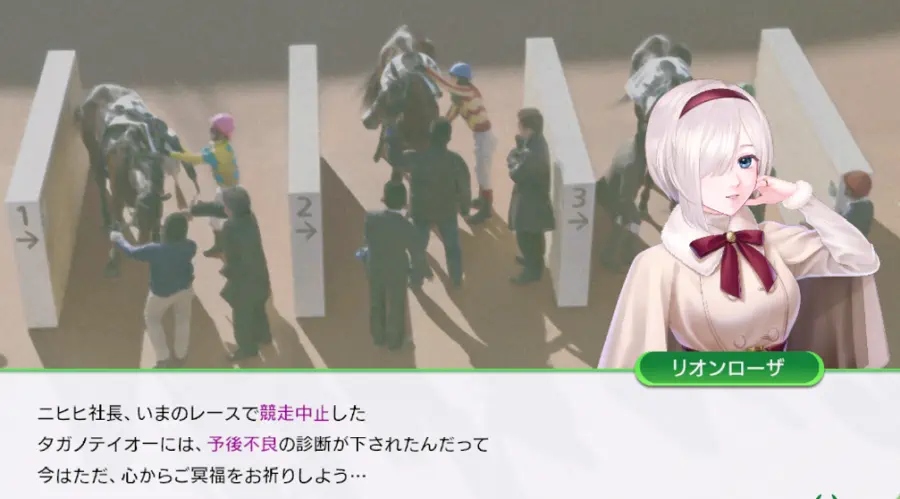
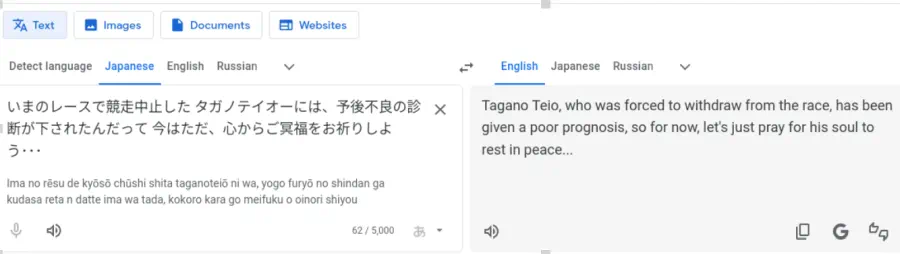
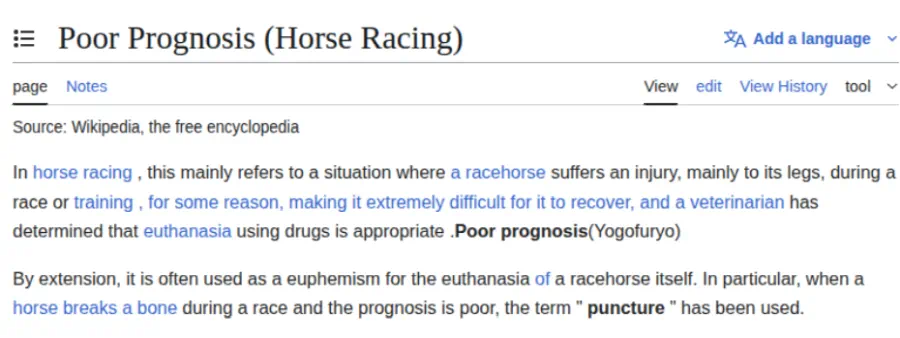
This game is hysterically big. I’m on year 3 right now. It’s taken me
35 hours, counting all the savescumming I did to get my horses to win or
at least place in the major races. The time limit on these missions is
like 30 years, and once I clear out these missions I can start getting
into the marriage and dynasty mechanics. At the start of the year if you
didn’t choose an arranged marriage and you’ve met the friendship
requirements for the NPCs you’ll get the option of marrying them and
having kids. I still haven’t run into these choices myself, but there’s
a menu that shows the conditions you need to meet for each of the NPCs,
and while a lot of it is things like just winning big races, I think one
of the options I saw was something like “opening a farm in Europe”.
Then, after picking your marriage partner you have kids and raise them
in real time, setting educational policy and watching them grow before
handing off the farm to them and doing it over again. At least, that’s
how the manual describes it.

So. Who would get something out of Winning Post 10? First and
foremost: Umamusume fans would get something like an Umamusume career on
steroids. The rhythm of the game is pretty similar, but more. You train
your horses, you schedule races, you try to keep their mood and energy
up so they don’t break their leg while racing, and you manage sparks for
breeding. Races are way harder though. Even on Easy mode every G1 feels
like it’s Group A in Champion’s Meet, at least if your horses are good
but not great. I got King Halo to 2 G1 wins and Stay Gold to 3 G1 wins
and that took some work. I was micromanaging everything from
the specific sub-style of running to the choice of jockey to even the
title they had equipped. All of it needed to be just right to
win with horses that were good but not as cracked as TM Opera O or
Special Week or Seattle Slew. It will make you respect the races you
cruise through in the average Umamusume career, and give you some more
respect for the characters as well. After a few years of dealing with
some absolute losers who struggle to get through their maiden or a 1 win
open you really start to appreciate a horse who can win a race – any
race – but especially one who can win a graded race.
Next: I think Football Manager and other spreadsheet game fans would
get a ton out of this. There are so many spreadsheets. There are so many
data cells. There are so many statistics and graphs and bar charts and
submenus within submenus, so many little details to get hung up on. One
of my friends plays a bunch of Football Manager and she says this game
seems like it would be perfect if it were translated, especially since
the most recent Football Manager is kind of bad.
And next, I think this game has some appeal to a subsection of
Stardew Valley players. It doesn’t have the overworld exploration or
talking to NPCs in their day-to-day life aspect, or as much variety in
what you can do to run your farm, but you are still managing a farm and
taking care of animals, and that scratches a similar itch sometimes.
Now all this leads me to the elephant in the room. None of these
games are in English and no translation projects exist. I think they
could do well on Steam with the right approach over here, and I’ve
emailed Koei Tecmo asking for a localization but they never got back to
me.
Though, saying that, if you’re trying to learn Japanese then horse
games like this one are an incredible way to work on your katakana
reading speed. The bulk of the game is spent staring down reams upon
reams of names written in katakana.
Interlude: Game Navigation Overview
I'll cover bits and pieces of this throughout the LP but I want to
centralize it a bit here, in case anyone else wants to play the game for
themselves. I won't be going over everything, just what I use to get by.
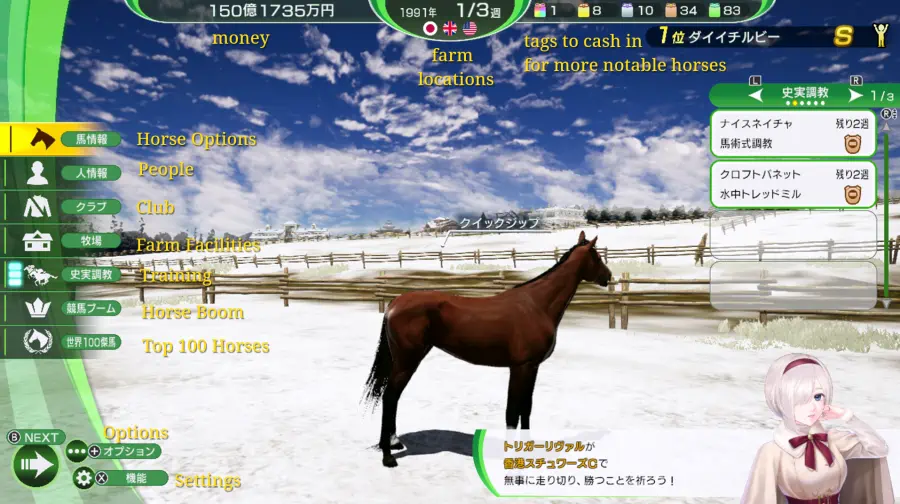
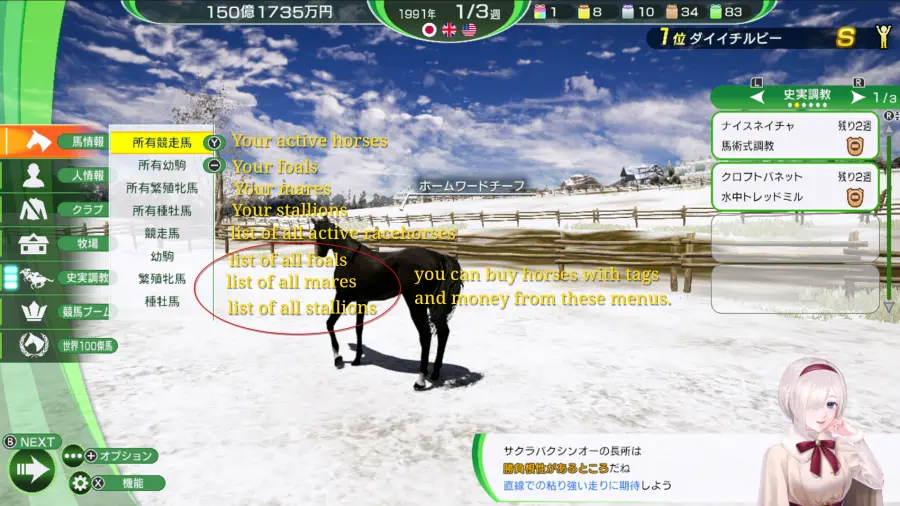
on the horse menu, the overview is something like this:
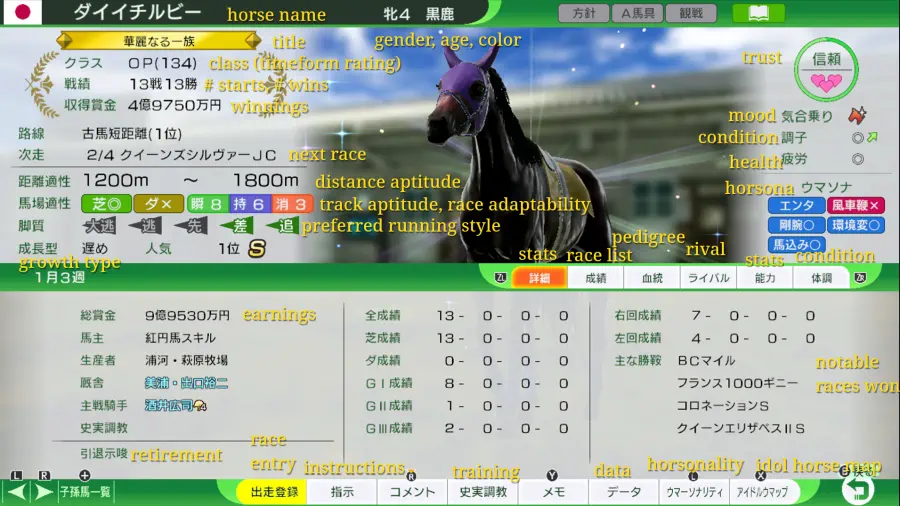
pressing + on this screen will bring up a list of the horse's notable descendants if they have any. There are a few growth types a horse can have, and they tell you when the horse is expected to hit their peak. They are as follows:
- 早熟 - Precocious,
peaks around December of year 2, starts falling off hard around June of
year 3.
- - 早め - Early, peaks in year 3. They can usually win races
through most of year 4, but usually don't keep winning through year 5.
- 遅め - Late, peaks in year 4, generally lasts through year 5.
- 覚醒 - Awakening: continues performing well after age 4. This covers horses who
hit their peak through year 5 all the way up through your John Henrys
who keep performing well up through age 10.
The instruction option brings up a submenu.
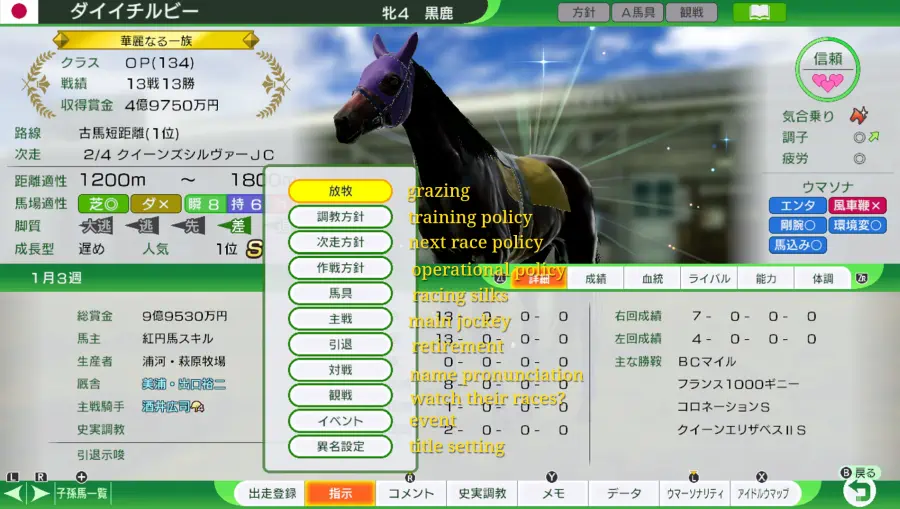
The various training policies let you micromanage how you want the horse to be
trained to prepare for various things, and grazing lets you set how many
weeks of dedicated rest they're getting between races. Grazing's pretty
useful for keeping the horse's energy up and making sure they don't
break their legs. I haven't dug into micromanaging the training policy
too much. It's a bit more in the weeds than I want to get, though it's
there if you want to try tuning the horse more to specific races or in a
more specific direction. Retirement will retire the horse on the spot, I
wouldn't recommend clicking it, generally. If the horse has multiple
epithets the bottom option lets you pick between those. It can be handy
for tuning results a bit more in your favor.
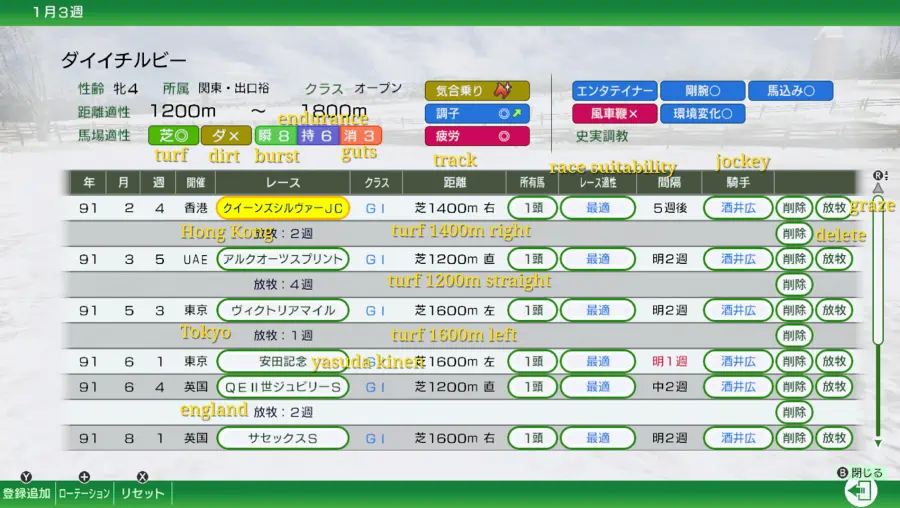
If you pick race entry you get sent
to this screen. Pressing + brings up a list of prebaked schedules, and
pressing Y brings up the race calendar.
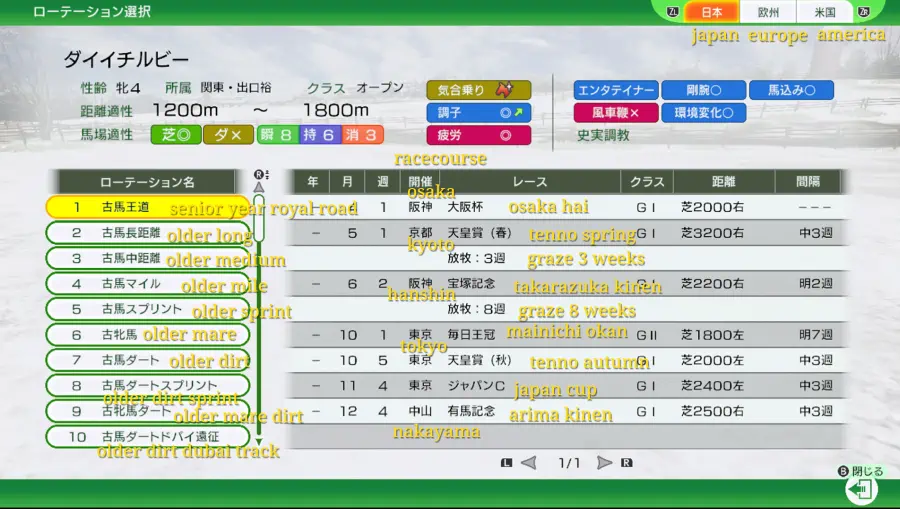
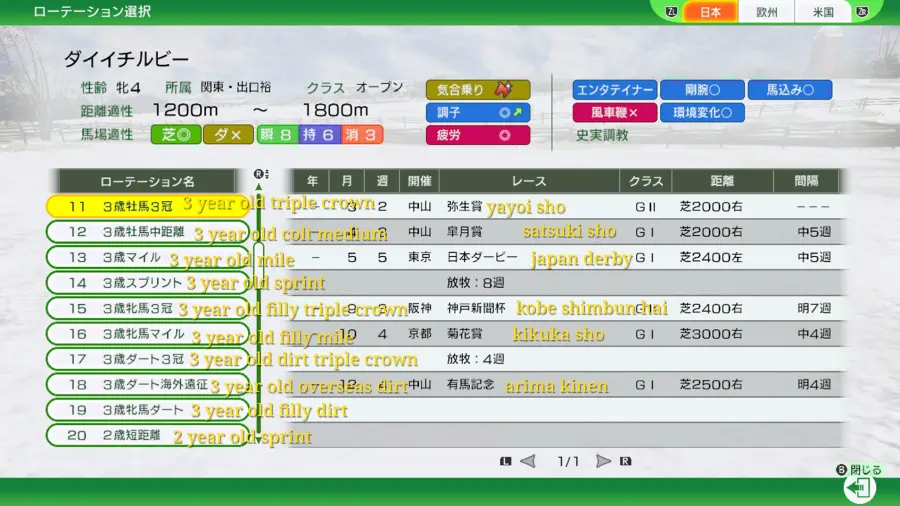
I won't be going over all the prebaked schedules like this, but if you
remember roughly when races happen from Uma Musume it's all pretty easy
to put together.
Next, the race calendar:
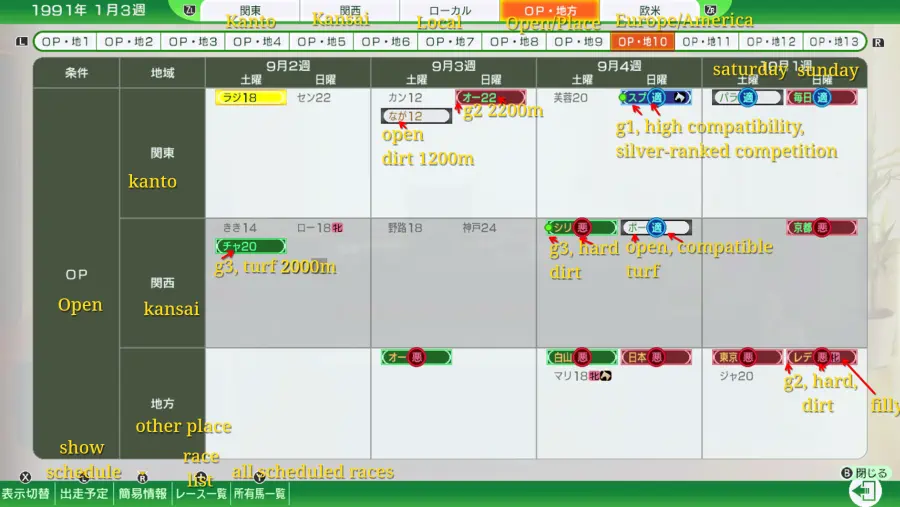
There's a lot of information
compressed in this screen. A black border around a race means it's an
open, Listed-class race. A green border means it's a G3. A red border
means it's a G2. A blue border means it's a G1. If there's a colored
horse icon next to the race that tells you that a notable horse is
competing. Rainbow is strongest, then gold, silver, bronze. A blue icon
flashing over the race means your horse is well-suited to it. A red icon
means it's difficult for your horse. The numbers in the column are a
shorthand for the race's distance (e.g. 22 is 2200m, 14 is 1400m, etc.),
and the kanji or kana next to the race are an abbreviation of the race's
name. If the race name is written in green text that means it's a turf
race. If it's written in orange text it means it's a dirt race.
Greyed-out text means your horse cannot be entered in it. Next.
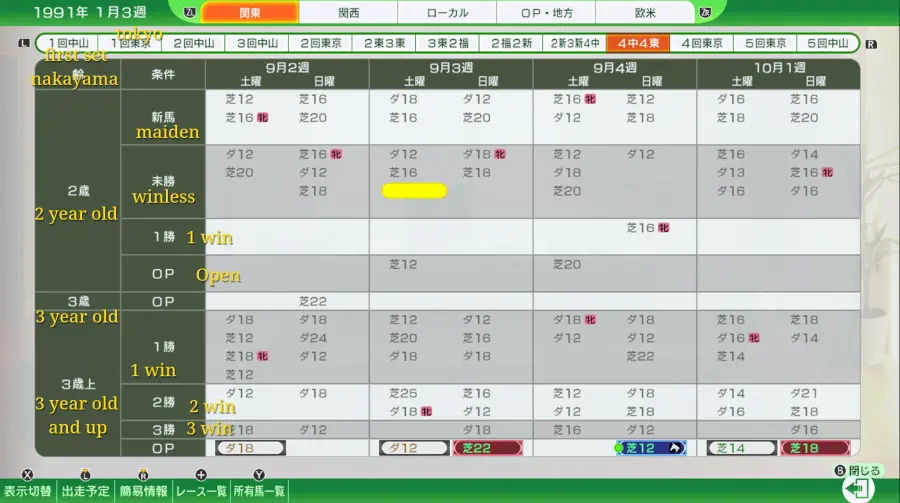
For the horses who aren't winning
opens or higher, there's the screens for Kanto, Kansai, and local races.
The row along the top says which set of races is happening in which part
of the country, but I don't have the space to translate it in the
screenshot because it's really compressed, on the order of
compressing "2nd set Fukushima, 2nd set Niigata" down to 2F2Ni. Horses
who haven't raced get scheduled in the maiden races, and then either get
moved into the 1 win class races or the winless races. From there horses
move up through the 1win class to the 3 win class and once they win three
races they're officially Open class, though you can try entering them in
Open races or highter before that to get them to jump the line. There's
probably a lot more that goes into it, but I mostly stick to the Open
screen and the overseas screen because I like to have horses that win.
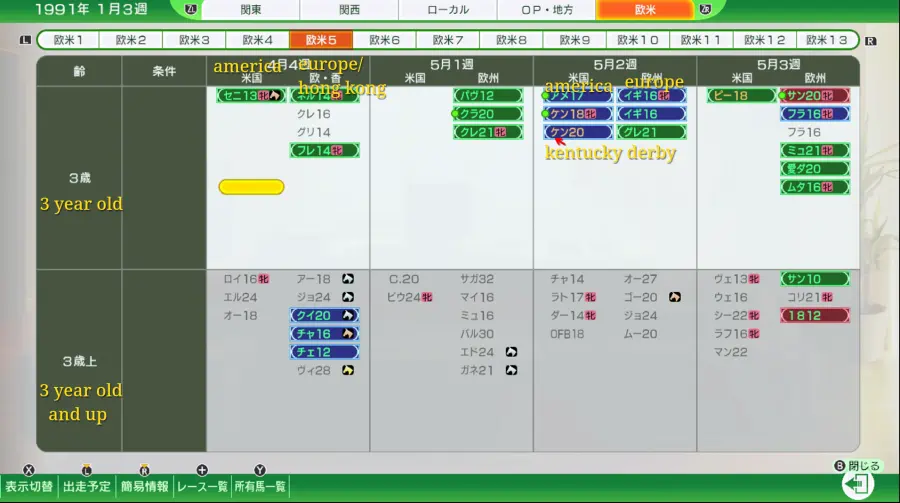
On the oversesas screen the main
thing to note that's a bit different in presentation is that the header
at the top of the column says which country it's in instead of which day
it's on. In this case, we can see a dirt G1 in America in the second
week of May with a length of 2000 meters, and an abbreviation of Ken.
This is pretty obviously the Kentucky Derby. Sometimes it'll group two
countries' races into one column, like we can see on the fourth week of
April there, where there are overlapping races in England and Hong Kong.
Additionally, if you press + on the race calendar screen it'll bring up
all the races as a list that you can sort by various column headers.
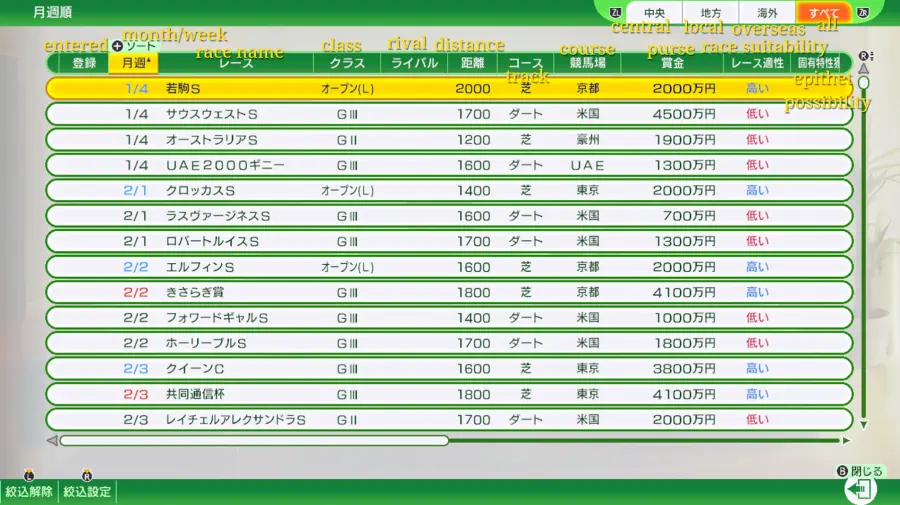
In the race suitability column there are five states the cell can have, but basically blue is good, red
is bad, black is neutral. I usually just sort by date and then sort by
race aptitude and pick the blue ones with around four weeks of gap
between them and that usually works out pretty well with the level of
recovery my facilities have. If the horse hasn't won a G1 I'll need to
further sort by country.
If a horse has a particular affinity for a specific racecourse or one
of the epithets that gives stat boosts for consecutive wins on specific
racetracks it might be prudent to enter them in races at that specific
track, though that's a bit too advanced for my pea brain.
When looking at the race entry screen there's some information about
the handicaps placed on the horses, the expected strength of the
competition, and notes on whether the race is part of a series of races
or not. Most races are handicapped by the standard methods and aren't
part of a series, but some have some more baroque approaches.
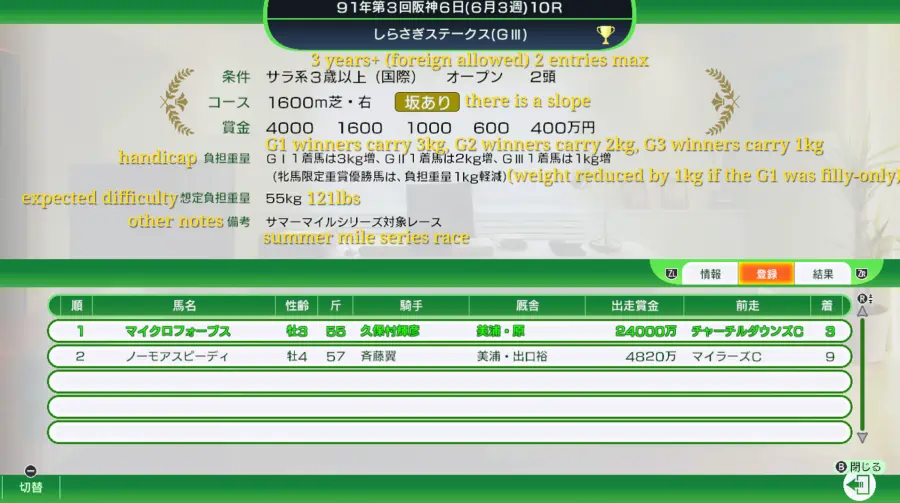
I think the slope note there is
saying whether the track is totally flat or if the horse is going to
need a bit more stamina or power to deal with some hills in the race?
I'm not totally sure, I don't usually pay it much mind.
On the race screen there's a lot of information that would be helpful
if I could read but the main buttons I click are jockey strategy and
watch race.
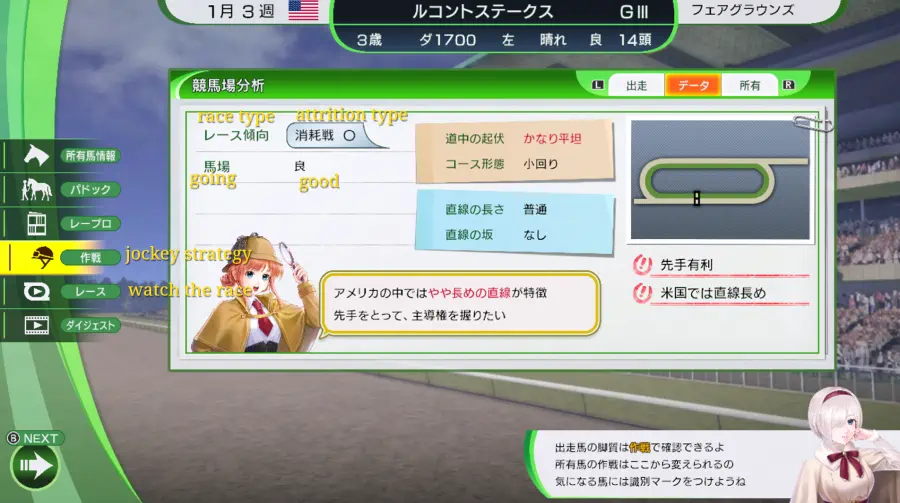
Here's the jockey
screen:
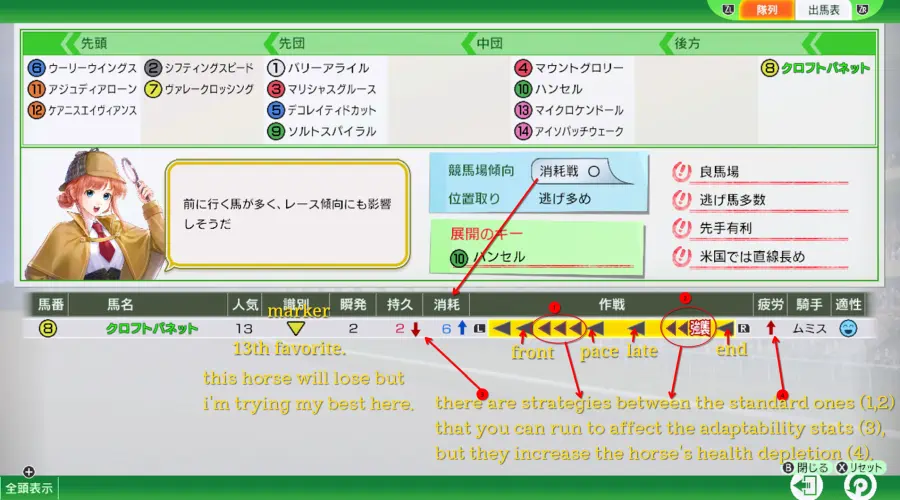
In this case I'm going to try
running the horse slightly ahead of end to increase their aptitude for
this course's expected race type. Now this horse is bad so they lost,
but they outperformed expectations by a couple places, getting 10th
instead of 13th. There's something about the race being more suited to
fronts, maybe? I dunno.
That's most of what's relevant to know about most of the game flow.
The last thing might be the breeding mechanics but I don't understand
those. I sort the columns by highest number and click the S ranks or A
ranks and sometimes that works out and sometimes they don't have any
speed, but they can usually win A race.
I think I’ve hit all the core points that I need to so now I’d like
to unpack this all a bit more. I condensed everything I felt during my
first go-through there into a bouillon cube of information so now I need
to pour some water over it, spread it out a bit, add some depth, so
let’s go through a campaign.
Part 2: Campaign write-up / Let’s Play
After I wrote everything in Part 1 I was frustrated. My horses
were up against some really stiff competition and I felt like, maybe if
I just started in an earlier scenario then I could have my farm built up
to a place where I could win with my favorite horses by the time I got
back there. Or maybe I’d gain some insight into some of the rest of the
systems that I hadn’t gotten to engage with and build up something while
I dealt with horses I didn’t have as much emotional investment in as the
1998 crew.
1971-1975
Because of this, I went back to the main menu and selected the
earliest scenario, 1971. This is so far back that the internet databases
don’t have any information on the horses who ran then. This is so far
back that there is nothing of note at the auctions. This is so far back
that in year 3 the informants came by to tell me about a little
up-and-comer named Secretariat.
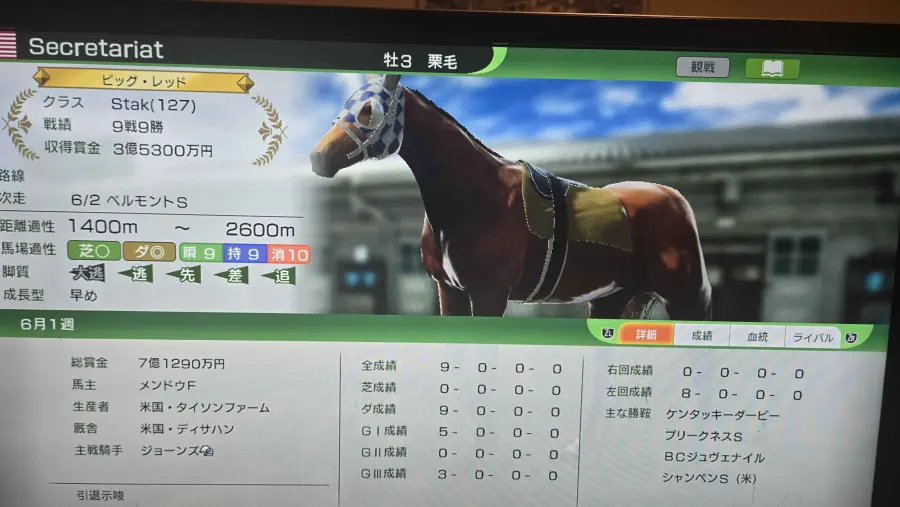

There’s a slight error in the automatic translation here. Google
Lens is confusing something to the effect of “G1 5 count” with “G1 15
count”. Secretariat wasn’t on that crazy of a run.
I think I heard this and went “lmao I’m glad I don’t have any dirt
horses, Secretariat would kill them”. Thankfully, I was minding my
business in Japan so I only had the legendary horse Haiseiko to worry
about. Haiseiko is to the 1970s what Oguri Cap was to the 1980s,
comparable in status to maybe Seabiscuit. In real life, Haiseiko won the
Satsuki Sho, a bunch of G2s and G3s, and then the Takarazuka Kinen, the
medium-distance fan-voted race. In this run, Haiseiko won the first two
legs of the Triple Crown, lost at the Kikuka Sho, won the Arima Kinen
and Osaka Hai, and a few others. He was a monster, and a real pain to
try to outrun. I think I got maybe one or two wins over him at distances
where he struggled.
Now, in the early years of the run I had, functionally, two horses:
Bell Wide and Nasuno Chigusa. In real life Bell Wide was a solid horse
who won a few opens, had a couple decent finishes in some G2s, and whose
big win was the 1972 Spring Tenno Sho. Meanwhile, Nasuno Chigusa was a
decent mare who won a couple of G3s and the Japanese Oaks and put up
decent finishes in a number of other graded races. I picked her out of
the options I was given as a second free horse in year 2 because she had
a speed-boosting epithet and a Japanese Wikipedia page, so I figured
that would help. I had other horses as well, because I bought a couple
of mares with rainbow tags at auction, Top Ryuu and Senjuu, two horses
who seem like they were mostly notable for being right at the edge of
the 5x5 pedigrees for Tokai Teio and Oguri Cap, respectively. They were
not very good, and produced horses with unrecoverably bad speed. They
were great for other stats, but the horses they produced were really bad
for winning races. In retrospect, I forgot to look up when they
produced their most notable progeny, and so I was stuck with overpaying
for some dud dams, but I didn’t realize this at the time.
So, functionally I had two horses. With a bit of savescumming and
spreadsheeting I managed to get Bell Wide to 7 G1 wins, and that was
really good. He started to fall off a bit toward the end of his seventh
year, and while I think he probably could have kept going, the
competition was getting pretty strong and he was getting pretty old. He
got wins in the 1971 Kikuka Sho, the 1972 Tenno Spring, the 1972 Tenno
Autumn, the 1972 Japan Cup, the 1973 Osaka Hai, the 1973 Takarazuka
Kinen, and the 1974 Tenno Spring, and then a bunch of G2s and G3s. That
is a very good and very respectable record and it’d make him one of the
best horses to ever do it. 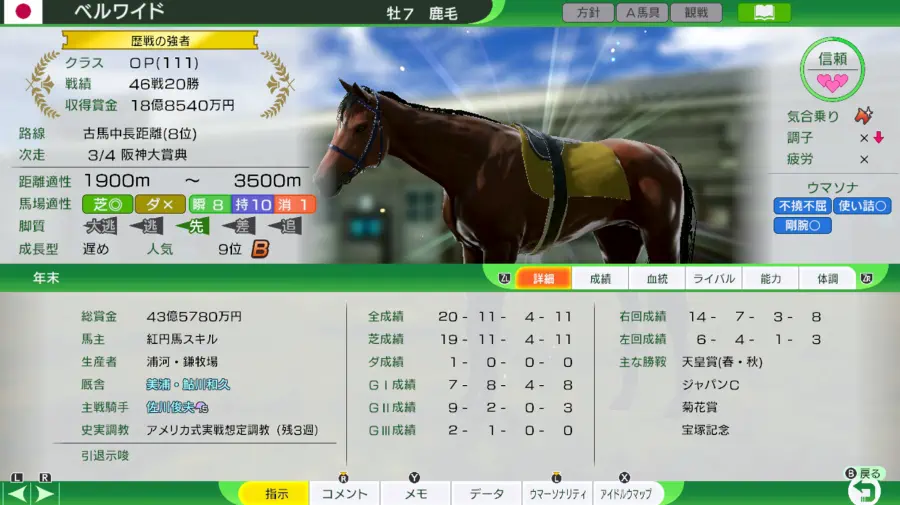
Now for Nasuno Chigusa. I wasn’t expecting much of this horse, but I
mean the Keiba sites said she won the Oaks in real life so she should be
decent at worst right? So I entered her into the start of the Triple
Tiara. She won the Oka Sho. Alright, next up, it’s the Oaks. She won
that too. Alright, I’ll enter her into a G2, she took it easily.
Alright, let’s see if she can take the Triple Tiara. She won the Shuka
Sho. Alright, well the Queen Elizabeth Cup is an alternate win condition
for the Tiara that’s more appropriate for the era so, what the hell,
let’s go for that as well. She won the Quadruple Tiara. Oh whoops, I
wasn’t expecting that and I still have her entered for the Mile
Championship, she’s taken that one too. Alright, let’s put her in a G2,
she’s won that as well. She narrowly finished in second place at the
Osaka Hai, but then won the Victoria Mile. Alright, what the hell, let’s
enter her in the Yasuda Kinen and the Takarazuka. She took both of those
as well. She is at 8 G1 wins now, so I decide I should try seeing if she
can win abroad. She finished second in the French Rothschild Prize, and
then won the Nassau Stakes in England. I could keep going but she had so
many major wins in so many countries that listing them all off one by
one would take way longer than I’d like.
She ended up with 27 G1 wins across seven countries. She couldn’t win
the Prix de l’Arc de Triomphe or some of the other really major races,
but she did manage to win the Breeders Cup Fillys Turf in America and a
number of other huge races, and she could have won more but I’d picked
up Tokino Minoru and wanted to pair her with him before he bit it, since
he was 27 at that point and that’s really old for a
horse.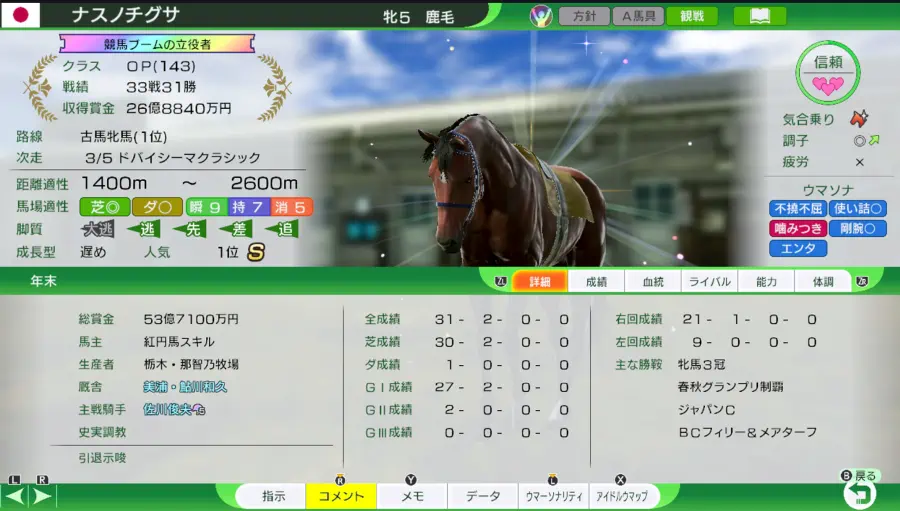
Oh right, Tokino Minoru. I picked him off of a list at the start of
the run as a special horse because it was the only name I recognized out
of all these horses. In real life, he was an undefeated horse from the
1950s who ran in 10 races including wins at the Satsuki Sho and Japanese
Derby, before dying a few weeks later from sepsis induced by tetanus.
Uma Musume fans will know Tokino Minoru as the suspected identity of our
friend, the Green Devil herself, Tazuna Hayakawa. As a side project in
this save I decided I’d try to continue Tazuna’s legacy, because that’s
the only horse anywhere near this era I really recognize and I am
clinging to any names I can recognize like a shipwrecked sailor clinging
to a piece of driftwood in the open sea.
Along the way to this point I had built up a couple of the highest
tier of tokens I needed to get more notable horses and with them I’d
picked up a young overseas colt named Seattle Slew. In real life,
Seattle Slew was one of the best horses to ever do it. He won three G1s,
then won the American Triple Crown in 1977 and then went on to win two
more G1s, a couple of G3s, and only ever finished outside of the top two
once. In the game, he is a freak beast that’s not losing unless you’re
getting really sloppy with it in something like the Prix de
l’Arc de Triomphe, or running against a horse that’s somehow even
stronger.
In the breeding realm, I also went and picked up Northern Taste and
Wishing Well with some of the tokens and money I’d accrued from Bell
Wide and Nasuno Chigusa raking in the cash. Wishing Well is the dam of
Sunday Silence, arguably the most important horse in Japanese horse
racing over the last 30 years, and Northern Taste is a fantastic horse
who also shows up in a ton of lineages, who Uma Musume fans probably
know better as Director Akikawa.
1976
At the end of 1975 I opted to retire my best horses so 1976 was a bit
of a dead year for the farm. Most of the year’s two year olds managed to
win their debut and got a couple other wins, which I really can’t take
for granted. I’ve been staring down a lot of pedigrees while trying to
figure out which horses I should buy and there are a staggering amount
of horses that never won a race, so I can’t take for granted that all of
my horses in 1976 were at least in the 1-3 win class, with one even
managing to win a G2. But, man, trying to get horses with F speed and
worse through races is grueling. If the competition is really
bad they can squeak out some wins with a good jockey and a strategy that
really plays to their strengths but it sucks. Towards the end
of the year Seattle Slew debuted and proceeded to win six races,
including a Jpn1 and the Hopeful Stakes. I am back to having one good
horse, and to be fair, he’s a really good horse.
1977
1977 was about what I expected. Seattle Slew won the Satsuki Sho, the
American Triple Crown, the Ireland Derby, the Prix de l’Arc de Triomphe,
and the Senior Autumn Triple Crown. The rest of my horses got a couple
of wins in some of the low-tier races. Tokino Minoru died of old age.
There’s not a lot to say. The horse I bought to win big won big
effortlessly and the rest of my horses sucked shit.
Now since the year was a bit boring for me in-game I’d like to talk
about the real 1977 a bit. There were a lot of crazy good racers that
year. 1977 was Maruzensky’s Classic year where he was dominating every
race he was allowed to enter, and there was a great trio of competitors
dominating the storyline. Tosho Boy, Ten Point, and Green Grass had been
building up a great rivalry in the classics. Twitter user
oju isosan has a good thread on it all which is where I’m taking
this all from, but it culminated in a legendary Arima
Kinen where, after Maruzensky had been withdrawn the field was
smaller than usual with only eight racers. However, even though
Potential Man Maruzensky was out, the race was still really good. From
the jump, Ten Point and Tosho Boy were fighting it out in front and the
rest of the field was way behind. 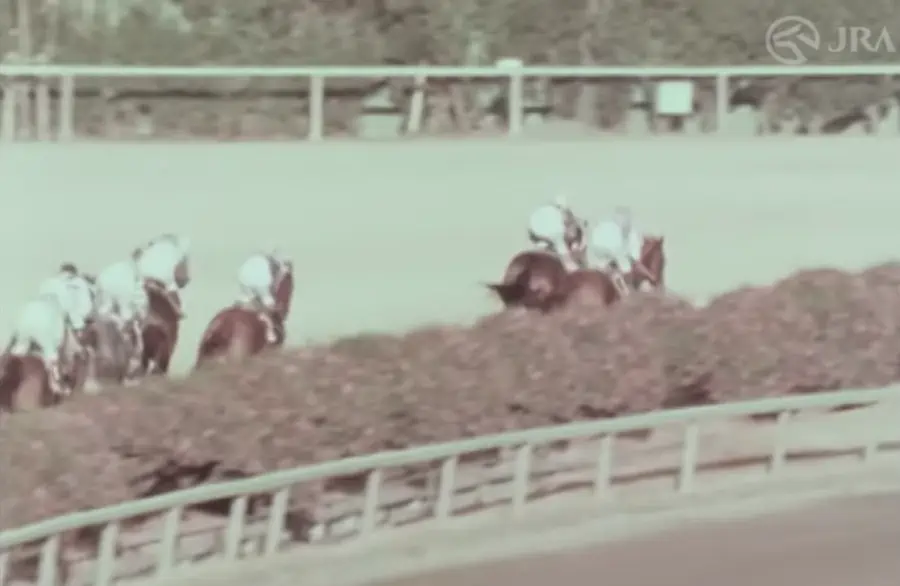
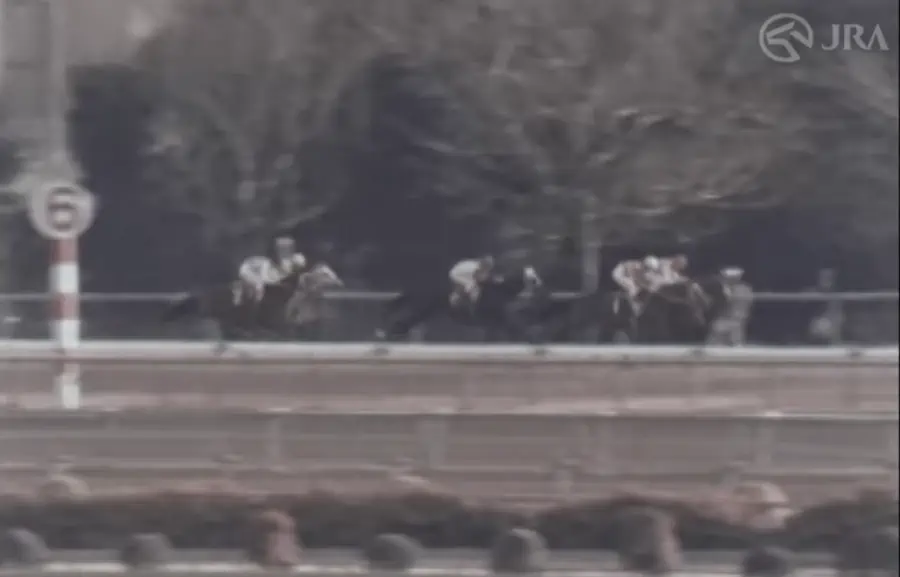
By
the third corner Tosho Boy and Ten Point were still duking it out
without giving an inch , with Green Grass following behind.
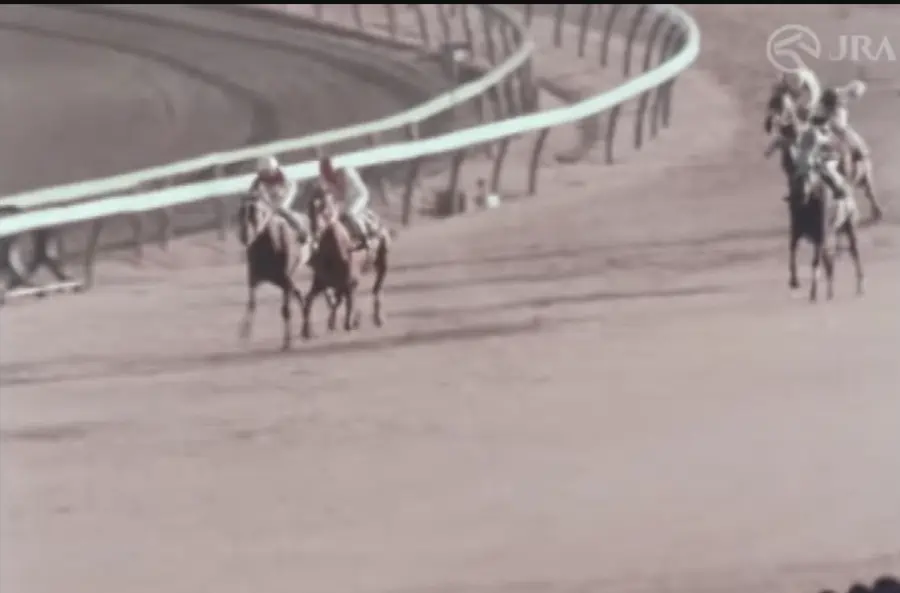
Entering the final straight it was
still Tosho Boy and Ten Point neck and neck in front, with Green Grass
and the rest of the pack behind them.
Around the 200 meter mark Green
Grass started pulling up and the rest of the pack was struggling to keep
up. It was a three way race, with nobody having a clear advantage until
the very end. 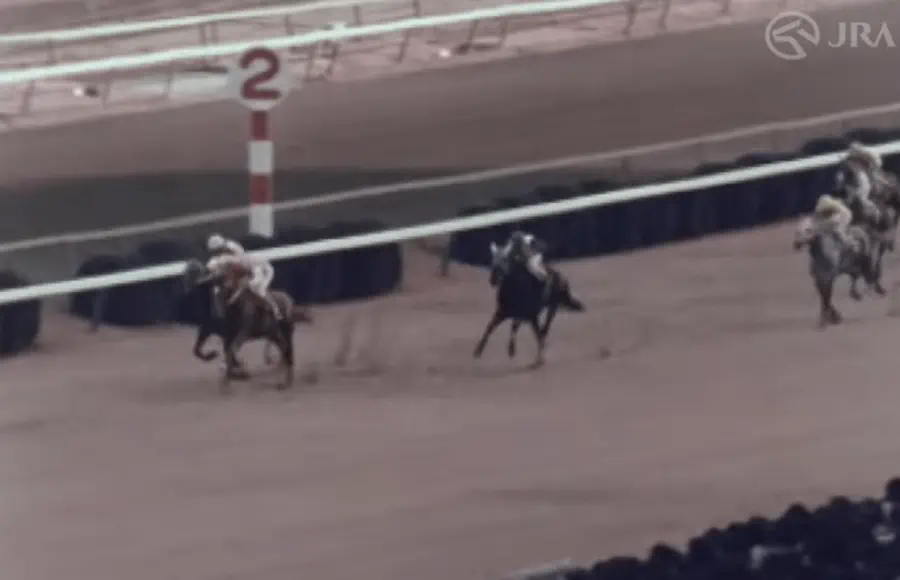
At the 100 meter mark
it was just the three of them still fighting it out, the rest of the
pack nowhere in sight, though Ten Point had gotten a slight lead.
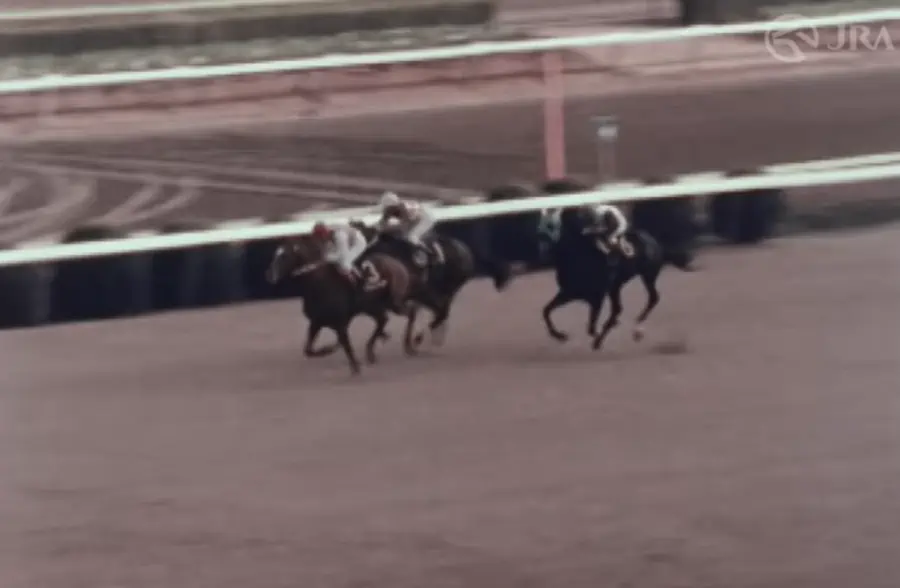
It was a dead heat until the very
end. Incredible race, one of the best there’s ever been.
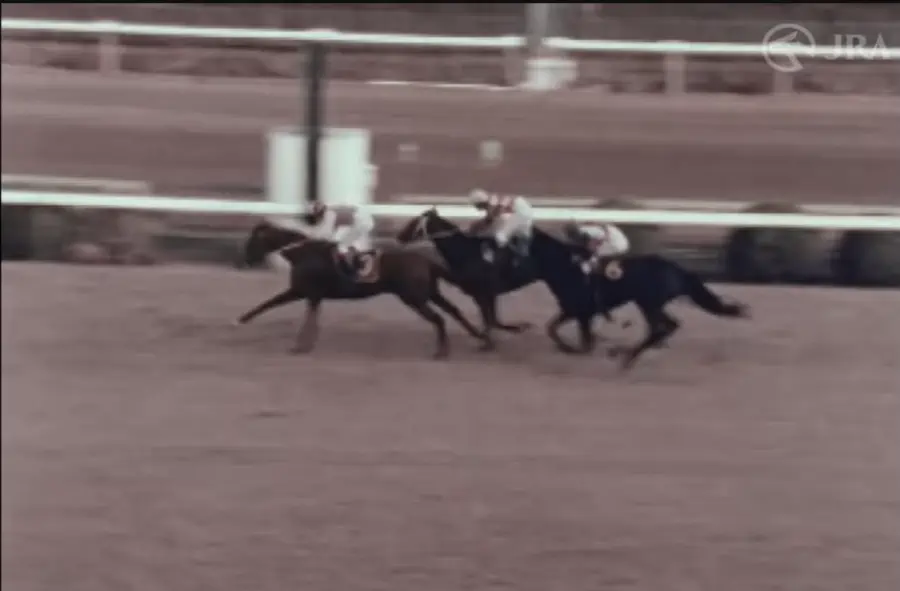
They were so far ahead of the rest I
had to go frame by frame to get to this shot, the only point where they
and the rest of the pack were on-screen at the same time, where you can
barely see Green Grass’s tail on the left side of the screen, and you
can barely see the fourth-place horse’s nose on the right hand of the
screen. 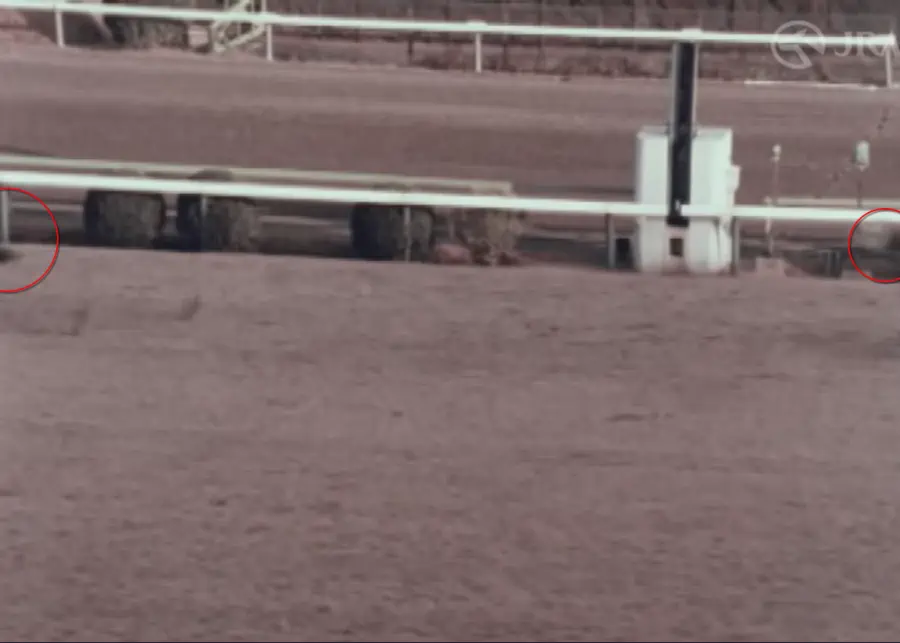
Anyway that’s some 1977
horse trivia I read in a thread once. Back to the video game.
1978
In 1978, Seattle Slew continued his unbelievably dominant winning
streak. The game gets a bit anachronistic in some places so even though
the Saudi Cup was first run in real life in 2020, it’s offered as an
option here, and I had Slew win it. I don’t want to go down all of
Slew’s wins here – there were too many – but some of the competition did
get a bit tougher. I switched Slew over to running the Breeders Cup Turf
at the end of the year because Affirmed was just a bit too much in the
Breeders Cup Classic. Now, I was wondering who Affirmed was and why he
was winning against my very strong horse so I looked him up and
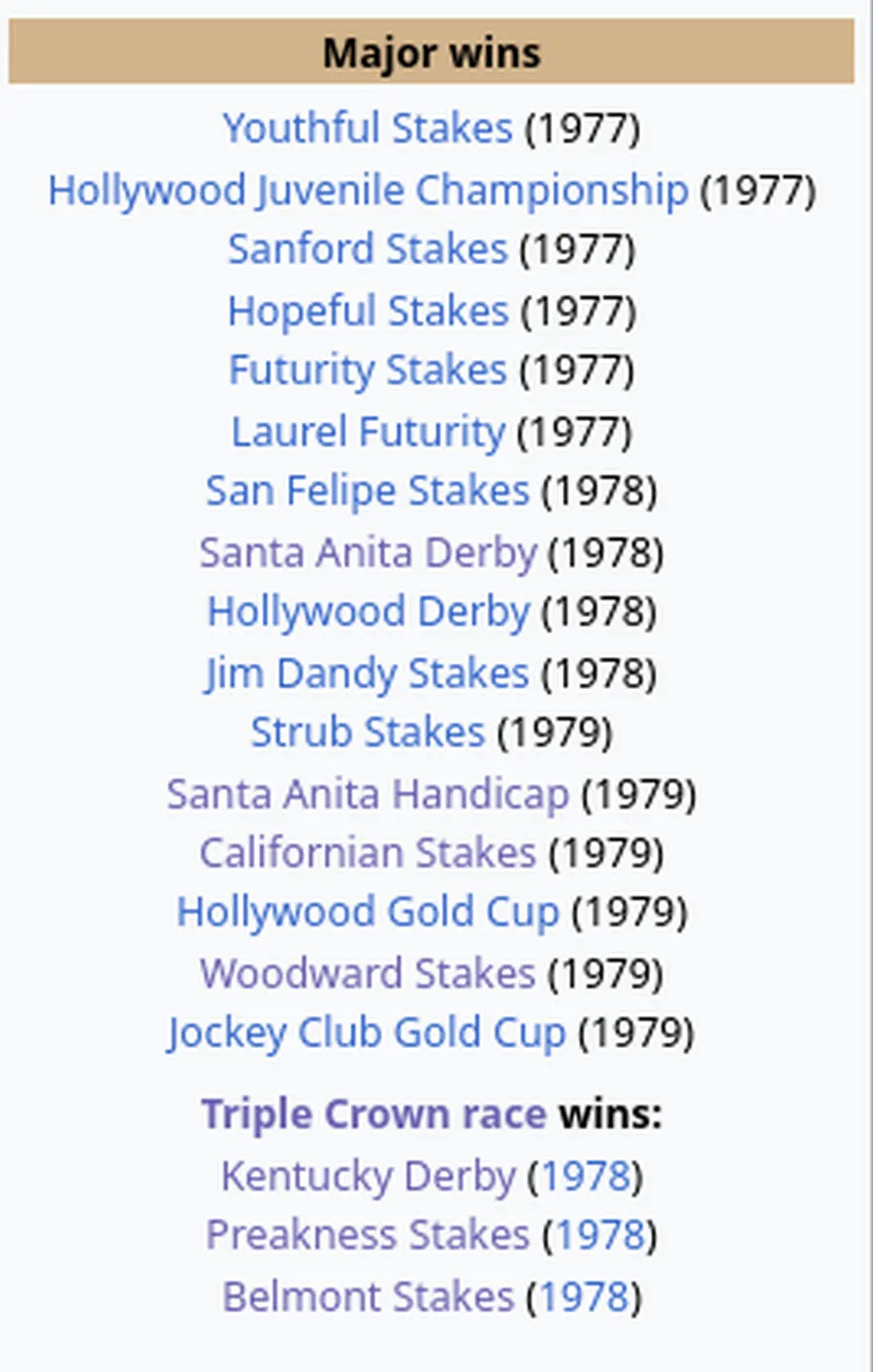
Yeah you know what that’d do it.
With 14 G1 wins, Affirmed looks to be one of the best to ever do it,
even more than Seattle Slew. Affirmed and Slew were the last two
American Triple Crown winners until American Pharoah in 2015. We don’t
see as many American Triple Crown winners these days because the races
are a bit too close together and a lot of owners usually opt to skip one
of them in the interest of the horse’s health. This seems like an
organizational issue in American horse racing to me, and i think it’d be
better for the health of the sport if the Triple Crown races were spread
out a bit more so that up-and-coming horses could reasonably run them
all without health concerns.
Outside of Slew, most of my horses continued to be middling, except
for one surprise. A couple years back I picked up Five Hope, a decent
mare who in real life won the Oaks, because it feels like I always get
good results from Oaks winners. Five Hope ended up sweeping the
Quadruple Tiara and the Mile Championship. I think 1978 was also when
the kids started entering school and the wife wanted to send the first
one to a Spartan summer camp. I said yes sure whatever but the kid
didn’t get anything out of it.
1979
At the start of 1979, Seattle Slew hit number 1 on the world horse
rankings, and this triggered some kind of scene where the secretaries
dragged me off to a deserted island where they wore swimsuits.


It was a bit jarring. There wasn’t even a CG, it was just four sprites
talking and then it was over as quickly as it started. Weird shit.
Anyway, in 1979, Seattle Slew continued his unbroken winning streak,
sweeping a bunch of the major races again, and Five Hope picked up the
Victoria Mile and Yasuda Kinen before falling off at the end of the year
with 16th place in Elizabeth Cup and 13th place in Mile Championship.
The second kid wanted to do math class over summer and it raised her
wits by one rank. Nasuno Chigusa’s first foal, Mint Gaia, started racing
and picked up Hanshin JF and Hopeful Stakes. Shadai Dancer started
racing and put up some good results in some G2 and G3 sprints.
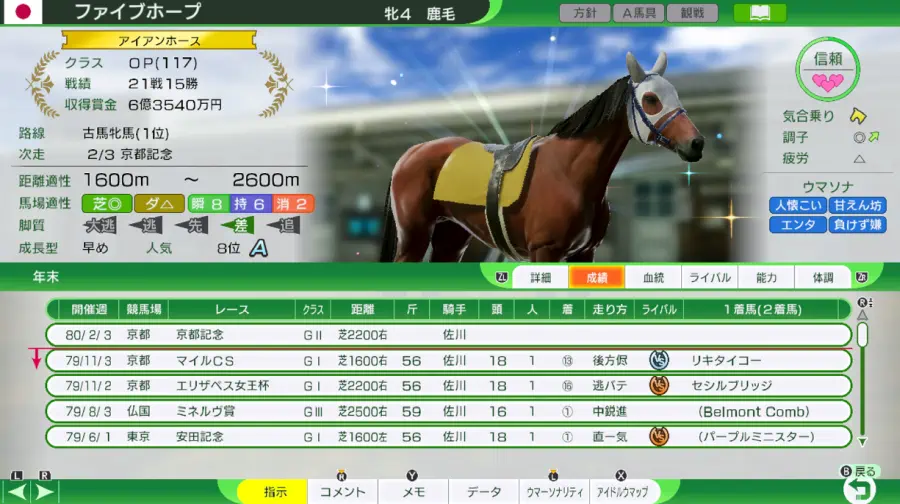
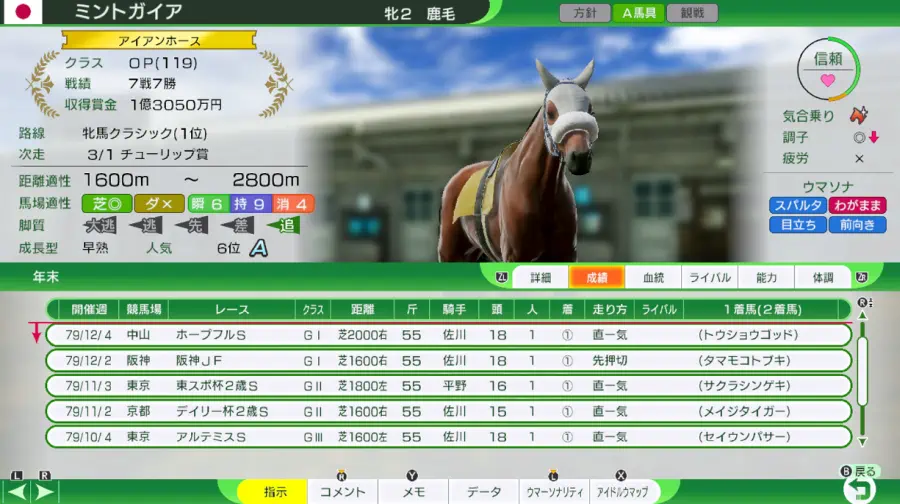
Every horse has a growth type stat that I think tells you when they
peak, as well as a stat telling you their current condition. Five Hope
and Slew peaked early and were a bit weakened at the end of the year,
and the other two horses were late bloomers in decent condition. I opted
to retire Five Hope since she’d been struggling and it didn’t look like
she’d get it back together. 
1980
1980 marked the start of a new decade, so the game gave me the option
to change the difficulty and swap out the secretary. I felt like I had a
better grasp on the game at this point, and I was positioned pretty
well, so I bumped it up to Normal and swapped the secretary for a change
of pace. I think the red-haired secretary’s secret quests were all
focused around winning the Dubai Sheema Classic and the other races in
Dubai that week. I think I’ll save that for Stay Gold.
Seattle Slew finally started falling off a little bit in 1980,
finishing second for the first time at the Saudi Cup. He won the
Takarazuka Kinen and the Cox Plate, but he finished second in the Dubai
World Cup and the Breeder’s Cup Classic, finished tenth at the Arc,
eighth at the Japan Cup, and third at the Arima. These are still good
results but he’s clearly past his prime so I opted to finally retire him
with a record of 46 races, 40 wins. He was undefeated for 5 and a half
years and made something like 55 million US dollars or whatever 13
billion yen works out to in 1980 money.
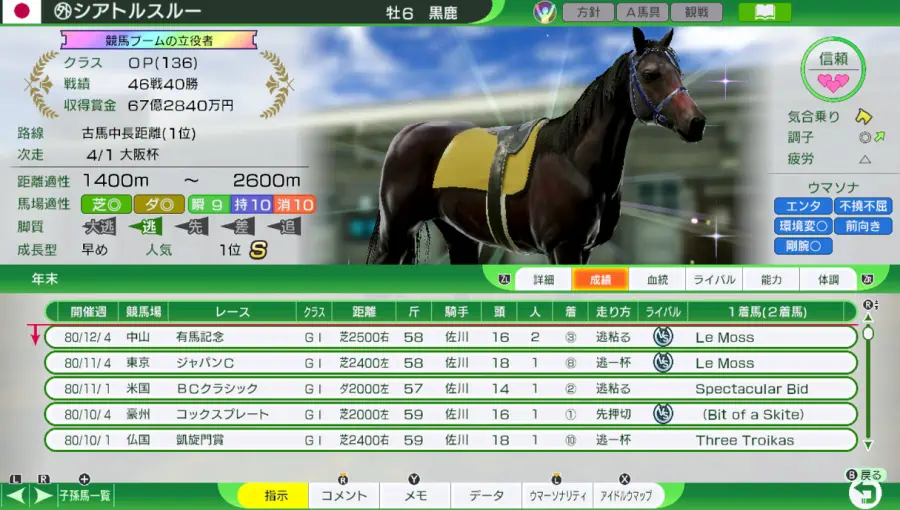
Now, I’ve been kind of writing off
Slew’s impressive win streak and a lot of that’s because that’s what I
expected out of him. I picked him up as a kind of investment vehicle
with the explicit goal of generating big cash returns. Like, yes, of
course Seattle Slew would win a bunch, he’s one of the most
successful horses of the 20th century. He was effortlessly dominant
in-game for five years here, with 34 G1 wins and a lot of them weren’t
even close. It’s more interesting when a less famously successful horse
goes on this kind of run. 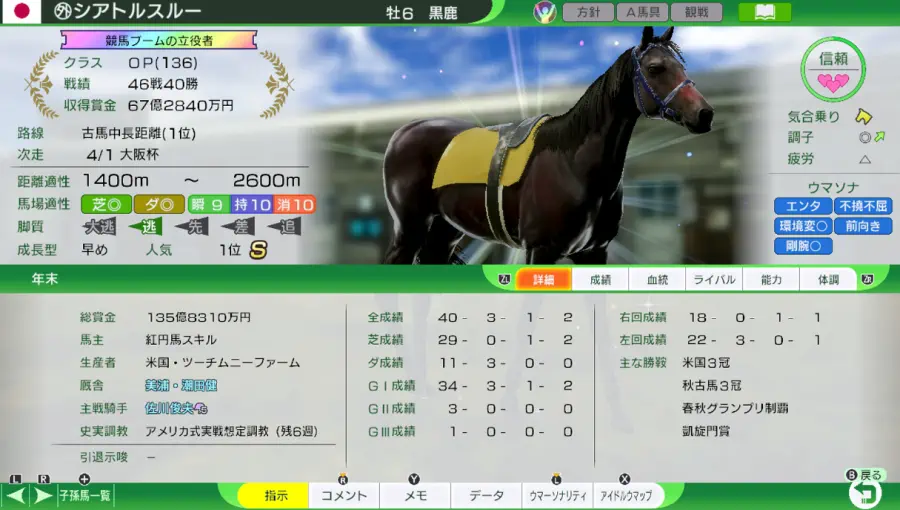
Mint Gaia
– Chigusa and Tokino Minoru’s foal – picked up wins at the Oka Sho, the
Oaks, and the Derby before falling off a bit at the end of the year,
with a second place finish in the Shuka Sho and an eighth-place finish
at the Queen Elizabeth II Cup. I also opted to retire her since her
growth rate indicated she was the sort to peak early and her E+ speed
didn’t give me any confidence she’d keep up in senior year.
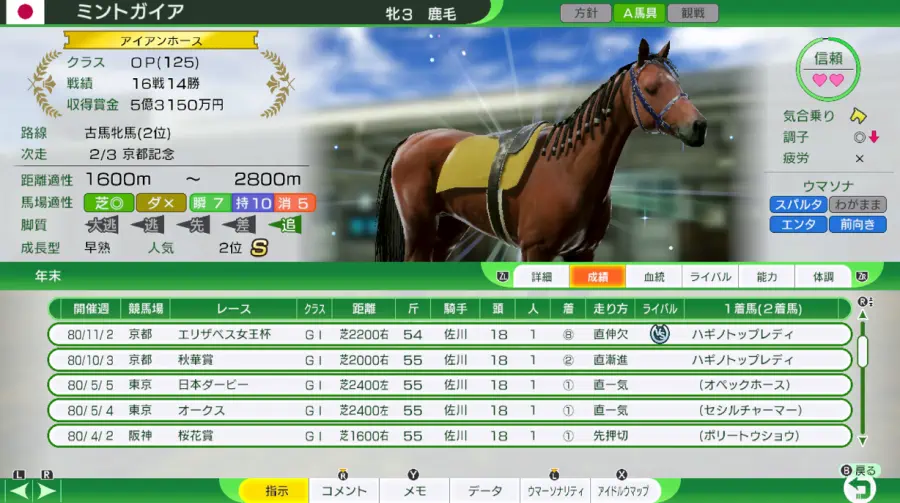
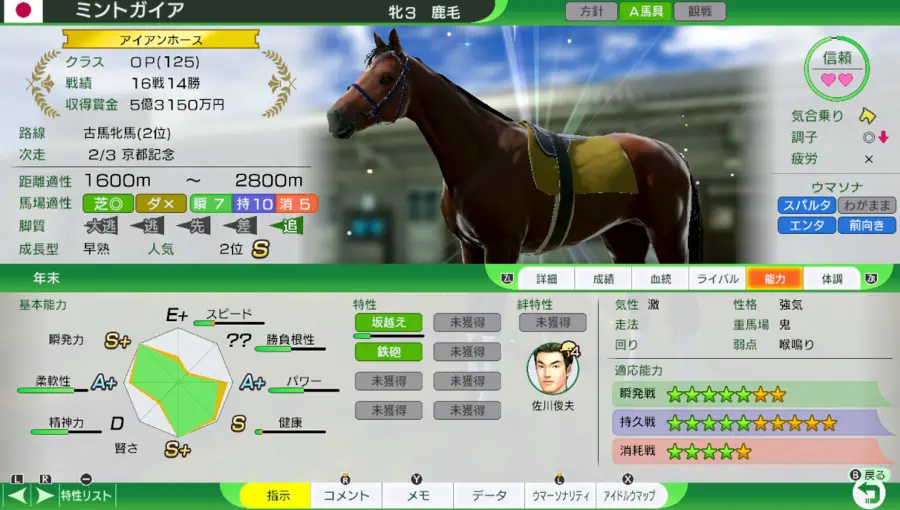
One of the two year old horses picked up Hanshin JF, but she had G
speed so I didn’t like her odds of continuing to win long-term. Shadai
Dancer did okay in lower-tier graded races and opens but she was also
falling off at the end of the year.
I think 1980 was also when I was exploring the menus again and
realized I didn’t need to wait for auctions to buy mares, and I picked
up Tokai Midori and White Lunaby and I think Sweet Luna as well, who are
the dams of Tokai Teio’s dam Tokai Natural, Oguri Cap, and Symboli
Rudolf, respectively. Somewhere along the line I also picked up Seiun
Sky’s damsire Mill George as well.
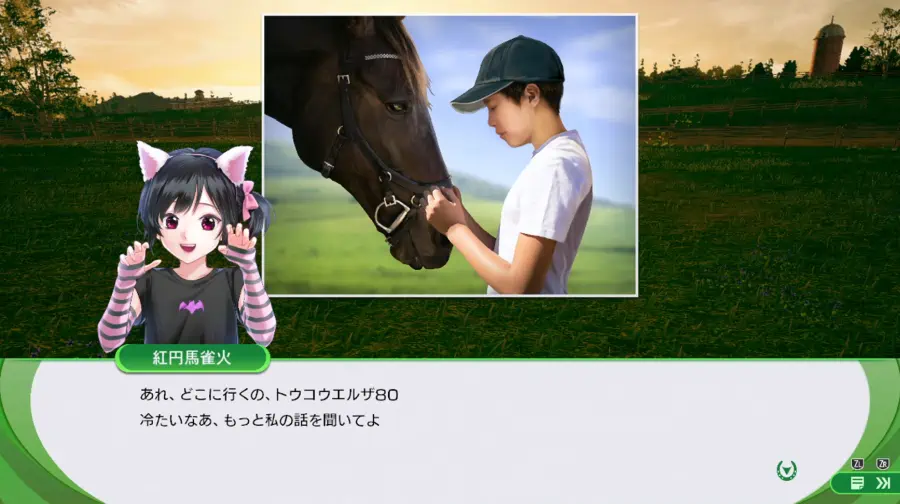
During the year, the second kid decided to get pact-bonded to one of
the new generic foals, currently named Touko Elza 80, but soon to be
known as Night Alcatraz. I have to respect the kid’s impeccable taste
and plan on passing the farm down to her.
I opted to retire most of my three-year-old horses this year since
I’m positioned reasonably well with Rudolf and Teio’s and Oguri’s line
in the farm pretty much guaranteeing some big wins over the 80s, and my
good horses are getting old and falling off.
1981
1981 was another pretty empty year for h o r s e farm without any
clear standouts to pick up major wins. The three year olds were
whelming, and there wasn’t much going on until the back half of the
year. Out of the two year olds, one of Northern Taste’s foals, Quick
Zip, ended up with a good speed stat and won Futurity and Hopeful,
though his effective distance is pretty much limited to miles and short
mediums.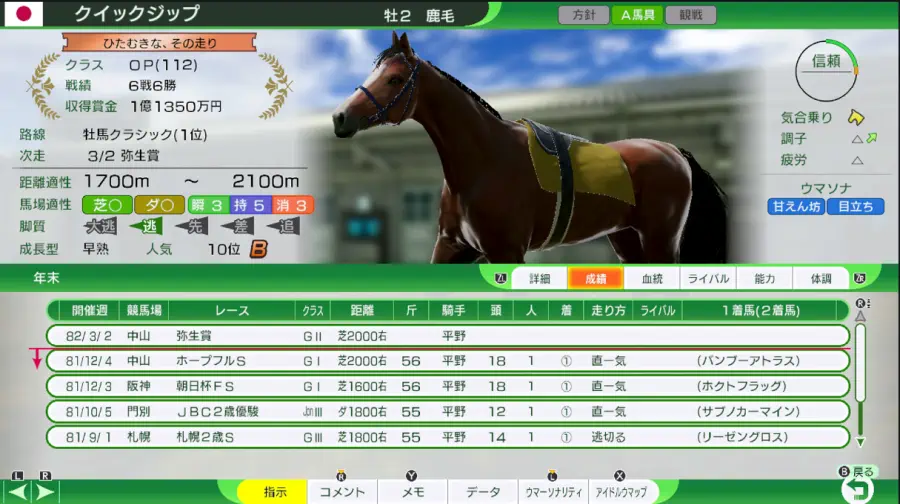
The other horses put up
middling records. Towards the end of the year I was given the option to
open an overseas branch in England, so I did. I think I also set up a
club, though I don’t understand how that all works yet, but at the end
of the year I opted to transfer a 1-year-old Katsuragi Ace to them in
the hopes that would help. I have no idea if that’s hurt me or how that
all works.
1982
1982 got my neurons firing again a bit. There were a few horses in
the farm that could win graded races but they weren’t good enough to win
effortlessly, which demanded a bit more thought and strategizing.
After a strong junior year where he won the Asahi Hai Futurity Stakes
and the Hopeful Stakes, Quick Zip, with a bit of effort, managed to win
the Satsuki Sho. 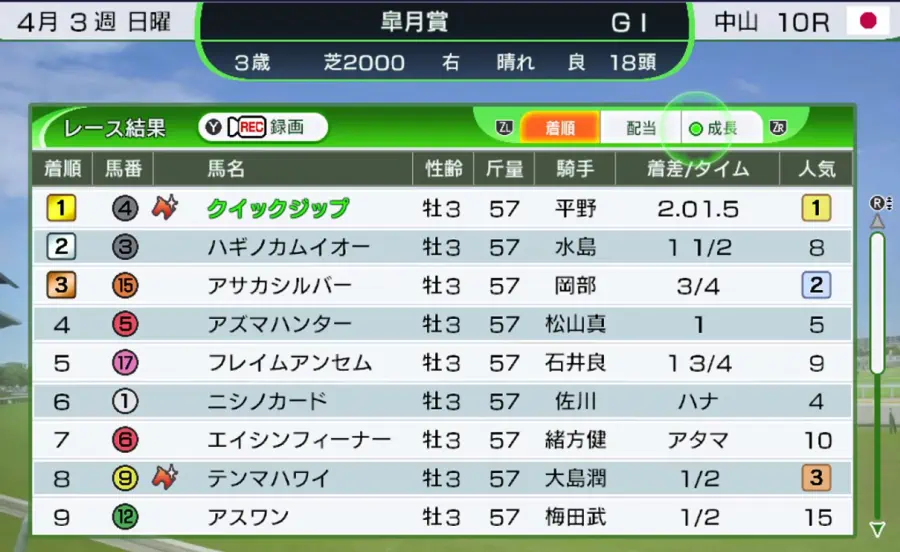
His distance
potential wasn’t quite good enough for the Japan Derby or the Kikuka Sho
so I decided to try pivoting him to some of the dirt G1s, but his
performance tanked. He managed a second-place finish at the Tokyo Derby
but just kind of collapsed after that.
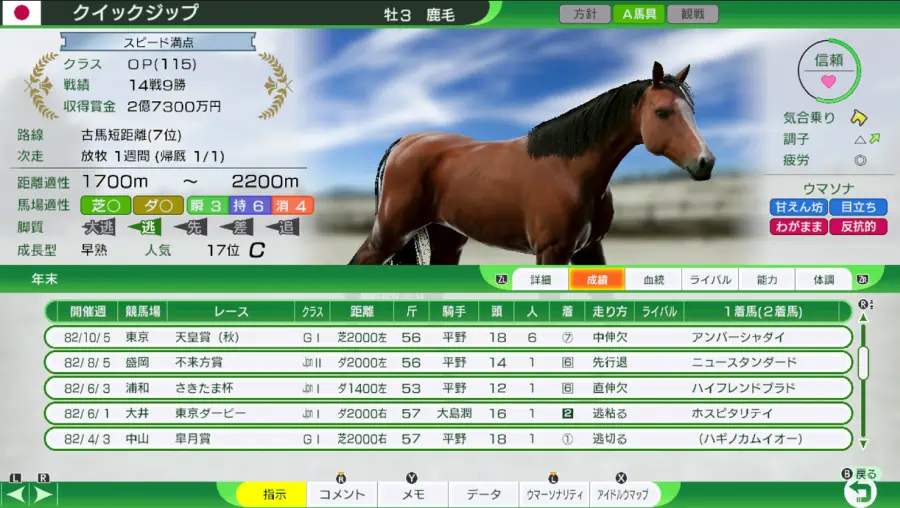
Going back through all this with a
bit more time under my belt, I can say I hadn’t looked too closely at or
understood all the fields or else I would’ve noticed this section here.
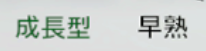 This translates to something like
“Growth type: Precocious”, which means the horse peaks really early and
explains Quick Zip’s collapse in the back half of the year.
This translates to something like
“Growth type: Precocious”, which means the horse peaks really early and
explains Quick Zip’s collapse in the back half of the year.
Real Shadai put up solid second-place finishes at the Derby and
Kikuka Sho, and managed a respectable third place at the Arima
Kinen.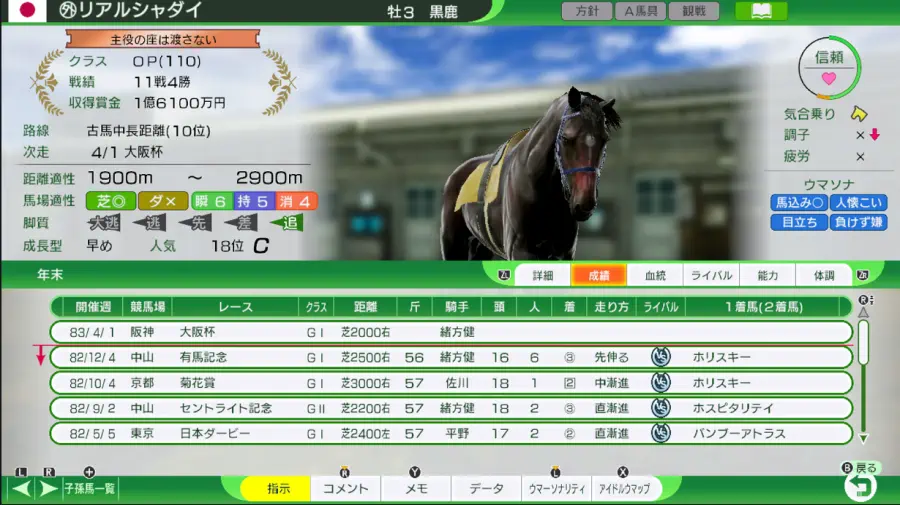
And that’s all pretty good, but Nasuno Chigusa’s second foal (sire:
Northern Taste), Mellow Yellow, debuted and got off to a really strong
start. After winning her maiden, she finished second in the G3 Flower
Cup, qualifying her for the Oka Sho. It took a little bit of fiddling
with different strategies and jockeys, but she managed to win it. After
that, she won the Oaks, finished third in the Takarazuka, and then
cleaned out the rest of the jewels in the Tiara with wins at the Shuka
Sho and Queen Elizabeth Cup. I explored running her in the Mile
Championship and Japan Cup but the Mile Championship would’ve put too
much strain on her and the Japan Cup was just a bit too strong with John
Henry competing, so I ran her in the Champions Cup which she won.
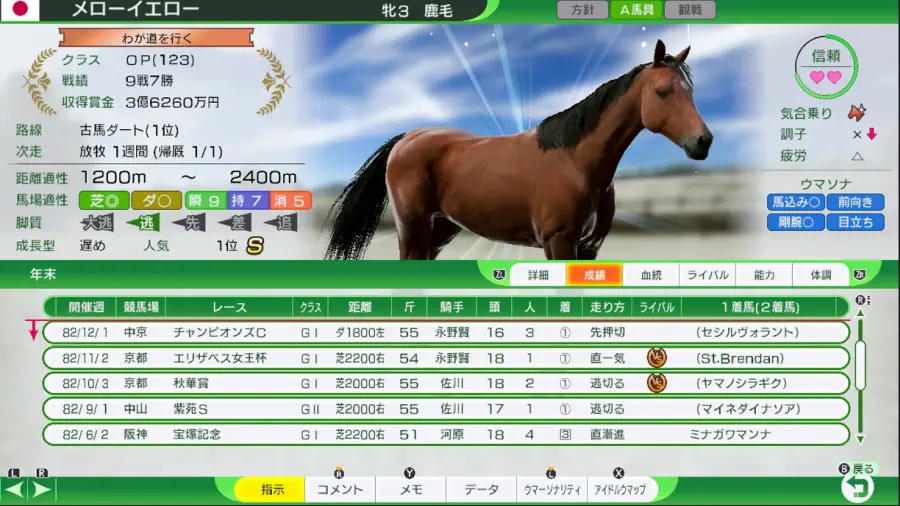
It’s a great start and she’s
seemingly a late bloomer with a great stat spread so she still has a lot
of room to grow. If she can get up to A speed I might try running her
abroad.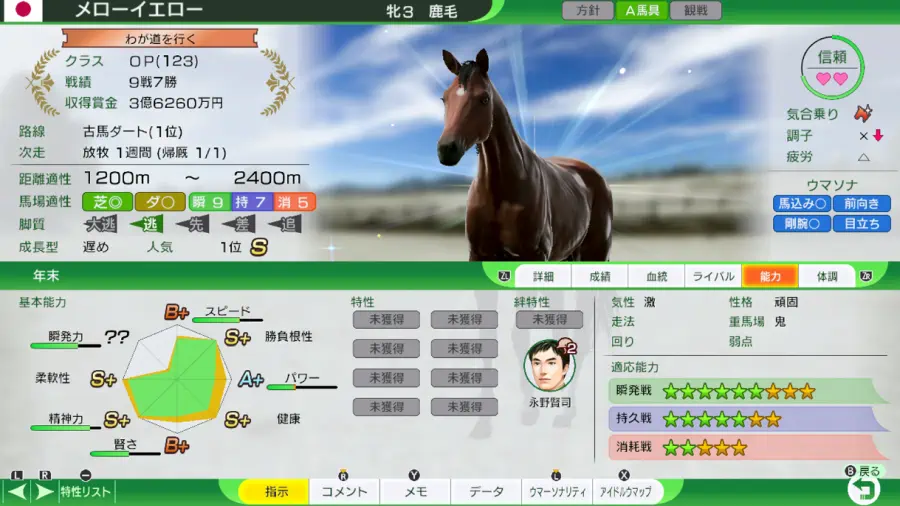
The second kid’s pact-bonded
horse, Night Alcatraz, also debuted and got off to a strong start. A
second place finish in a G2 into winning Hanshin JF and Hopeful Stakes
with a should position her well going into next year.
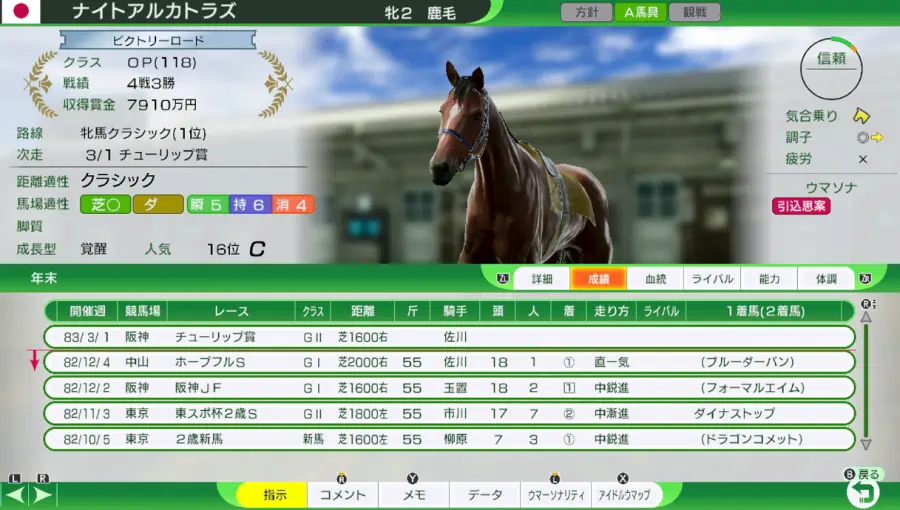
I opted to retire Quick Zip since his performance had collapsed, and
also retired Real Shadai to keep in line with real life, but kept the
rest.
1983
Okay, so there’s a few lines I could go with here but to start I’ll
say I was planning on running Night Alcatraz in the Tiara to pick up
some easy G1s as I have been, but then this happened.
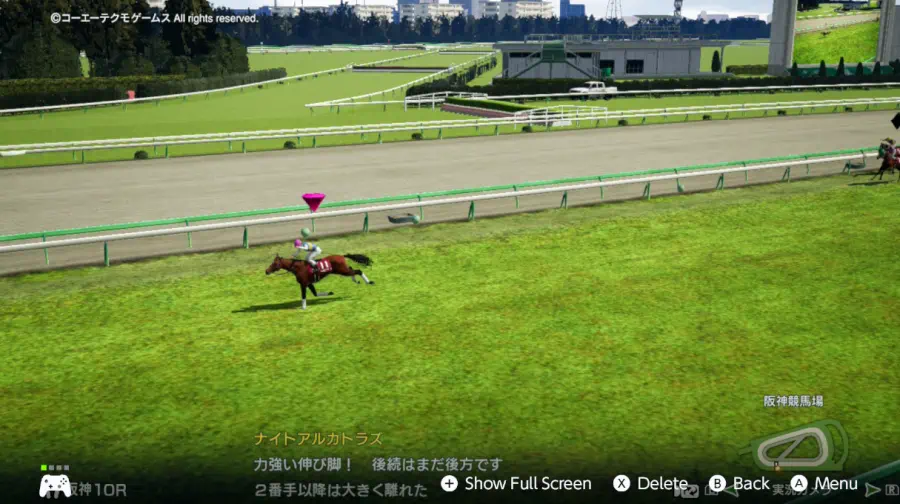
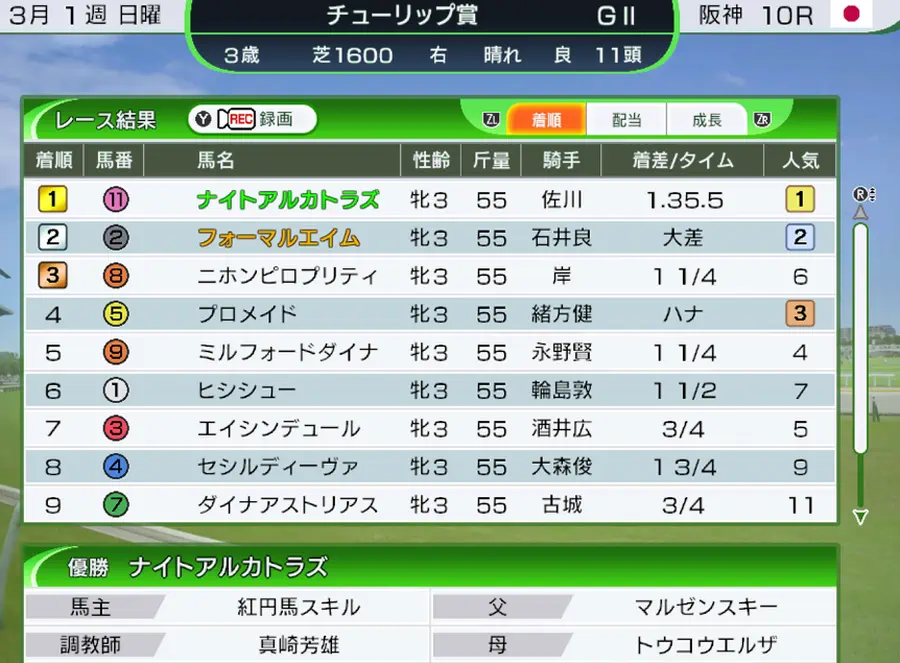
A
distance win at the Tulip Sho. Say, what’s her preferred distance again?
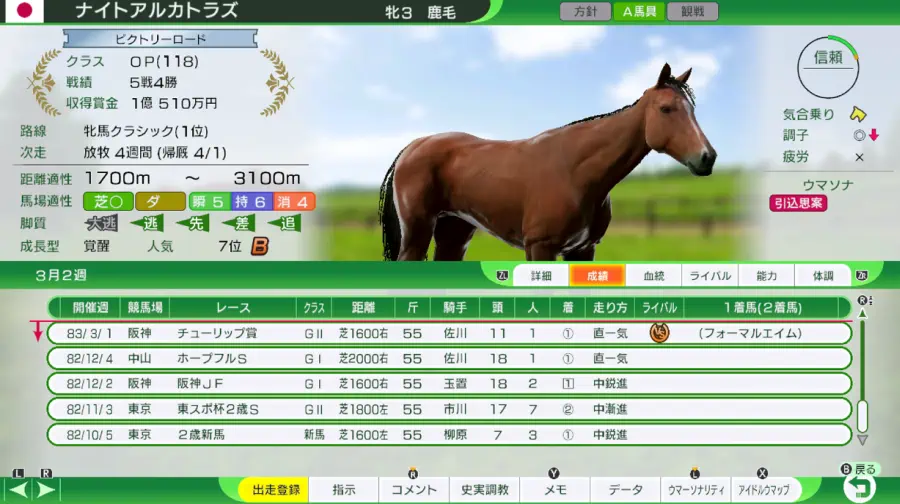
1700m to 3100m huh. That’s… solidly
within the Classics, and could be extended to Tenno Spring temporarily
with a training. You know what, forget the Tiara, I think she’s got a
shot at winning the Triple Crown. Surely I’m not forgetting anyone
important. This’ll be easy. 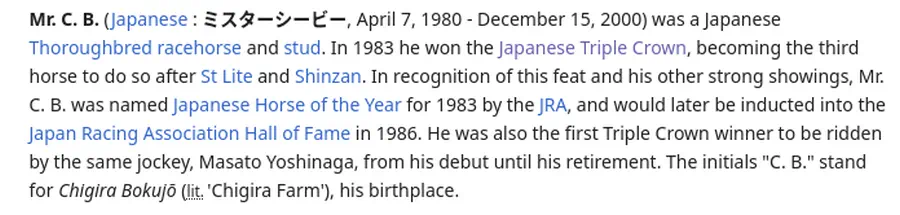
hey
don’t worry about this unrelated wikipedia paragraph aha
I’ll talk about the other horses later but first, let’s try running
Night Alcatraz at the Satsuki Sho. My initial tests had Night Alcatraz
losing to Mister CB by a length, but some short-term speed training
patched that up and got her to a win.
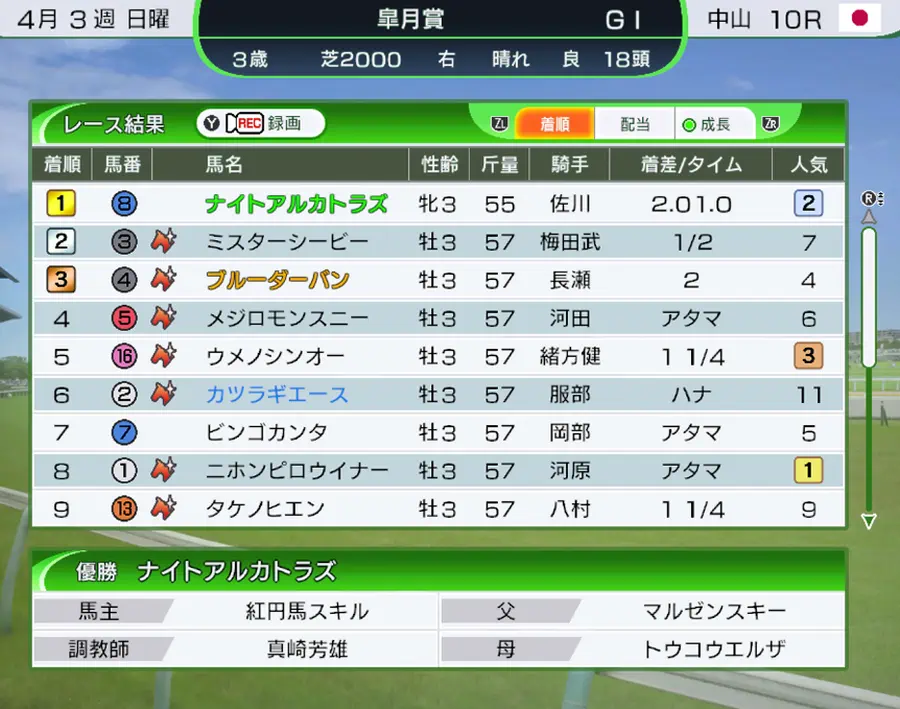
After this I thought about having
Night Alcatraz pick up a win at the NHK Mile before taking on the Derby,
but that would have put too much strain on her and given her tendonitis,
so I opted to have her rest before trying to tackle the Derby. With
functioning legs, her first attempt at the Derby was super frustrating.
Look at this: 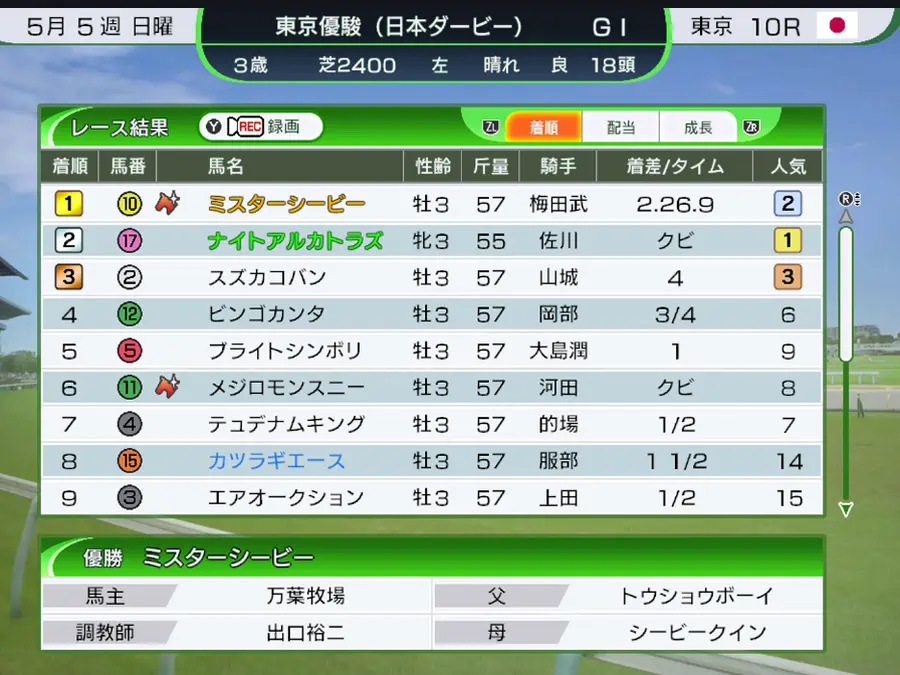
It was a loss by a
neck, and I couldn’t get better than that with that setup, so I had to
go back a bit and get another horse in the race. It literally didn’t
matter who, I just needed any horse who could enter the Derby to take up
a slot. So I got a win in a listed race with one of my less good horses,
Apple Alder, so that he could be just good enough to barely qualify, and
that was the piece I needed to get a win.
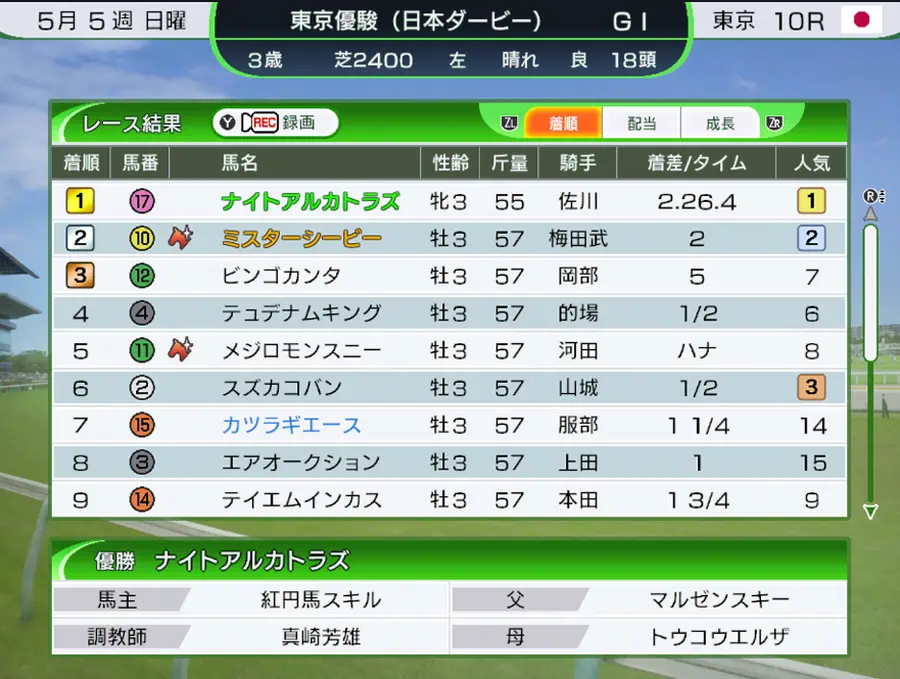
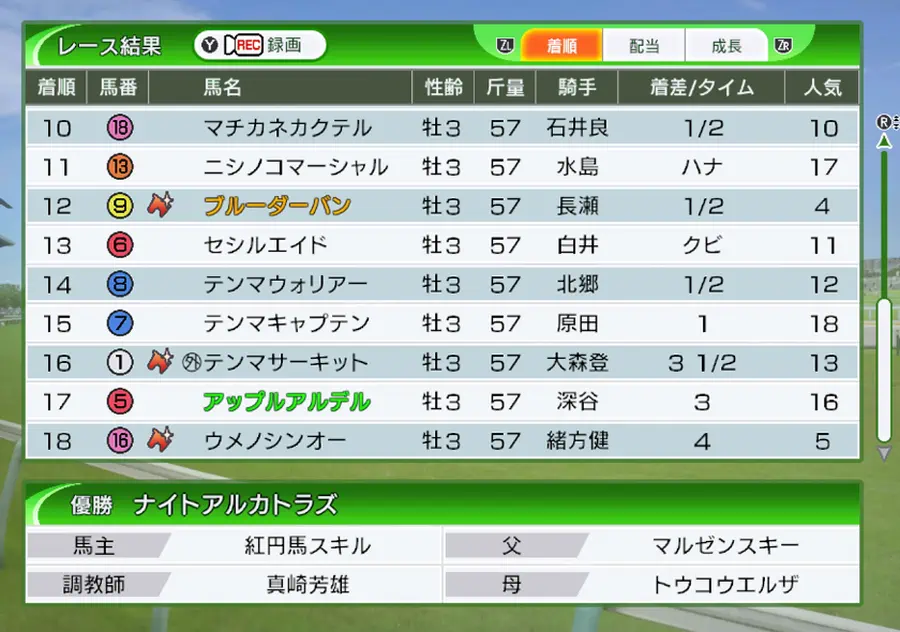
Something about that messed with Mr. C.B.’s positioning enough so that
Night Alcatraz could keep the lead long enough to win.
Next, I tried skipping ahead to the Kikuka-Sho so I could see what I
needed to fix, and there, without doing any more training, I lost by
about six lengths. To fix that, I figured I’d need to slot in a couple
more races and work on improving some of the adaptable stats – the
stamina one especially – so I entered Night Alcatraz into a couple of
the Summer 2000 Meter Series races, and I ran her in front to try and
boost her speed. It worked out pretty well, and got her a grade boost to
her speed, some positive conditions, and a gold skill.
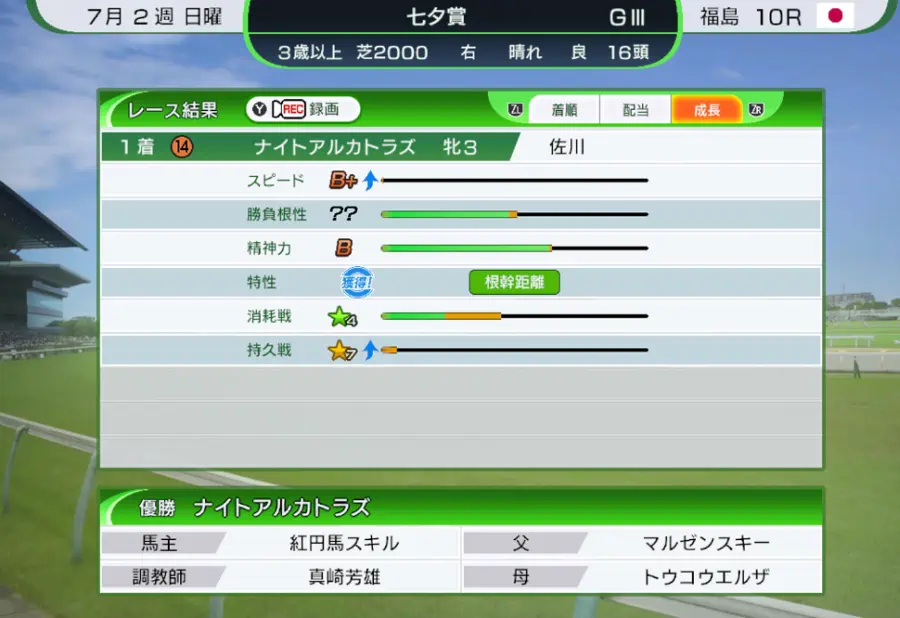
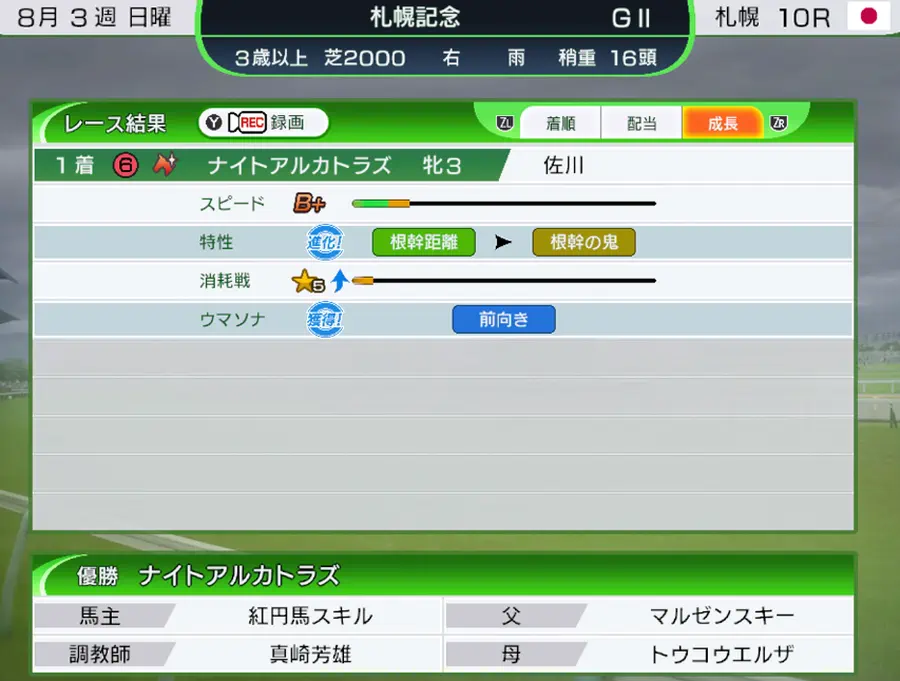
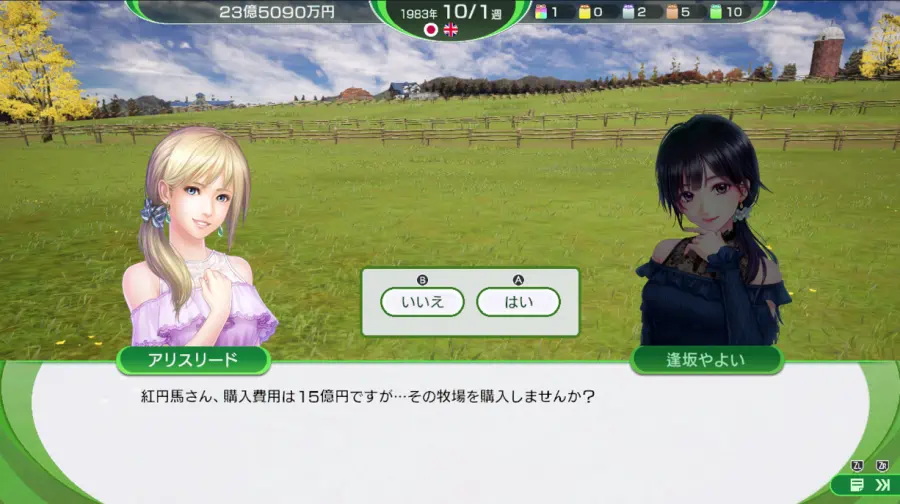
In the middle of this the American rep came around and asked for 1.5
billion yen to open a farm in America, which I gave her.
At the end of the month it was time for the Kikuka Sho. To improve my
odds I went with a speed training and got a great success. A couple
initial attempts didn’t quite bear fruit, but once I tried frontrunning
the whole way it worked out.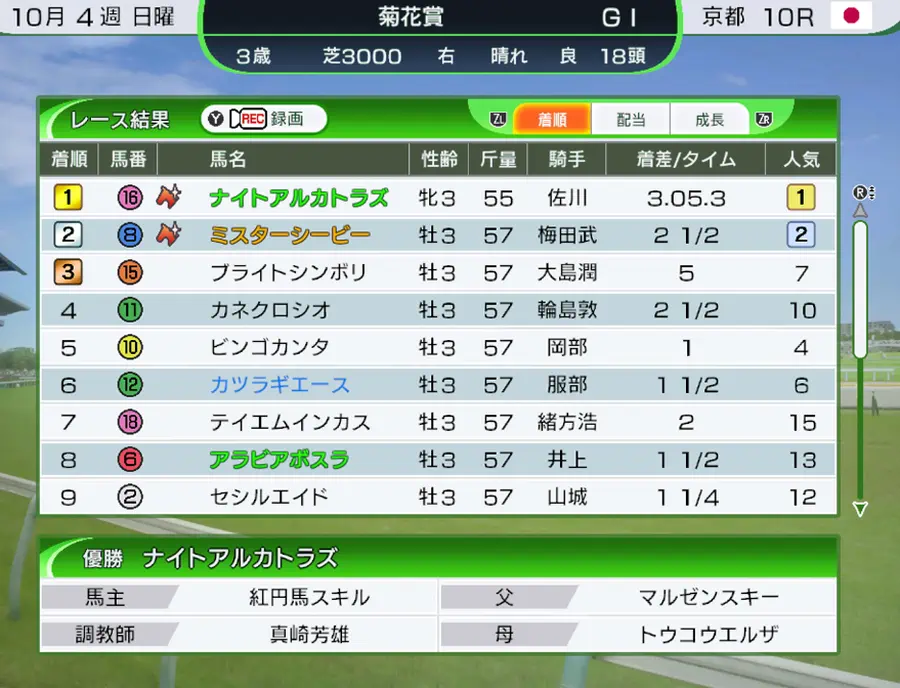
Night
Alcatraz successfully claimed the Classic Triple Crown, and against a
real contender, at that. Mr. C.B. was tough as iron and trying to find a
way to get past him was a heck of a challenge. Doing this with a mare,
too, will be great for reasons I’ll get into later. It’s hysterical, I’m
going to need to make her face Mr. C.B. some more. After this, Night
Alcatraz went on to win the Japan Cup and the Arima Kinen as well. She’s
up to 7 G1 wins now.
As for the rest of the horses, they did pretty well this year. Mellow
Yellow picked up another four G1 wins, bringing her up to 11, Symboli
Rudolf picked up Futurity and Hopeful, and one of my other horses, which
I’ll choose to read as Wings of Zil, won the February Stakes. I think I
meant to run Mellow Yellow in the Takamatsunomiya Kinen and then forgot
for some reason. Oh well, maybe next
year.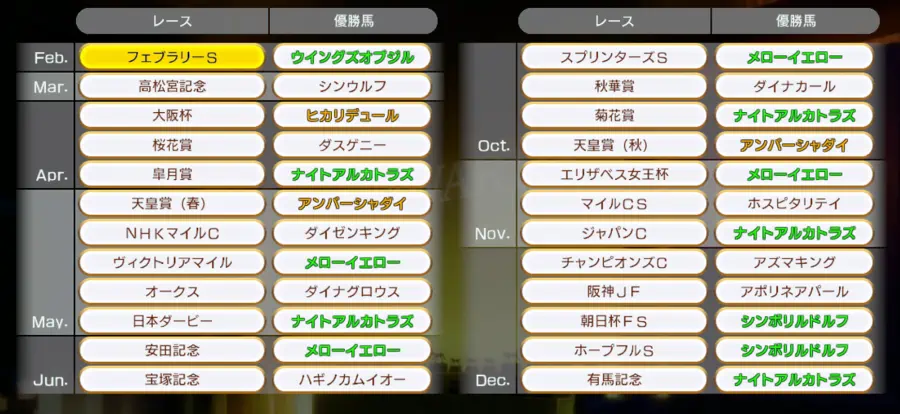
My overseas horses didn’t do as
well as my Japanese horses. You’ve got a bit less control over there and
I don’t think my horses are especially well-adapted for the races there
yet. Also most of my attention was on figuring out how to get Night
Alcatraz past a real heavy hitter and I might have gotten a bit lazy
with some races I could’ve won over there.
I think the game’s at its most engaging when the horses are in the
kind of B, B+ range. The races are winnable with some adjustments, but
they aren’t free, and this year I had a decent number of horses sitting
there.
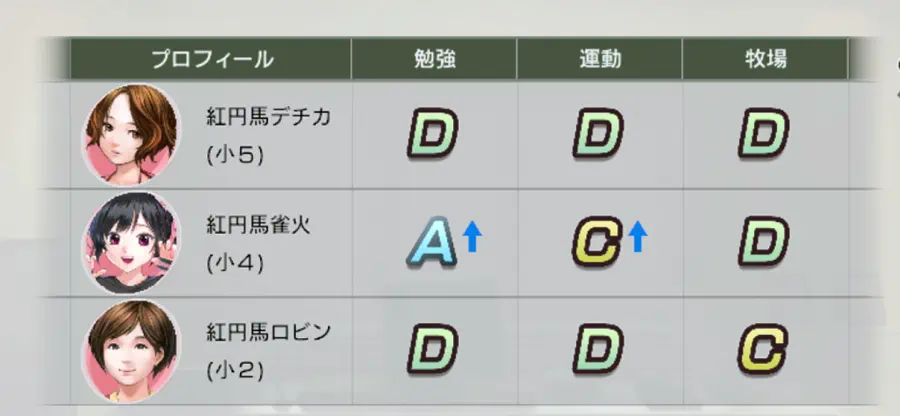
The kids’ grades are– Well, the
second one’s doing well. The 11-year-old still hasn’t gotten anything
from school and the third kid could be worse.
1984
I don’t want to do another play-by-play covering the emotional
journeys as they happened right now so I’ll go with this: My goal this
year was to get Night Alcatraz the Spring and Autumn Triple Crowns, and
I succeeded, but only because of nepotism. I got her through everything
else but I kept losing to Katsuragi Ace at the Arima Kinen. The only way
I found to get Night Alcatraz the win was by using my power as owner of
the club that owned him to remove him from the race.
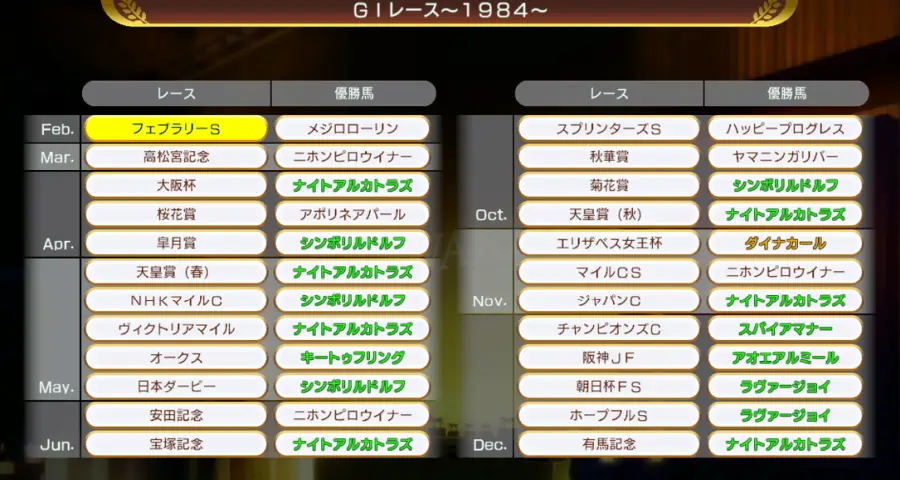
Here’s the overview of the major
races at the end of the year. Names in green are my horses, names in
orange are designated rivals. Rudolf picked up the Classic Triple Crown
and NHK Mile, as well as a couple of races overseas. Night Alcatraz
picked up the Spring and Autumn Triple Crowns. One of my other horses,
Spy A Manor, picked up Champions Cup and Tokyo Daishoten and three
others, and a couple of the foals from horses at the farm, Aware Myr and
Lover Joy, picked up the two-year-old races. Mellow Yellow racked up
another ten G1 wins abroad, including wins at the Prix de l’Arc de
Triomphe and The Everest, and my overseas horses lost a lot of
races.
1985
At the start of 1985 there was a scene where all the secretaries went
to the hot springs, triggered by some mechanic I don’t understand
because, I need to reiterate, I am illiterate and cannot read Japanese.
I’m working on improving it, which is why I play games like this in
Japanese, but my vocabulary is weak and I haven’t internalized how to
make the grammar make sense and while my kanji knowledge has improved
it’s still not up to par, and these all compound on each other to make
reading Japanese more difficult than it should be. A lot of this would
be easier if I could just copy the text out of the game and search the
kanji on Jisho or something, but LunaTranslator doesn’t work under Wine
and Google Lens is Android only. I should really look up an OCR program
or something. 
In 1985 Rudolf pretty effortlessly picked up the Spring and Autumn
Triple crowns, as well as King George VI and the Arc.
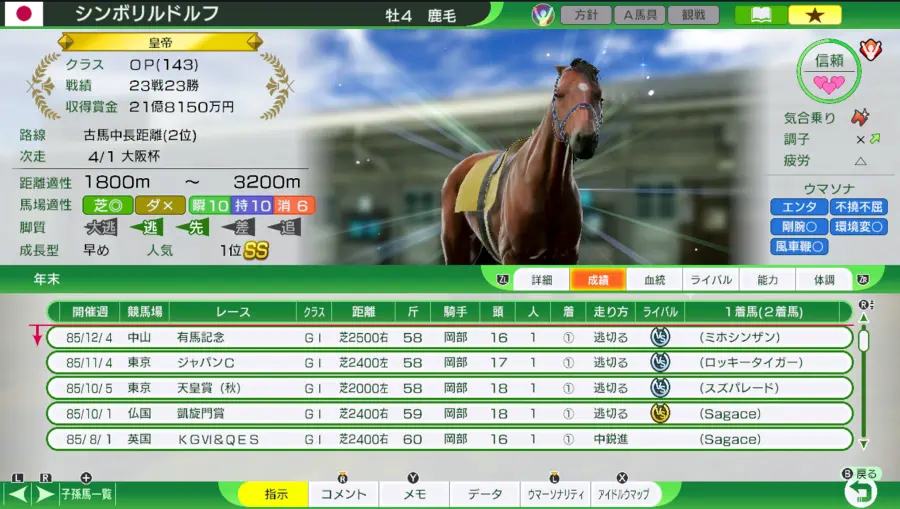
I thought about running Night
Alcatraz in the Hong Kong Triple Crown but that was a bit too much for
where her statline was at, so I ran her in some overseas races she could
win instead. She ended up picking up another 8 major wins, the most
notable of which seem to be Breeders’ Cup Fillies Turf and the Eclipse
Stakes. 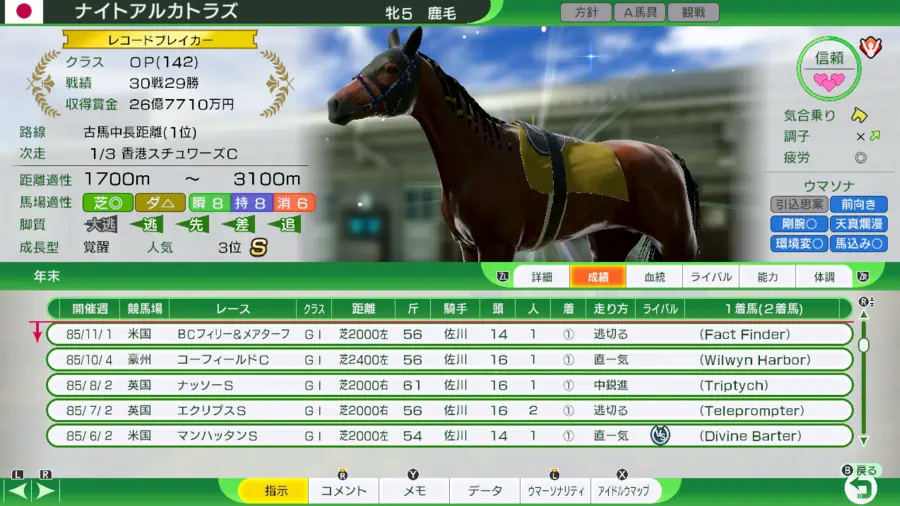
Mellow Yellow continued
trucking along and picked up the Hong Kong Sprint Triple Crown, another
win at The Everest, Breeders’ Cup Distaff, and five other G1s, bringing
her to a total of 31 total. 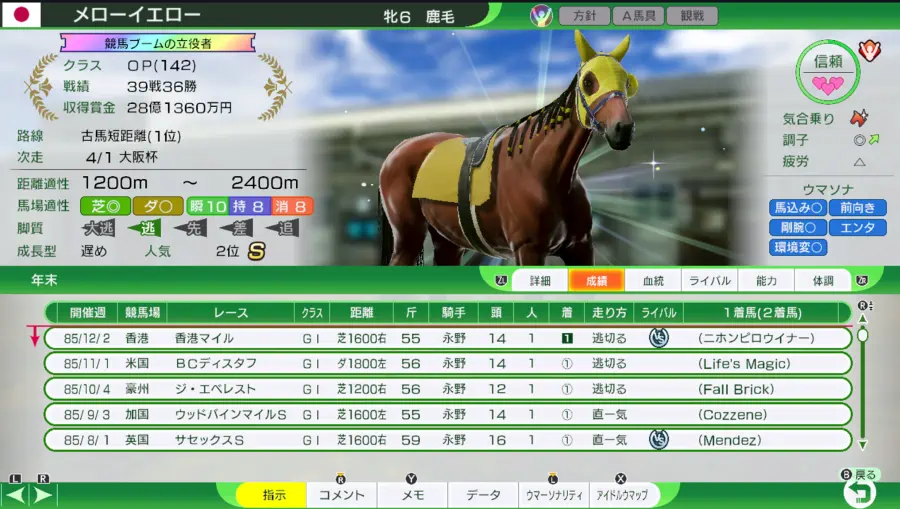
Spy A
Manor surprised me a bit, just kind of trucking along and picking up a
lot of dirt wins. He didn’t do especially well abroad but he picked up
wins at the February Stakes, Kashiwa Kinen, Sakitama Cup, JBC Classic,
Tokyo Daishoten again, and one other one that I can’t quite make out.
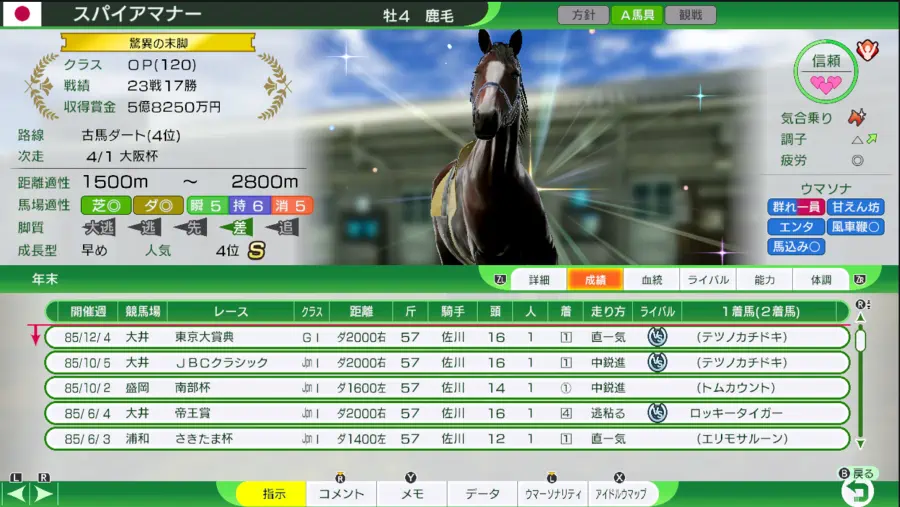
Lover Joy, a generic foal by White
Narubi and Northern Taste, picked up two thirds of the Classic Triple
Crown, but lost at the Kikuka Sho because I couldn’t find a good jockey.
She might have still lost it with a good jockey, but it didn’t help that
the jockeys capped out at Long C. 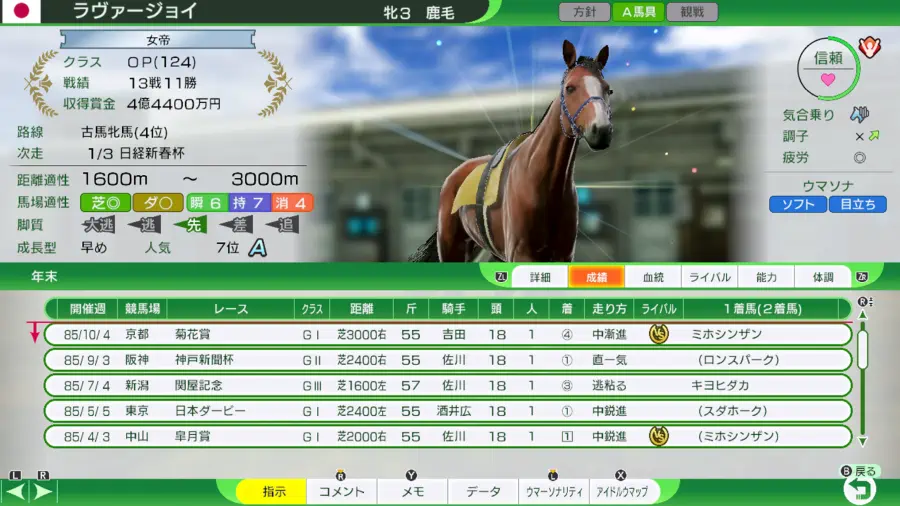
Aware Myr, or however you read that vowel soup, a generic foal by Nasuno
Chigusa and Seattle Slew, picked up the Triple Tiara and a couple of
Jpn1s.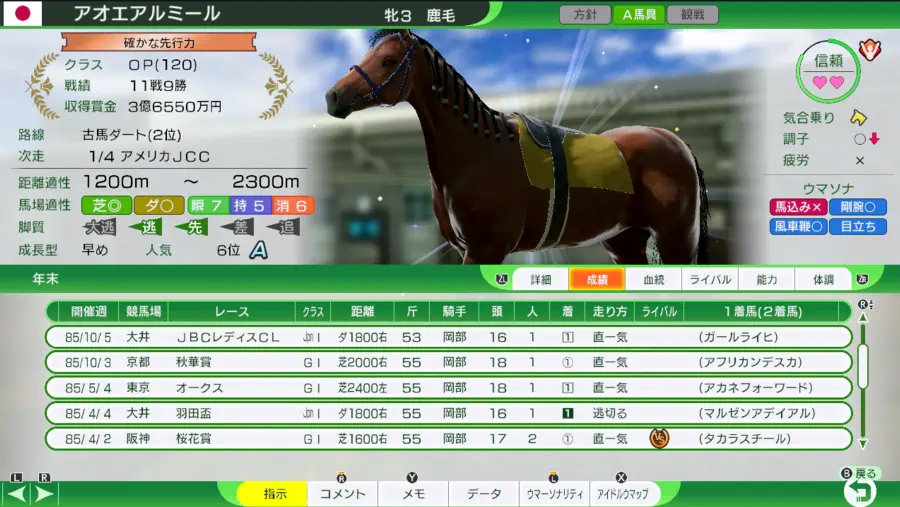
Overseas, I started paying more attention to the schedule and started
entering the horses in races they could win. Saddler’s Wells got his act
together after a disastrous Classic year and picked up 8 G1
wins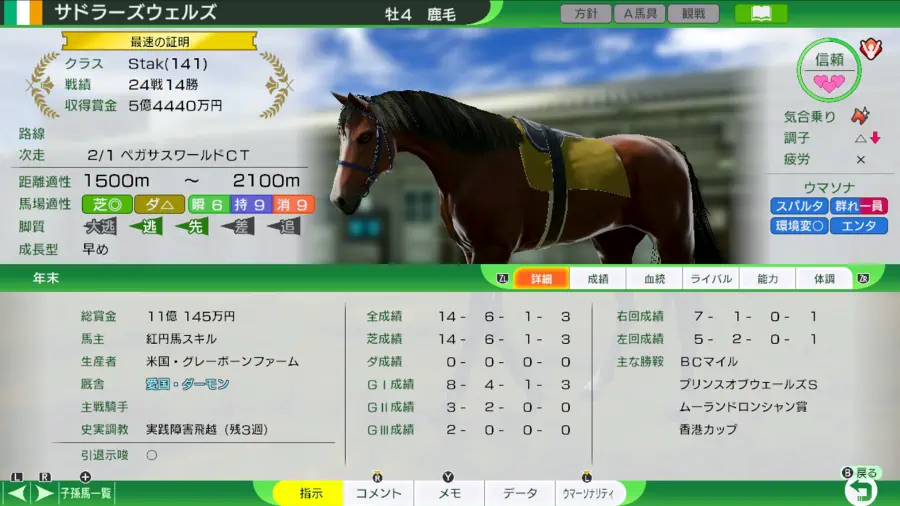
One of my generic foals by
Northern Taste, Forest Arashi, picked up two thirds of the European Mile
Triple Crown, but I couldn’t find a line to get him winning the English
2000 Guineas and not break his leg in the Irish 2000 Guineas, so I
eventually opted to just pull him out of that race. He also won a G1 in
Canada. 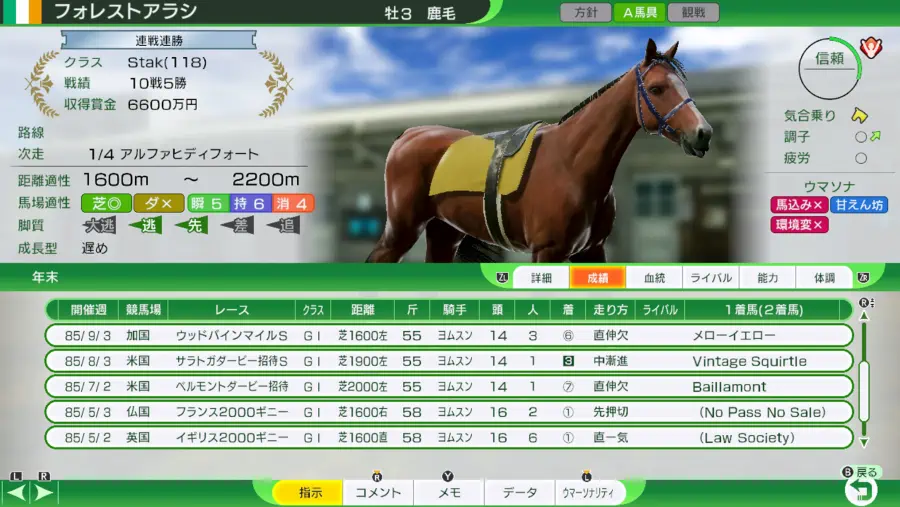
At the foal auction I spotted a familiar name, which reminded me I
should go and check the others to see if there was anyone else I could
recognize that I should pick up. From that, in addition to Super Creek
there, I ended up picking up Tamamo Cross, Yaeno Muteki, Bamboo Memory,
Soccer Boy, Sakura Chiyono O, and a couple of grandparents for some
other notable horses. 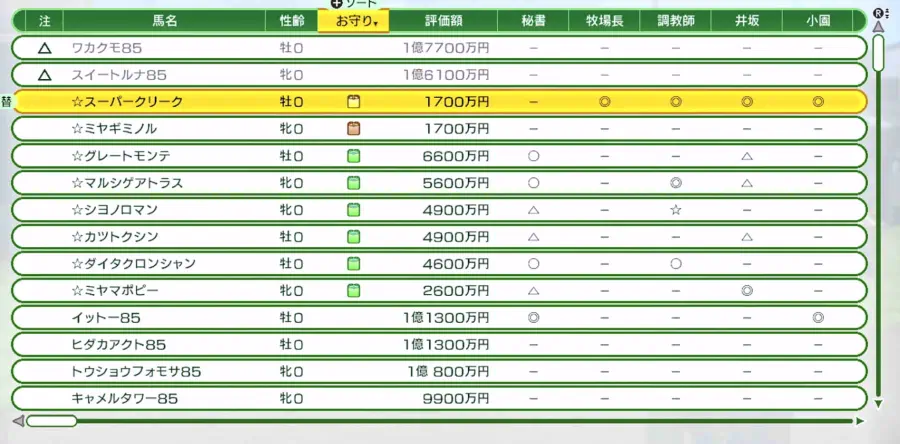
I was a bit overwhelmed by the number of horses I had at this point
so I opted to retire a lot of them at the end of the year. I’ll still
have way too many. God, managing all of this is going to be a real pain.
I have too many good horses. How am I going to get them all the wins
they deserve?
1986
Oh well, that’s still another year out. This year, I dunno. I don’t
have any real up-and-comers so I guess I’ll just have Rudolf run the
table on the Classics again, I’ll have Night Alcatraz try the Hong Kong
Triple Crown again, and for the rest I’m going to start using the
prebaked schedules because that’s the only way I’m stopping there being
too much overlap. Last year I started using the + button to bring up the
races in spreadsheet form and started sorting them by aptitude so I
could have an easier time finding the races that would work well for a
given horse, but it was kind of a pain to find specific notable races
doing that.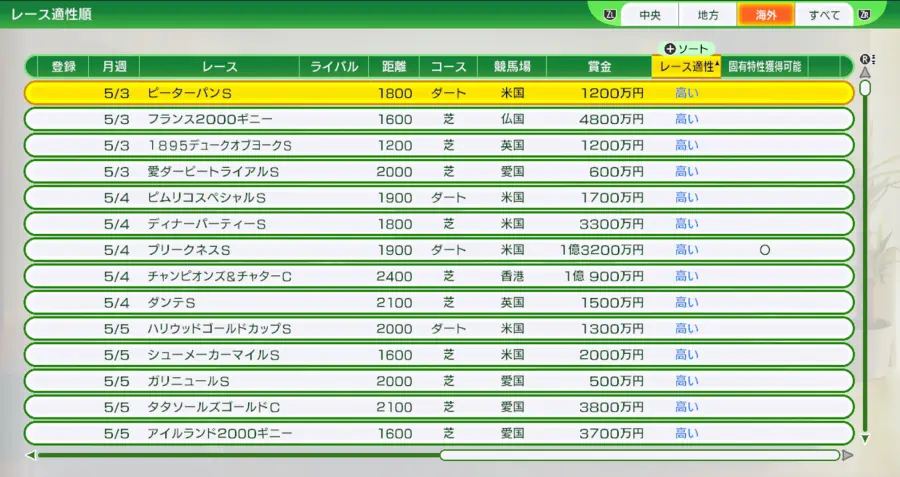
Like, I don’t know the names of all the Hong Kong races so I was just
kind of flipping through these listings one at a time looking for
something in the text field that said トリプルクラウン (triple crown in
katakana) or 3冠, which is the kanji for
it.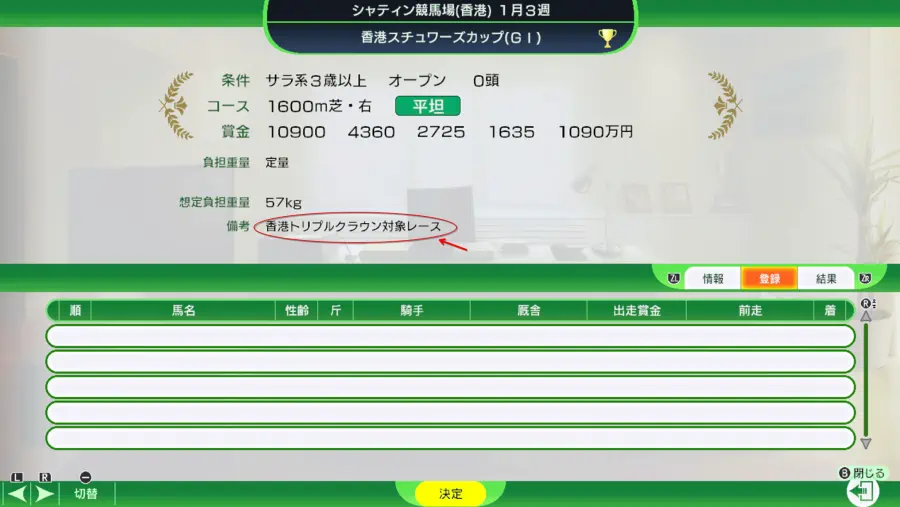
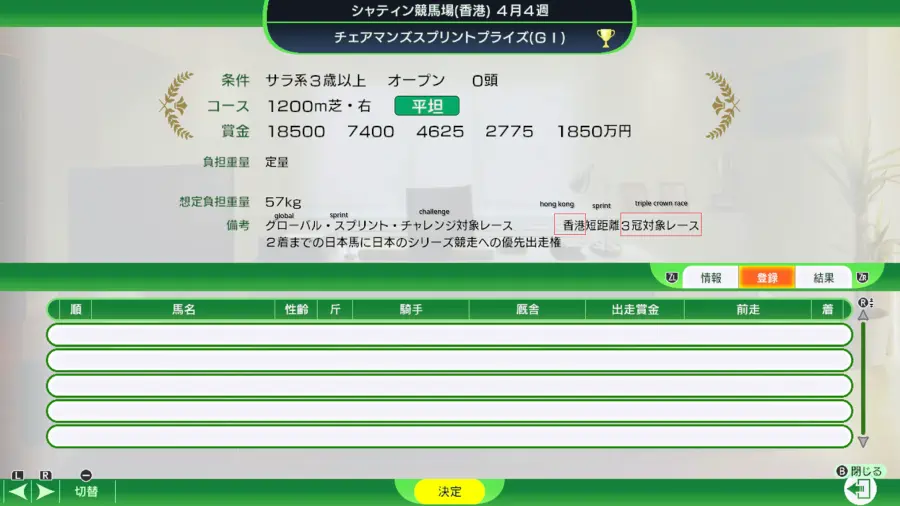
At some point it’s easier to just put them in a pre-baked
schedule so I don’t have to do that every time.
Also, while going down the list I noticed that there’s not really a
lot going on in America or England outside of the Triple Crown races.
There are a lot of G1s there, but most of the time their rewards are way
closer to G2s or G3s in Japan or some other places and it’s hard to
justify running them. That’s a lot of extra time I’d need to set aside
to run them for not a whole lot of benefit. There’s not really anything
secondary going on in America or England like the Global Sprint
Challenge or the Stayers Million Series or the Summer 2000 series or
some of the secondary Triple Crowns meant to emphasize different major
races that places like Japan and Hong Kong have. There’s nothing to
create secondary or tertiary storylines or any real attempt to promote
competition at distances outside of medium-length races.
Anyway, 1986 was a relatively restrained year for the farm, at least
in terms of surprises or having to think, even as I picked up some more
major wins again. Rudolf cleared the spring and autumn races again,
though he started struggling a bit near the end. Night Alcatraz picked
up the Hong Kong Triple Crown, King George, the Arc, and Breeders’ Cup
Turf, along with three others, bringing her up to 31 G1 wins total.
Aware Myr picked up three G1 wins and a few top three finishes.
Overseas, a few horses picked up a few smaller G1 wins.
I opted to retire pretty much all of them because I have too many
foals lying around and a lot of the horses on the farm were on the
decline or weakened, even as the only real retirement recommendation was
Rudolf. 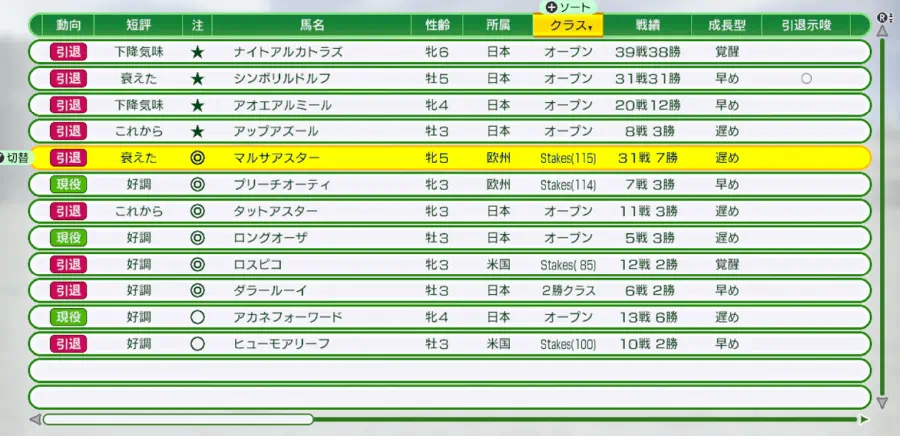
When it came time to transfer horses to different farms I opted to
spread them out a bit more and sent Super Creek, Bamboo Memory, and
Soccer Boy to the club to try and improve my standing there a bit more.
1987
Back at the beginning, probably like 7000 words ago, I said I’d been
playing the game for 35 hours. I just want to check back in on that. How
long have I been playing this again?
Ah, I see. If this writeup peters out before I can get the last three
trophies I need to hit credits, please understand. I am an
ill-disciplined moron, especially when it comes to longer-form pieces
like this one, and this is already way past where I can usually get to.
Anyway.
At the start of the year I noticed I had made an error.
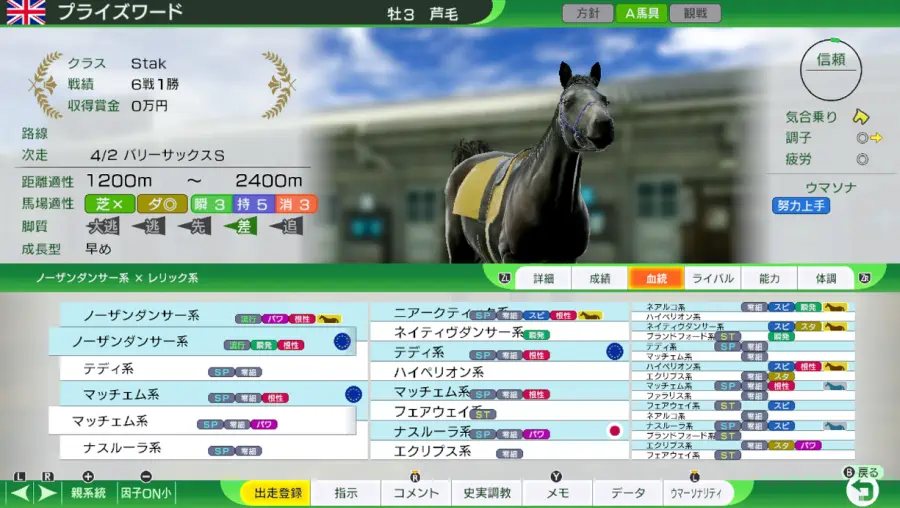
See, a couple years back I sent this
horse over to Europe as a foal because, I mean, I see a lot of European
flags in the pedigree, he’s probably good in European races. I think
that’s a pretty reasonable assumption to make absent anything else.
However, and this only became apparent with time, look over here:
 芝 is turf and ダ is an abbreviation
for dirt. This is a horse that is more suited to dirt races. There are
no dirt races in Europe, and I can’t run him abroad until he wins some
major races. There is no option for me to transfer him to one of my
other farms. This horse is doomed.
芝 is turf and ダ is an abbreviation
for dirt. This is a horse that is more suited to dirt races. There are
no dirt races in Europe, and I can’t run him abroad until he wins some
major races. There is no option for me to transfer him to one of my
other farms. This horse is doomed.
The first half of the year went by pretty quickly. Tamamo Cross
picked up the Satsuki Sho, one of my European horses picked up a couple
G1s abroad, and then it was May and it was time to pick who to pair the
mares with for the year.
A few years back I said I’d explain why it was good that Night
Alcatraz was beating Mr. C.B. and now that I’ve retired her I can
finally get into the rivalry mechanics a little bit.
As you race against specific horses more and more, they may develop a
rivalry. Competing against them will increase their rivalry level. One
of my friends joked something to the effect of “what, is it measuring
their level of sexual tension?” to which I looked at the columns and
found that, yes, that’s exactly what’s going on there. As the rivalry
level increases, the number of sparks flying between them increases, and
they get a breeding bonus when paired.
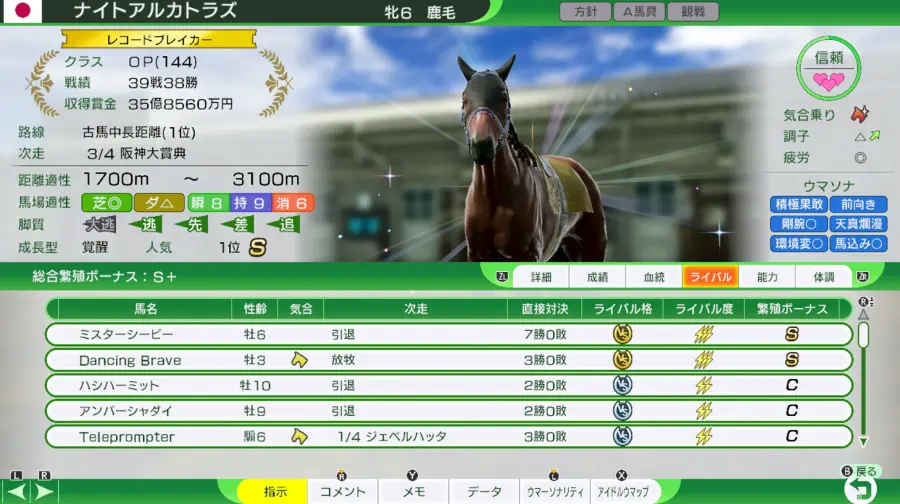
Over the course of her career Night
Alcatraz developed an intense rivalry with Mr. C.B. and Dancing Brave,
and this is great for their compatibility.
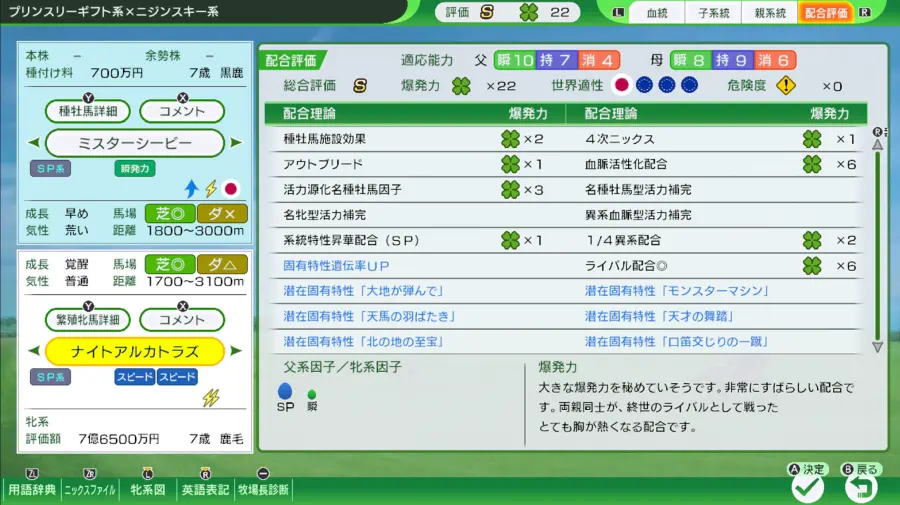
Down in the corner there it says:
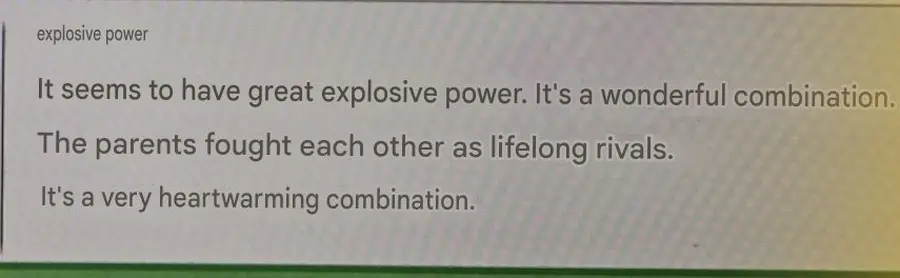
oh my god, they were rivals? from different farms??
As mechanics go, this is hysterical. It’s enemies to lovers
formalized and codified. I think there’s an audience that would be
completely obliterated by this.
Outside of that pairing I mostly just continued focusing on pairing
horses that had a good letter and number of clovers up top there, and
also got a good excuse to talk about the star in this one
here.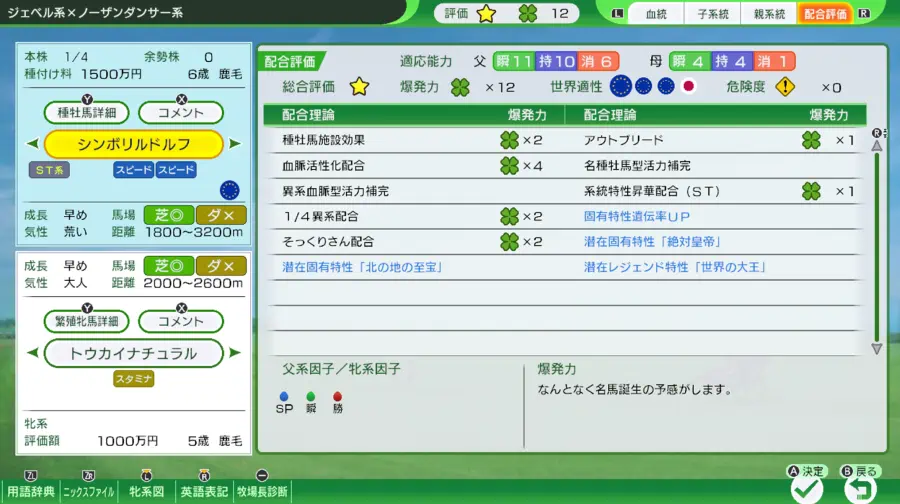
Sometimes if you have a
specific mare and pair them with a specific stallion in a specific year
you get the real horse that came out of that pairing. In this case I’m
pairing Symboli Rudolf with Tokai Natural in 1987, which will produce
who even knows, it’s a mystery.
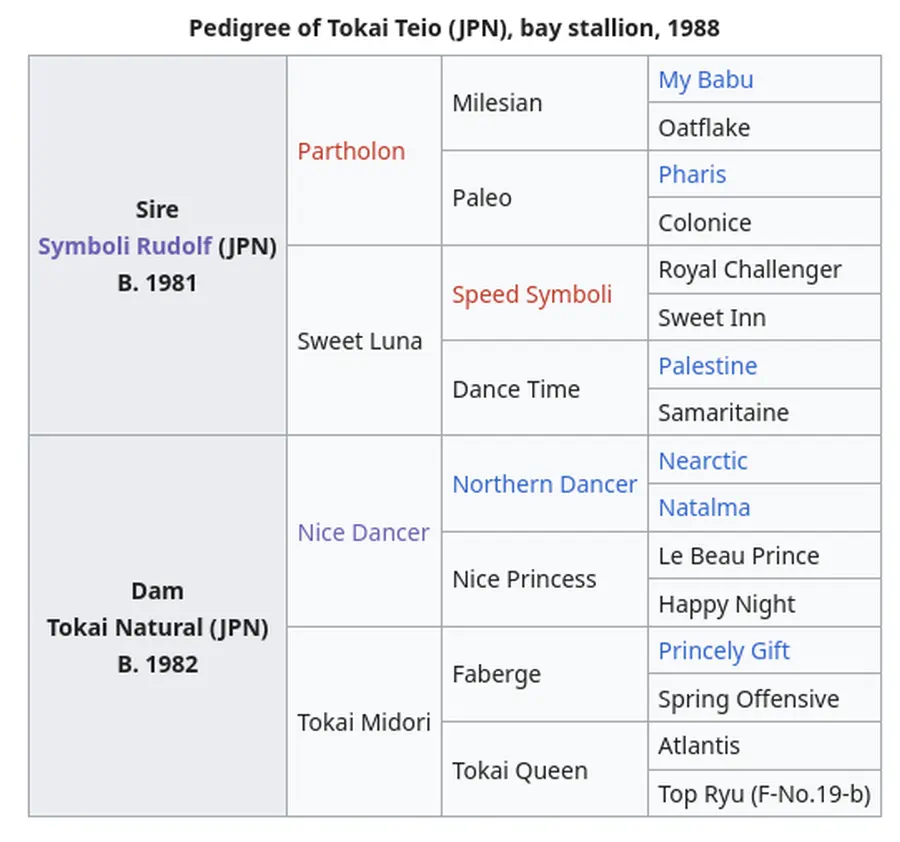
Over the rest of the year, Tamamo Cross won the rest of the Triple
Crown and the Arima Kinen, Oguri won Hopeful Stakes, and I picked up an
armful of names I recognized from the foal menu. I think I own all the
good horses of this era now. I think I could probably have Oguri pick up
the Triple Crown next year, but I might just run him in some of the dirt
races I’m missing so I can see credits.
1988
To split up my good horses so they weren’t all bunched up, I opted to
send Oguri abroad to America, Yaeno Muteki to NHK Mile and Yasuda Kinen,
and Chiyono to the Satsuki Sho and the Derby, while Tama cleaned up the
major senior year races.
For whatever reason the game started recommending Tamamo Cross for
retirement at the start of the year.
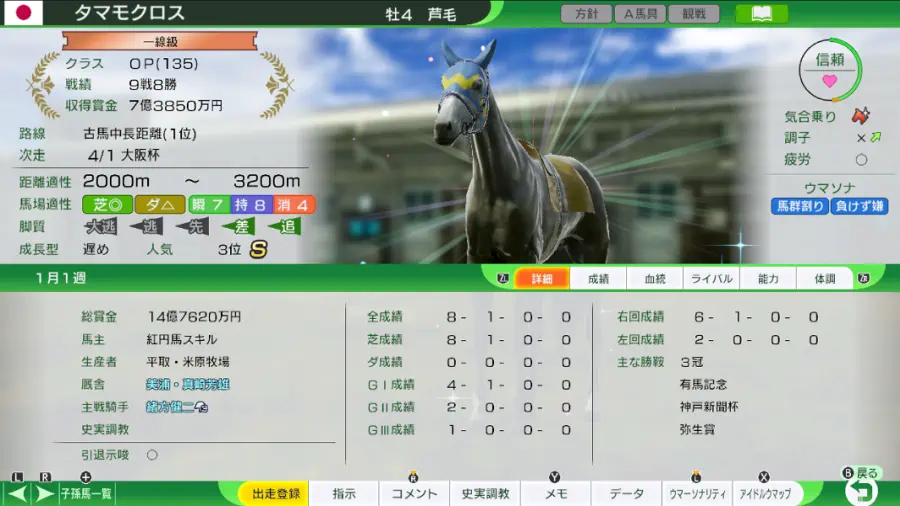
It seems a bit baffling to me since he’s a late bloomer and nowhere near
his peak. I know he was retired at the end of the year in real life, but
that was a questionable decision there too.
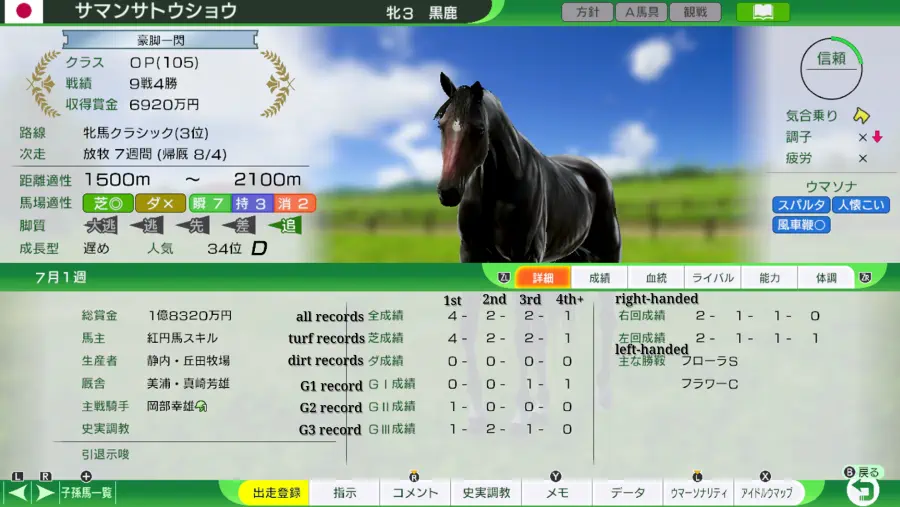
The first few months were relatively uneventful. Samantha Tosho
placed pretty well in some G3s and G2s, and I managed to get her to a
third-place finish in the Oka Sho, though I forgot that her distance
aptitude caps out at 2100m and accidentally ended up entering her in the
Oaks, where she ended up in 16th place.
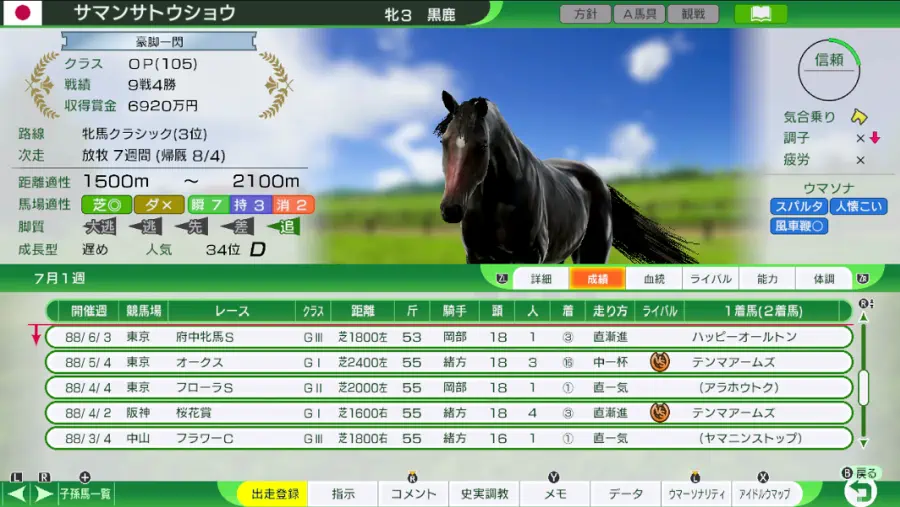
Otherwise, she seems pretty solid
with a 9: 4-2-2-1 record so far. I was confused by that at one point so
I should probably explain. That 9: 4-2-2-1 record is saying she has been
in nine races, of which four were first-place finishes, two were
second-place finishes, two were third-place finishes, and one was a
finish outside of the top 3.
My other horses were varying shades of pretty good. Tamamo Cross won
the Senior Spring Triple Crown, Sakura Chiyono O won the Satsuki Sho and
the Japanese Derby, and Yaeno Muteki picked up NHK Mile and Yasuda
Kinen.
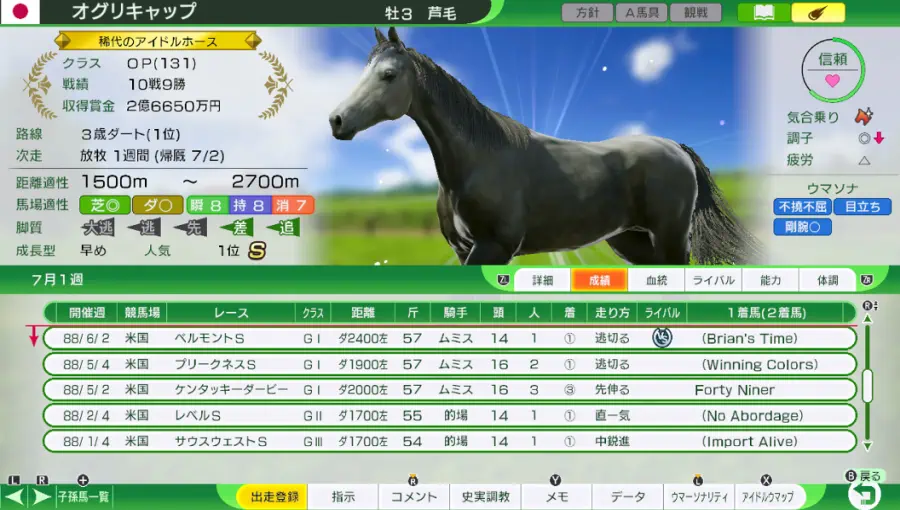
I tried getting Oguri to win the American Triple Crown but I couldn’t
find a way to get him above third in the Kentucky Derby since he was in
the middle of another training and I couldn’t use the Overseas Training
option to juice his overseas aptitude for a turn. He won the Preakness
and the Belmont though.
Most of my overseas horses were pretty bad. Pretty Otie picked up a
few more G1s in Europe, Ima Devil picked up a couple G1s in America, and
Overnote picked up a couple of top 3 finishes, which is pretty good. My
other twelve horses that raced struggled. Most of them managed to at
least win their maiden race but some of them couldn’t even get that
far.
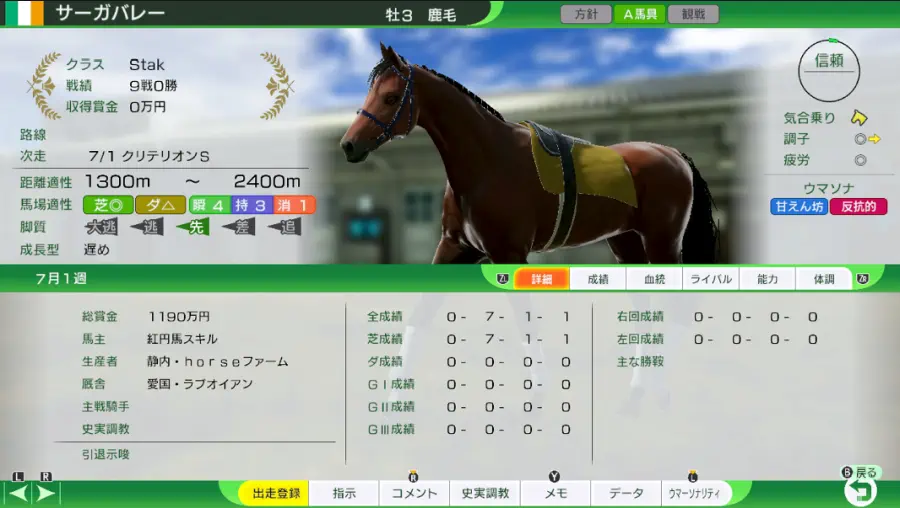
get it together Saga Valley.
Now thankfully right after this Saga Valley and a few of my other
struggling horses did get it together long enough to win some G3s.
In the back half of the year I think I might've gotten a bit too
aggressive with scheduling because there were a lot of back-to-back
turns with like seven or eight races apiece. I guess I'll just go down
all of them and see if I find anything more to say.
Tamamo Cross finished his sweep of the senior year Japanese G1s. Good
job Tama. Of note, when I skipped ahead to the final straight in the
Japan Cup Tamamo Cross was in this position:
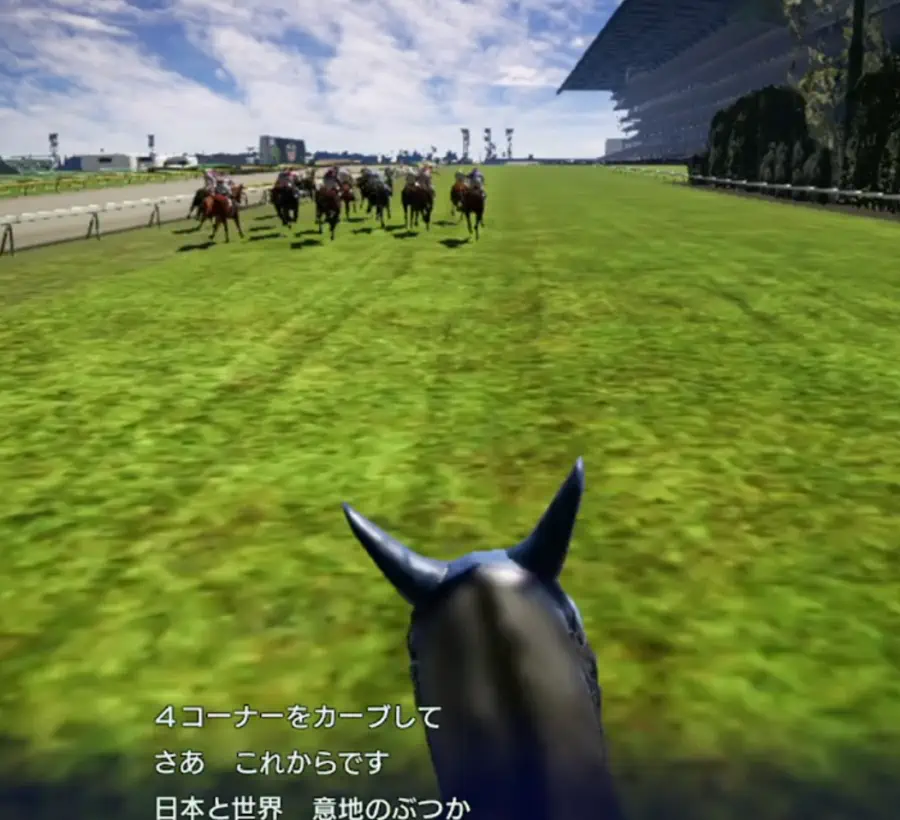
I watch a lot of these races to get a feel for it all and, normally,
if I see this it's because the horse broke their leg or suffered some
other similar injury. In this case though Tamamo Cross was just
preparing to hit the nitro or something and then he sped past the entire
pack to win by three lengths. Wild run, Tamamo Cross's acceleration is
insane.
Oguri Cap won the Haskel Stakes, the Prix de l'Arc de Triomphe, won
the Hong Kong Mile, and finished second in the Breeders Cup Classic to
Ferdinand.
In real life Ferdinand was a great horse who won the Kentucky Derby and
Breeders Cup Classic, and whose unceremonious death in a slaughterhouse
created a donation program to help keep old racehorses alive, as well as
inspired some animal welfare bills that, much like Ferdinand himself,
died after being passed around to a less visible place once attention
fell off.
Sakura Chiyono O picked up a few
lower-stakes graded races before clearing out the Woodbine Mile, the Cox
Plate, and Breeders Cup Turf.
Yaeno Muteki won the Mile Championship against Soccer Boy, and two
other graded races.
My one two-year-old mare, Ruse Wallaby, a foal by Tokai Midori and
Northern Taste, managed to win Hanshin JF against all odds, though given
how 1989's been going I think that might have been a fluke.
I think I've developed an entirely unwarranted fondness for Samantha
Tosho. She's not the best horse. Her timeform rating right now puts her
at the low end of the average G3 winner. She's not a consistent G1
winner. Even with a distance buff to get her in range of the Queen
Elizabeth II Cup she ended up coming in sixth. She didn't win the Oka
Sho and she didn't have the aptitude for the Oaks, but she did
win the Shuka Sho, and she's pretty good at winning, or at least
placing, in G2s and G3s.
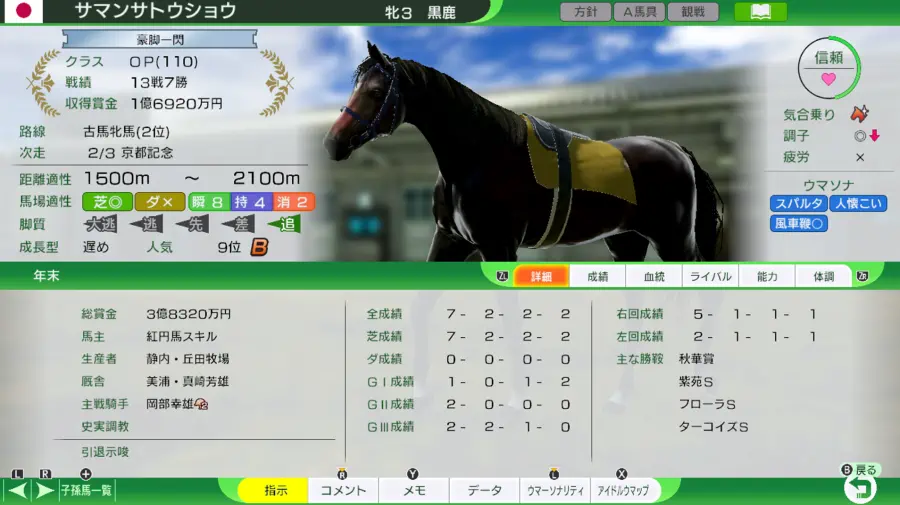
Her stats are deeply mediocre, aside from a good power stat and an
epithet that boosts her performance if she's running as an end closer.
But I really like horses like this. She's not bad. She can win races.
She can win the low, lower-mid-tier graded races pretty regularly,
though she struggles in higher level competition. But she's a good horse
who's clearly a cut above the bottom tier horses who maybe only
sometimes cross into graded wins.
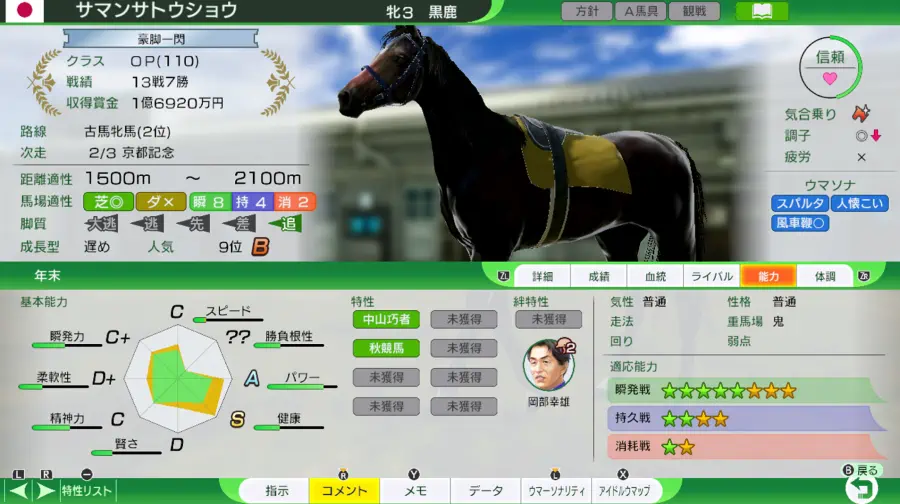
I guess if I want to try and put how this all feels into words a bit
better, I'll compare it to sumo, because that's my other frame of
reference for sports. I like sumo's
ranking system and I think it's good for getting a more fine-grained
breakdown of relative competitive strength. In this framework I'd say
graded races are like Makuuchi, open-class races are like Juryō, the
3-win class is like Makushita, 2 win class is like Sandanme, one-win
class is like Jonidan, and maiden races are like Jonokuchi. From this
I'd say Samantha Tosho is like a lower-mid maegashira type, maybe
maegashira 9 or 10. She can compete in the lower end of the highest
level, but gets stomped by the higher rankers. And if I'm working with
this kind of framework then we would understand someone like Seattle
Slew as yokozuna-tier, Oguri and Tamamo Cross are like strong ōzeki,
Yaeno Muteki is like a komusubi, and Nice Nature and King Halo are low
and mid-tier maegashira, respectively. It's not as exciting when the
champion ranks win. Of course they'd win, they're the best. That's what
they're supposed to do. It's way more exciting when one of the low or
mid-rank maegashira guys goes on a tear, like what happened back in May
2025, which my favorite sumo analyst explained really well.
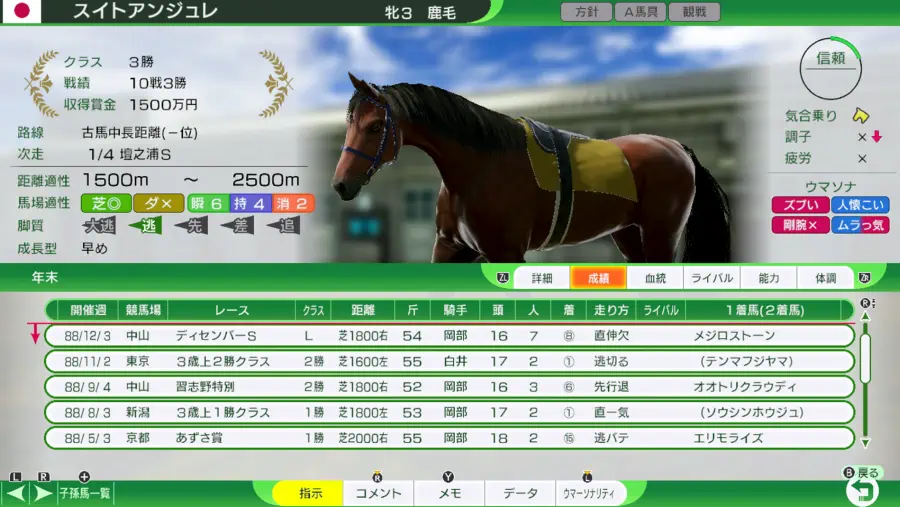
Meanwhile, if I'm continuing with this framework, we can understand
Sweet Angelet here as a jonidan-tier horse that I've dragged all the way
up into low makushita in the back of the year here. She's not very good,
but this is still three more wins than the real Sweet Angelet got. I'll
be retiring her at the end of the year so that i can get Seiun Sky's dam
next year, but hey. She put in some work and got more out than I ever
expected of her.
Overseas in England, Pretty Otie picked up four more G1s and two top
3 placements. She's been doing pretty well but she's getting old. 11 G1
wins is a great career.
One of my generic foals by Takaeno Kaori and Seattle Slew, Chain
Mosborough, debuted in the back half of the year and proceeded to pick
up two G1 wins, a G3 and a G2, and came in second place in the Los
Alamitos Futurity to Easy Goer (already
you know you're in for some shit when the horse has a wikipedia page),
who in real life was the winner of the 1989 Belmont Stakes and eight
other Grade 1 races. Sometimes you just run into LeBron James in these
races, I guess. Otherwise, Chain Mosborough seems really good. I'll
probably be mostly entering him in G1 races.
None of my other European horses had especially noteworthy
performances. A couple of the horses that were struggling managed to get
it together long enough to win G3s. Happy for them. they're still
getting retired.
Over in America the results were a bit better. I'm a Devil, a generic
by Sweet Luna and Northern Taste, picked up wins at the Jockey Club Gold
Cup and Breeders Cup Distaff.
Sunday Silence debuted and went straight into three G1 wins: Breeders
Cup Juvenile, Hopeful Stakes, and Breeders Futurity.
One of my generic fillies by Touko Elza and Northern Taste, Speed
Vine, picked up a G3, a G2, Breeders Cup Juvenile Fillies, and the
Alcibiades Stakes.
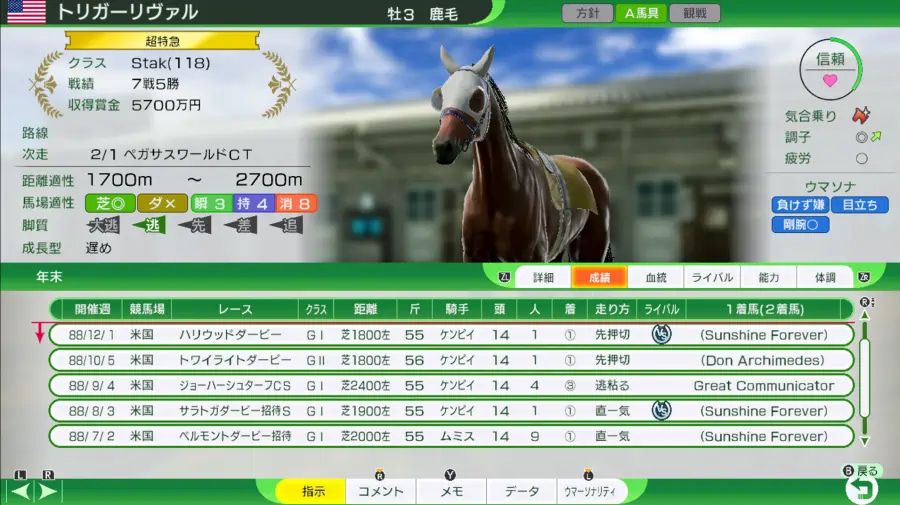
One of my generic colts by Mint Gaia and Seattle Slew, Triggery Val
(or however you're supposed to decipher トリガーリヴァル ), was
struggling a bit in the early half of the year but pulled it together in
the back half and won the Belmont Derby, the Saratoga Derby, and the
Hollywood Derby.
Over Note, a generic colt by
Nasuno Chigusa and her old rival Haiseiko, continued struggling in G1
races but still placed reasonably well in them, and he won a few
G2s.
Love Bridle, a generic filly by C.B. Queen and Seattle Slew, picked
up two G1 wins at the Del Mar Oaks and the Belmont Oaks, and had
inconsistent performance after that.
The other five horses won a couple of G2s and G3s but otherwise
struggled.
Now, I feel like I haven't been covering the horses I have in the
upcoming year super well so I'll go down them here. The one year old
horses I have right now that are especially notable in real life that
are set to debut next year are: Mejiro McQueen, Ines Fujin, Haku Taisei,
Daiichi Ruby, Campaign Girl, Daitaku Helios, Mejiro Ryan, Mejiro Palmer,
Agnes Floral, and Nice Nature. To make it easier to vizualize for the
Uma Musume fans, it's all of these, and also Haku Taisei who isn't in
Uma Musume right now, and Agnes Flora, an Oka Sho winner who's the dam
of Agnes Tachyon. I've palette-swapped Special Week to visualize
Campaign Girl since that line is basically all palette swaps anyway.
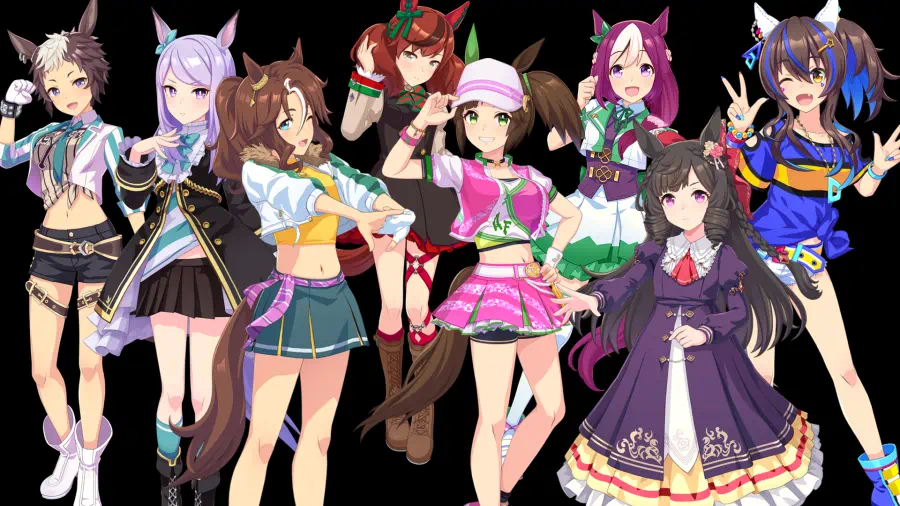
And then beyond those I have a few generic foals that seem like they
should be pretty good, mainly Sweet Luna 87 and Tokai Midori 87 but
we'll see those when we get there.
Beyond those, I think I picked up Tony Bin at the end of year
stallion sale, and I picked up Still in Love's dam, Bradamante, because
she seemed like the best of the bunch there. I moved around some of my
horses and brought Night Alcatraz back to Japan. I'll probably need to
expand my stables overseas a bit next year since I'm running out of
room.
1989
At the start of 1989 I got a phone call from another horse owner
asking if I wanted to buy Inari One, which, of course I do.
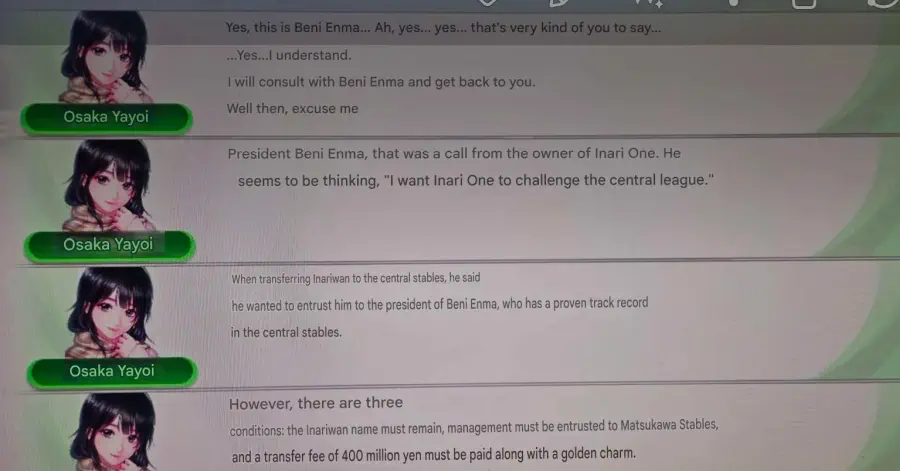
It messed with my already precarious plans of trying to figure out
"how do I get all these horses to not overlap all their races" a bit,
but it sure did solve the problem of "who do I have that's good enough
to take on the Osaka Hai, Tenno Spring, and Takarazuka Kinen", which he
then proceeded to win.
I really tried getting Sunday Silence the American Triple Crown but I
couldn't get a better finish than a loss by a nose to Easy Goer at the
Belmont Stakes.
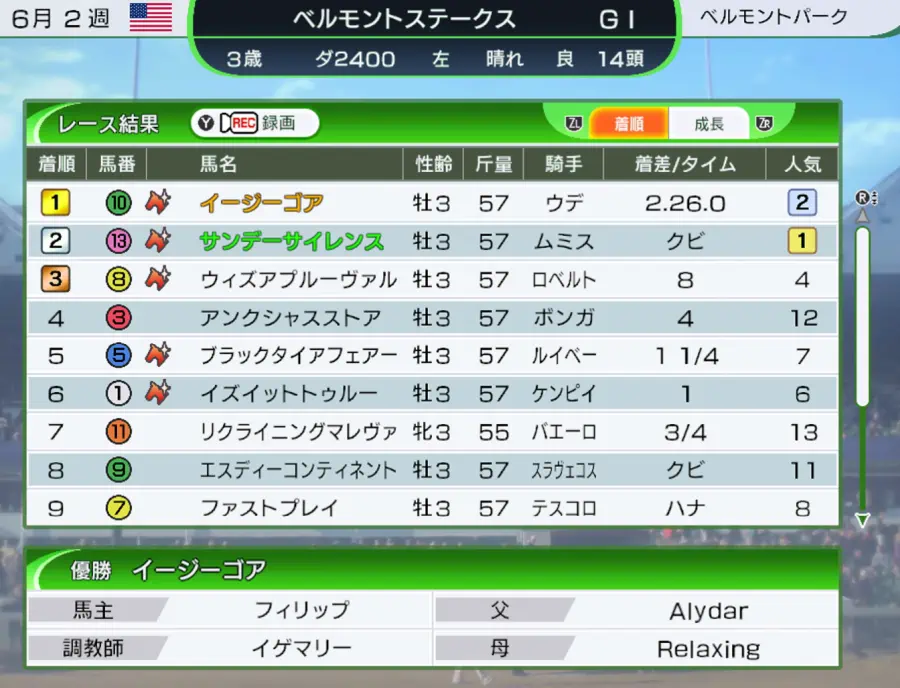
I tried everything
but he just couldn't quite pull out the win.

Meanwhile I had Oguri clearing out the last couple of major trophies
in the cabinet, and after he effortlessly cleared JBC Sprint I had
finished getting all of the major trophies for Japan. I thought that the
credits would roll after this, but this was an error of failing to read
on my part.
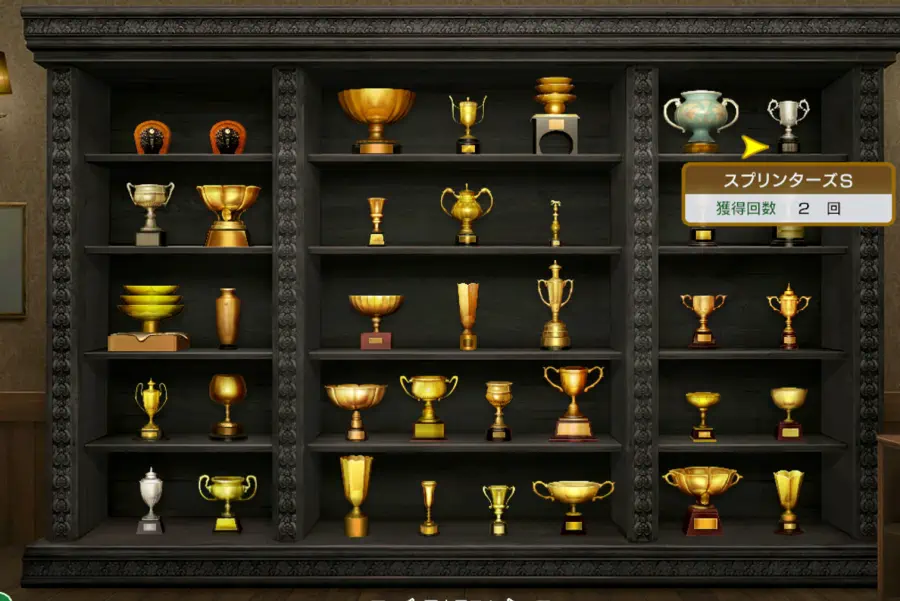
I think I need to finish
filling out the foreign trophy cabinet too.
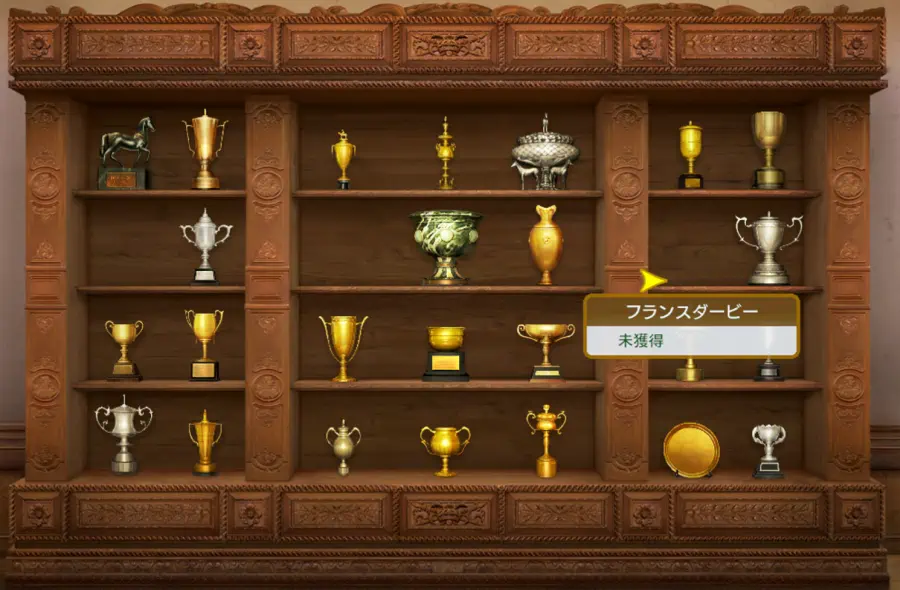
Right now I'm still missing the
English Derby, the French Derby, and Breeders' Cup Sprint. I'll do what
I can to get those cleared out but I don't know how much more I'll find
out by doing so, other than going "wow those races are hard". I might
divert a couple horses to try winning those races but I think if I just
focus on running horses in races they're good at it should happen pretty
naturally.
Anyway, let's run down how all the horses did over the rest of the
year.
Since I already had Tamamo Cross run over the senior year races in
1988 I mostly just ran him abroad in 1989. He picked up some races like
the Dubai Sheema Classic, Queen Elizabeth Stakes, King George VI, the
Arc, Melbourne Cup, and the Hong Kong Cup, and a few others.
As mentioned, I had Oguri mostly clearing out some of the dirt races.
Nothing too crazy there.
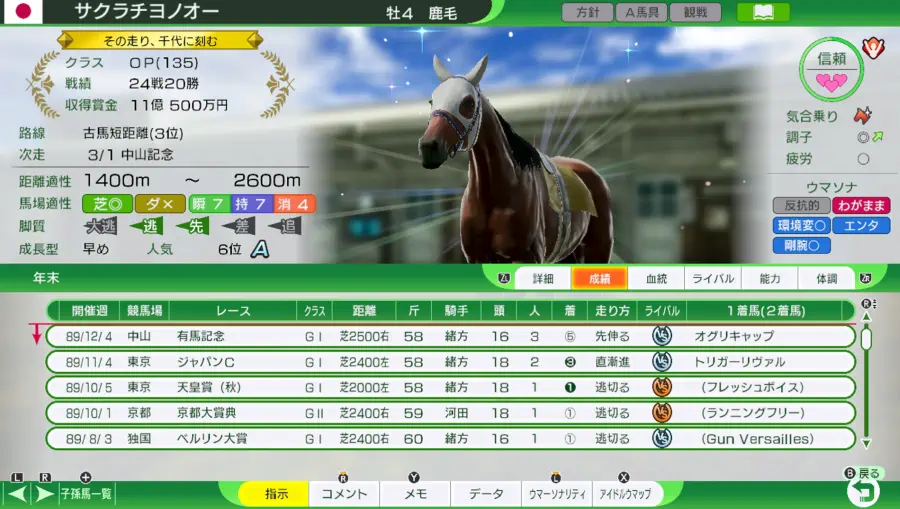
Sakura Chiyono O I had win the Hong Kong Triple Crown and I was
planning on having him finish out the year by clearing out the Senior
Autumn Triple Crown, but he'd hit his limit and started falling off
between Tenno Autumn and Japan Cup, so I had Triggery Val win that race
and then ran all my good horses in Arima Kinen.
Yaeno Muteki I continued just running in mile races and he continued
doing well in them. 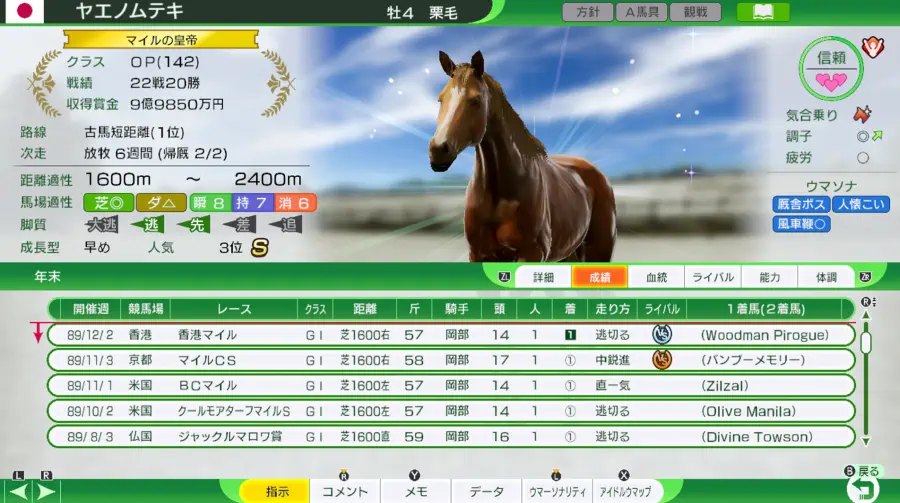
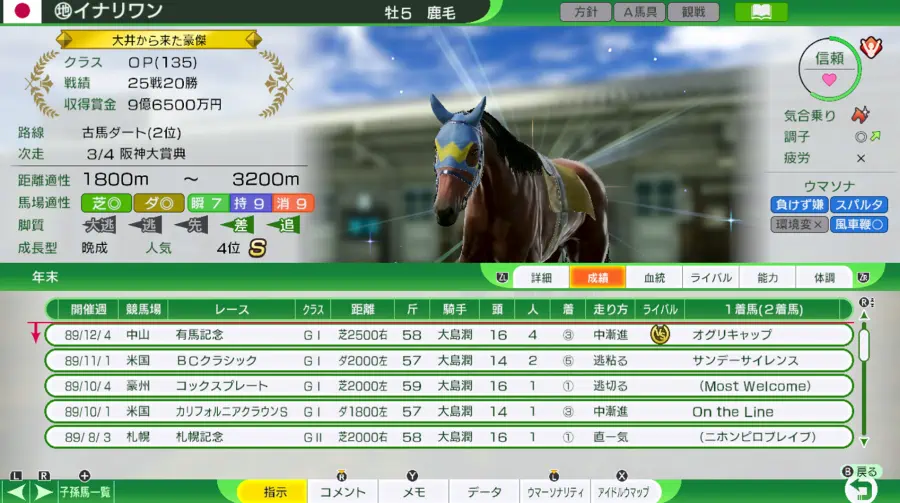
Inari One did
pretty well in clearing the Senior Spring races but he felt like he was
falling off a bit near the end so I opted to retire him. Though maybe
that's just because I kept racing him in the absolute hardest races
instead of dialing it back at all.
Mejiro McQueen debuted in December, which wasn't quite in time for me
to see if I could get him into Hopeful Stakes, but it's Mejiro McQueen.
He'll do fine.
Samantha Tosho I mostly kept to G2s and G3s and she did well there.
Her rating improved a bit from 110 to 116 and she won Victoria Mile and
the Queen Elizabeth II Cup this year.
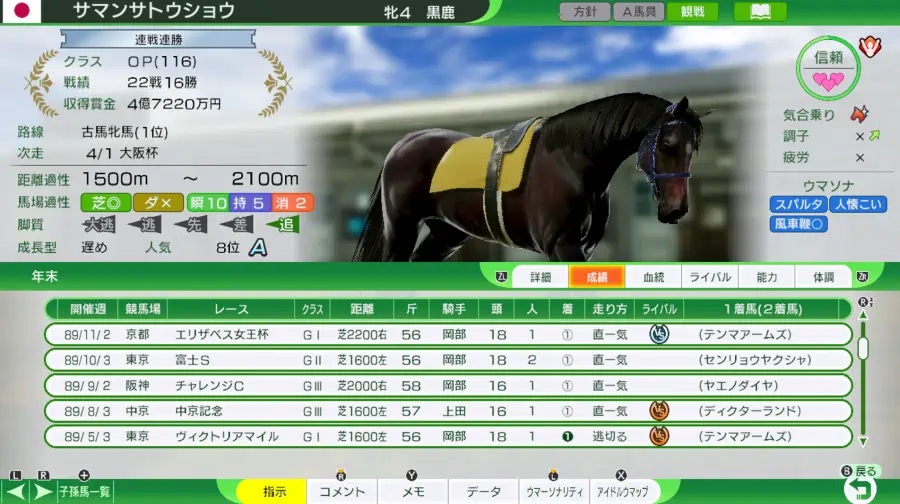
Also, while I've been working on all this I did finally think to go
"what does that (116) after the OP mean?", and it seems to line up with
the Timeform handicap rating system. As best I understand, it's a
numerical rating that assigns a weight in pounds that a horse would need
to carry to be on par with the other horses in a race, which they come
to by looking at the weight a horse is carrying over various distances
in races, the pace of the race, and the level of competition the horse
is up against. There seem to be other factors that go into it, but I
guess those would be Timeform's proprietary secrets. Understanding this
now, it answers some questions like, "when I'm looking at this race,
what does that 55kg there mean? Is it like the maximum the jockey can
weigh or something?"
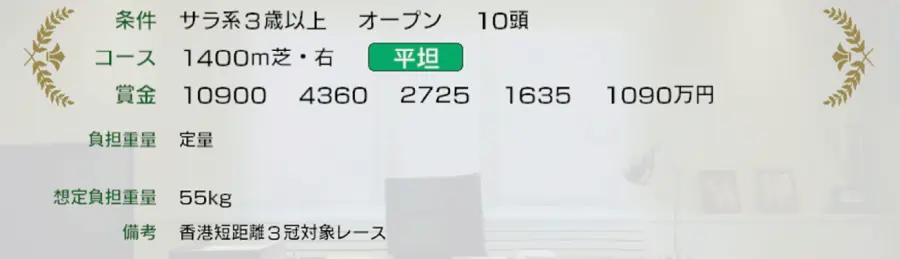
However,
knowing now that the Timeform system is a measure in pounds I can work
from that and figure out that what it's actually saying here is that the
level of competition in this race is expected to have a handicap rating
of around 121.
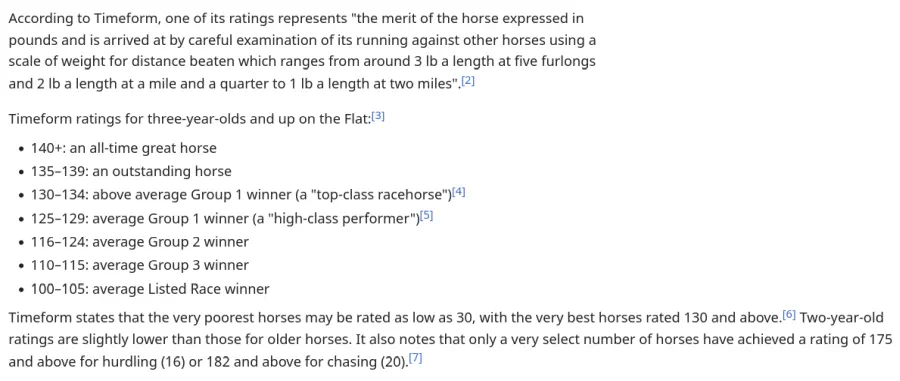
So, 116 would be sort
of at the lower end of average for a G2 winner, and 55kg would be on the
higher end of average for a G2 winner. I could expect Samantha Tosho to
be able to compete in a race like that, but it might take some work to
win, assuming her current rating is accurate.
Haku Taisei debuted nearer the end of the year and picked up Asahi
Hai Futurity and a pile of G3s. He's a pretty strong horse, though I
don't like the look of that growth rate so I might just run him in G2s
and G3s and see if he falls off later next year. In real life Haku
Taisei was undefeated up through the Satsuki Sho, won the Satsuki Sho,
and then broke his leg in the Japanese Derby, finishing fifth, and while
they tried letting the leg heal and racing him in the Yasuda Kinen the
next year he had to be scratched right beforehand and retired afterward.
Still, there's a lot of value here. I'm just feeling a bit cautious
because I don't expect him to beat McQueen or Ines Fujin and that growth
rate has me thinking he'll collapse before he can pick up another G1.
I'll play it by ear. 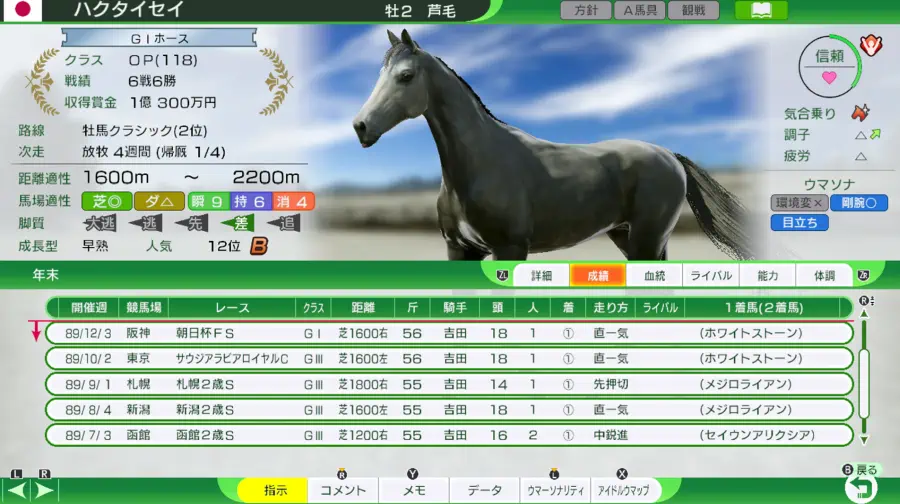
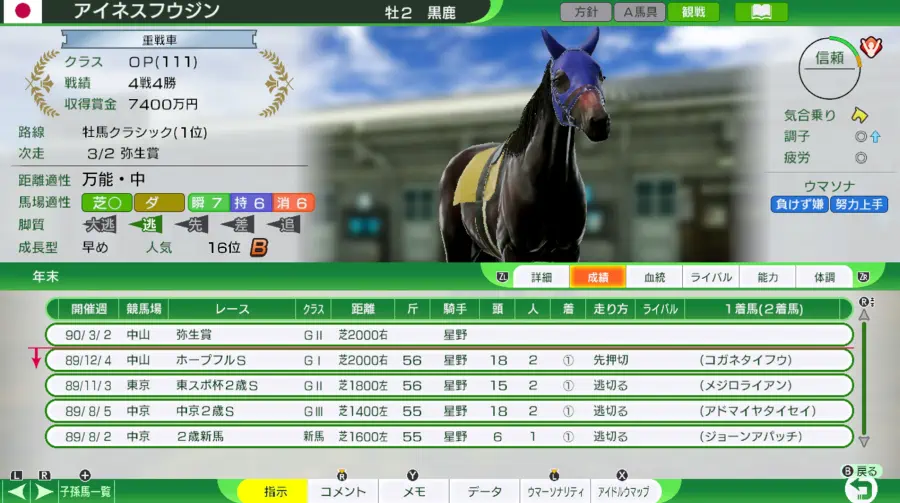
Speaking of Ines Fujin, he also debuted and managed to win Hopeful
Stakes. I can't remember if I've written about this here or in one of
the essays I abandoned but Ines Fujin is one of the pivot points of
Japanese horse racing, with his real life Derby win marking the point
where horse racing went fully mainstream, and the point where the fans
in the stands started cheering the jockey's name after a win. I tried
finding Eiji Nakano in the list of jockeys to assign him to Ines Fujin
but he didn't seem to be in there.
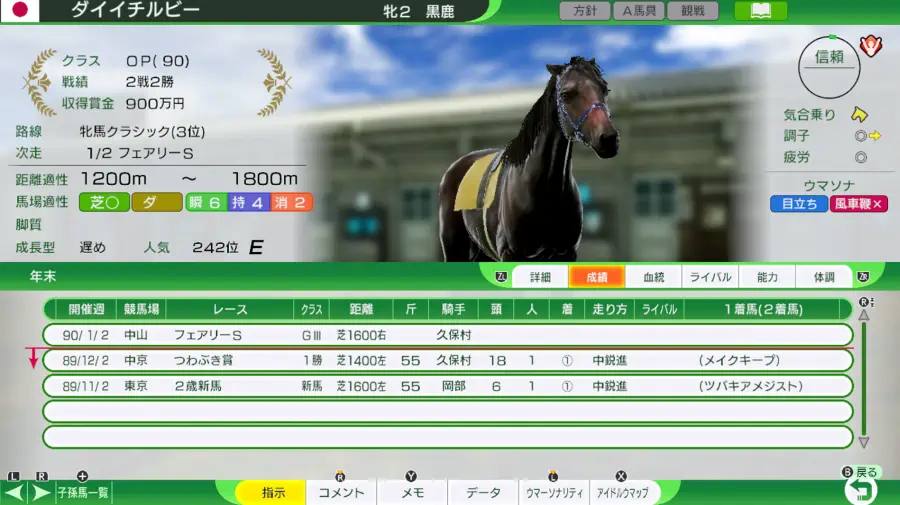
Daiichi Ruby also debuted near the end of the year. There's not a lot
to her results in game yet but in real life she was an incredible
racemare. She won the Yasuda Kinen and Sprinters Stakes, won a G2 and a
G3, and had a solid number of second-place finishes. She lost to Daitaku
Helios a few times at the Mile Championship and the Takamatsunomiya Hai
before it was shortened and upgraded to a G1. Great horse, I'll be
running her in a bunch of sprints and miles.
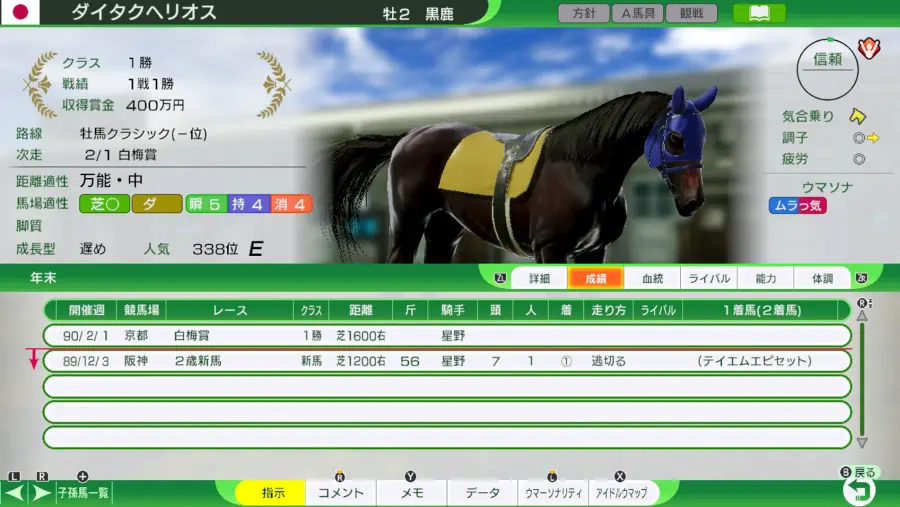
Now, speaking of Daitaku Helios, he also debuted, albeit right at the
buzzer. He's a pretty good horse at miles and mediums. In real life, as
mentioned a bit above, he won the Mile Championship against Daiichi
Ruby, and then repeated the feat again the next year. He had a number of
G2 wins, a G3 win, and a few second place finishes in some other graded
races around 1600 meters. Great horse. Not a total genetic freak, but he
should be able to do well if I juggle the races right.
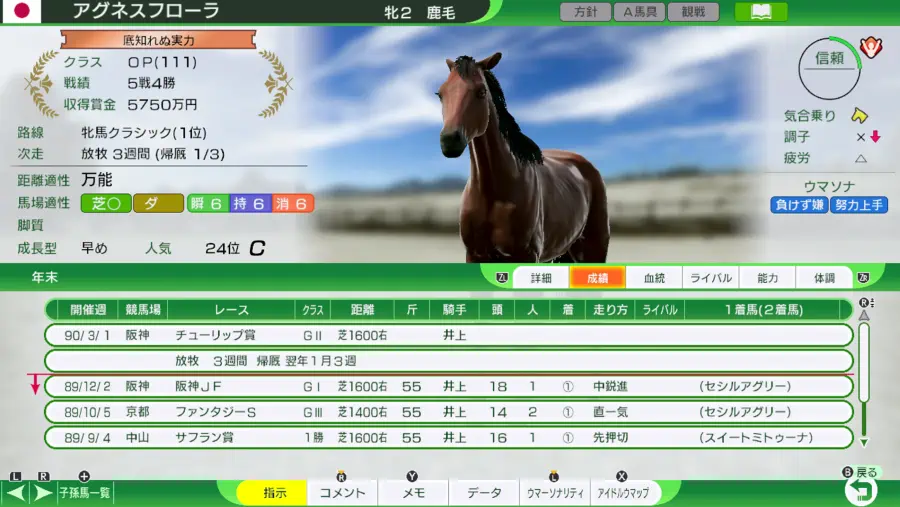
I also had Agnes Flora debut and win Hanshin JF. In real life her
career was pretty short. First place in the Oka Sho, second place in the
Oaks, and then she retired. She's a solid racer, though her real value
is going to be in 1997 when she foals Agnes Tachyon. I always appreciate
getting a mare who can actually race though.
I had some other generic horses debut but they're kind of bad.
Campaign Girl also debuted and she's able to win some really low-stakes
races if I struggle.
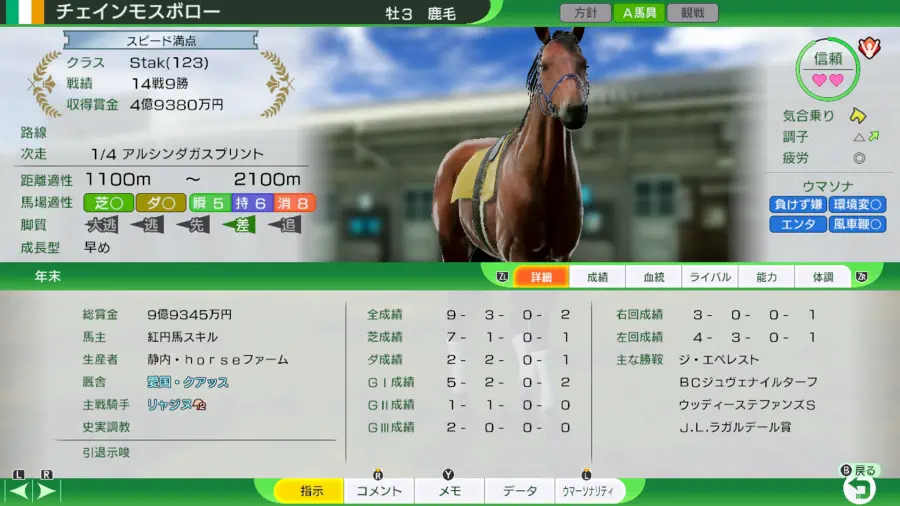
Overseas, in England, Chain Mosborough picked up the American Turf
Stakes, Woody Stefan's Stakes, came second in the Haskell Stakes, had a
few lower place finishes, and then won The Everest, bringing him up to a
total of 5 G1 wins.
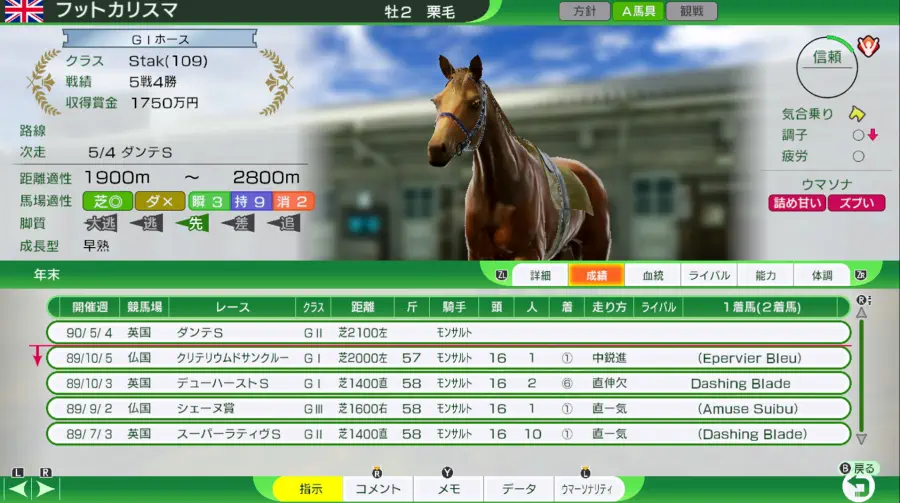
Foot Charisma, a generic foal by Tiramisu Prochyon and Caerleon,
debuted and picked up a couple of graded race wins. Seems like an
alright horse for now, but that precocious growth rate is making me
think he'll fall off by the middle of next year.
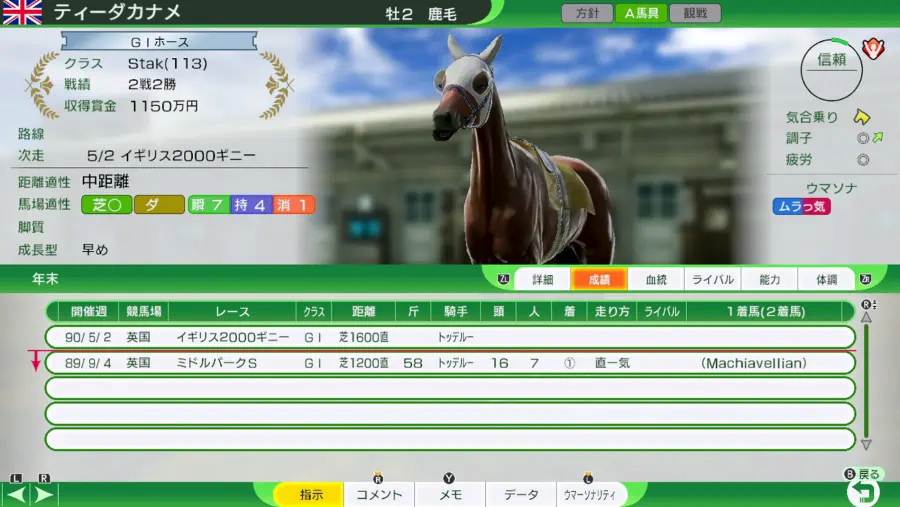
Tyrda Kaname, a generic horse by White Lunaby and Mister C.B. debuted
and won a short G1. Good job.
The rest of my English horses were middling and didn't get any wins of note and I'll retire them.
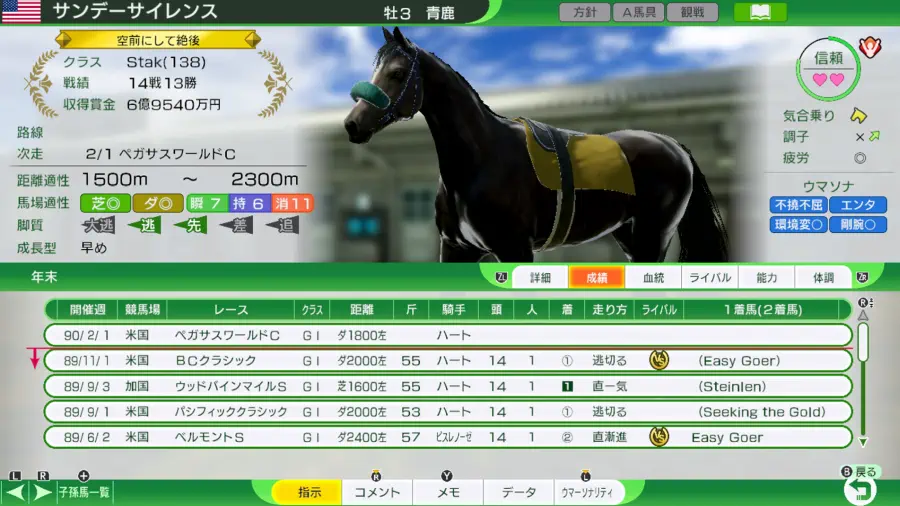
Over in America, Sunday Silence won the Florida Derby, two legs of
the Triple Crown as mentioned, lost the Belmont to Easy Goer by a nose,
picked up two more G1s and then won Breeders' Cup Classic. He is as good
as expected.
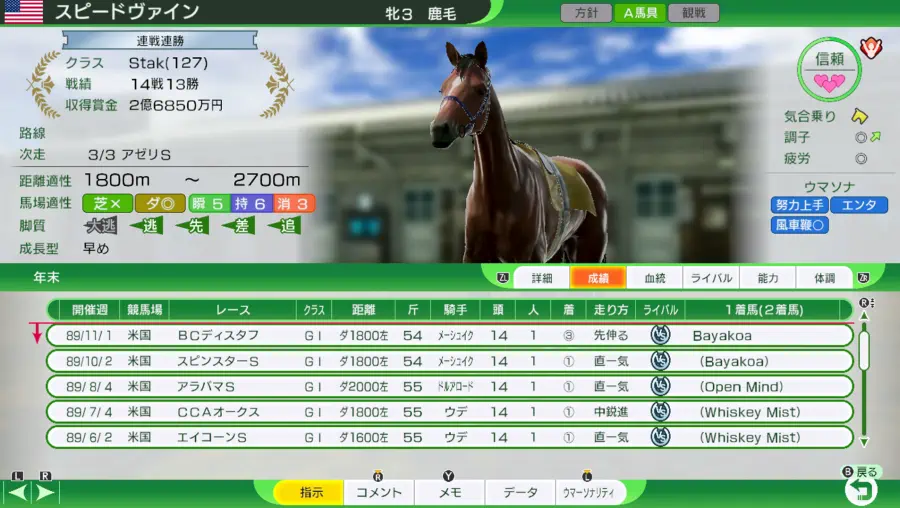
Speed Vine's continued to do pretty well. She won the Triple Tiara
and a decent number of other G1s, though she placed third at Breeders'
Cup Distaff. Still, she's putting up some great numbers.
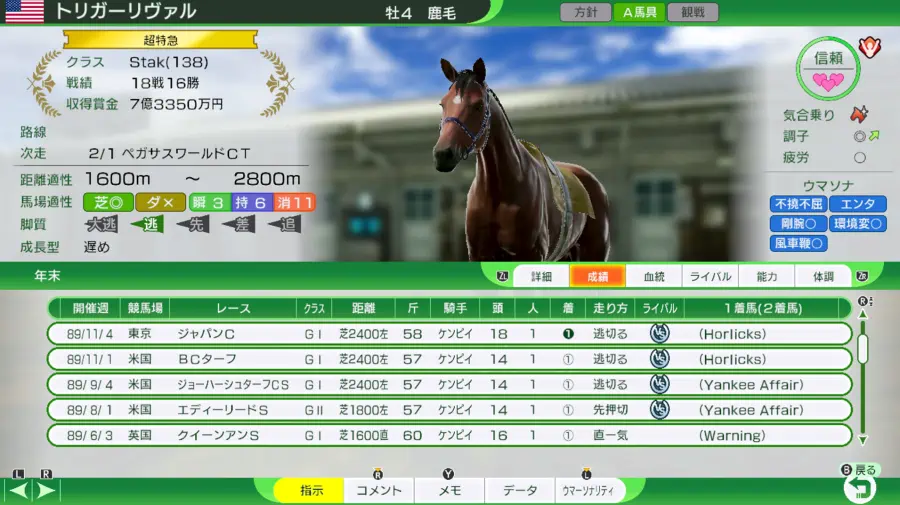
Triggery Val's continued doing well. He picked up Pegasus World Cup
Turf, Australian Cup, OFB Turf Classic, Coronation Cup, Queen Ann
Stakes, Joe Hircsh Classic Stakes, Breeders' Cup Turf, and Japan Cup
when it became clear to me that Chiyono couldn't win anymore.
Short Slum, a generic foal by Tokai Midori and Seattle Slew, debuted
and placed on the board in a couple of G1s before I decided it would be
more prudent to run him in G2s and G3s instead. He has a precocious
growth rate so I assume he'll fall off but he's doing okay for now.
I Know Parking, a generic foal by Northern Taste and Sweet Luna,
debuted and put up some pretty middling results, but did win a G3.
Narubi Fairy continued putting up middling results throughout 1989
but did win the G1 Bluegrass Stakes in April before her performance
collapsed.
Cryabo, a generic foal by Mint Gaia and Seattle Slew, made it to
Stakes status and won a couple of G3s and a G2 but was overall kind of
mid.
Over in the club, Super Creek picked up a few overseas G1s and
generally put up a lot of strong performances.
Bamboo Memory's been confusing me with how badly he's been doing over
the last few years, but he got it together and started winning some G3s
and started placing on the board in some G1s towards the end of the
year.
Mejiro Palmer debuted and hasn't made it out of the 1 win class
yet.
Mejiro Ryan also debuted and hasn't gotten a second win yet, but he's
been losing to good horses like Haku Taisei and Ines Fujin so he's Open
class. He's on the board consistently though.
1990
I wonder why it feels like it takes longer to go through a year now.
Anyway I have like 40 horses to go over this year.
Around the middle of the year I realized I should probably stop
erasing my spreadsheet results every race so I could have an easier time
replaying turns if I needed to, and it also makes it easier to go back
and remember what went on since I've been kind of alternating between
writing this up as I go and writing it up as I load up the save I made
at the end of the year and look at the results.
I like my horses to win and I try to make sure they get the best
result they can, which means a lot of save scumming to try and find a
line for them to get through. The last turn of 1990 gave me one of the
thinnest margins of victory on a couple of races that I've ever seen.
These were wins by a nose where whether they won or not came down to
whether I watched the race or not, which I noted in the column on the
right. Short Slum could only win that G3 if I skipped to results, and
Agnes Flora could only win the American Oaks if I watched the race.

Now let's go down the results for the year.
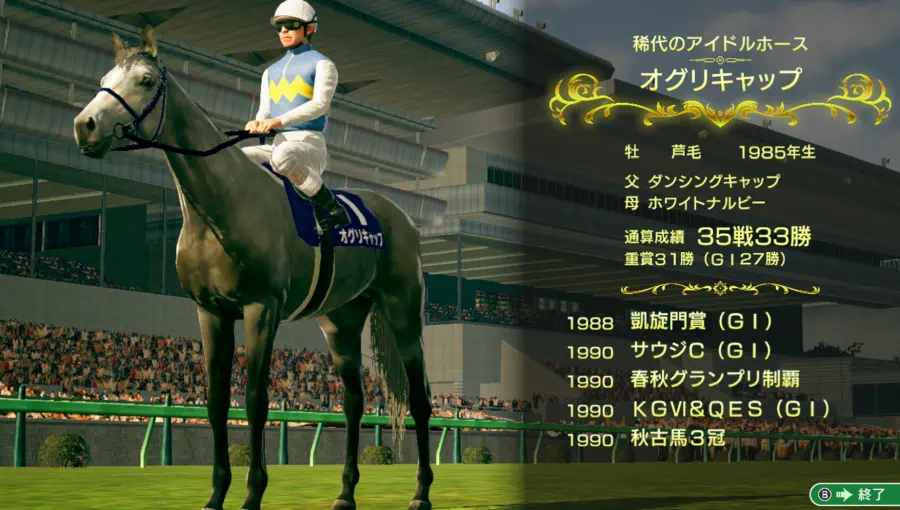
Oguri continued doing well, and I had him run over most of the high
cash value races. He won the Senior Autumn Triple Crown, the Takarazuka
and Arima, and the Saudi Cup, Dubai Sheema Classic, King George VI, and
a few others. I think I'll retire him after
this.
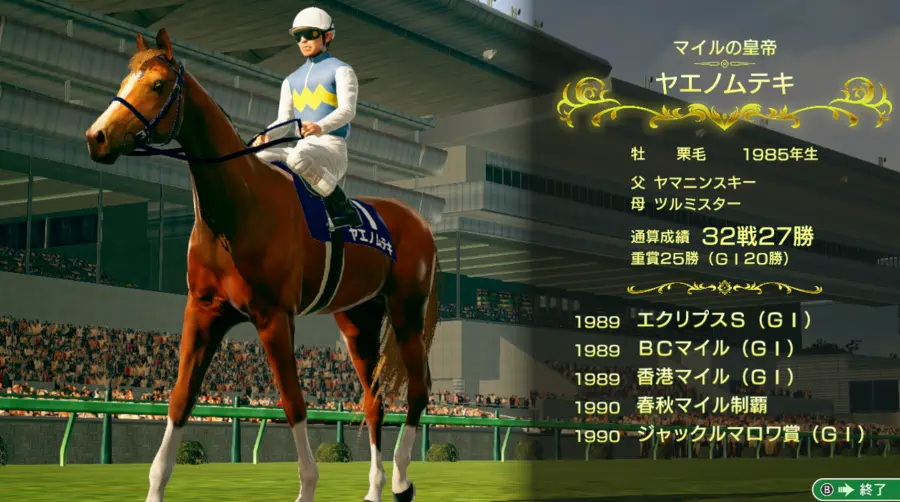
Yaeno Muteki continued putting up strong showings in mile races but
he was falling off near the end of the year. I opted to retire him. He
got to 20 G1 wins. Great work
Muteki.
Samantha Tosho improved a bit more and picked up five G1s at the
Coolmore Classic, the Takamatsunomiya Kinen, Victoria Mile, the First
Lady Stakes, and the Queen Elizabeth Cup, bringing her to 8 G1 wins.
She's starting to get a bit older now, but more importantly I have a lot
more horses in her niche coming up so while I might be able to squeeze
another year out of her since she was still performing well in real life
up through early 1991 I think it's prudent to retire her now.
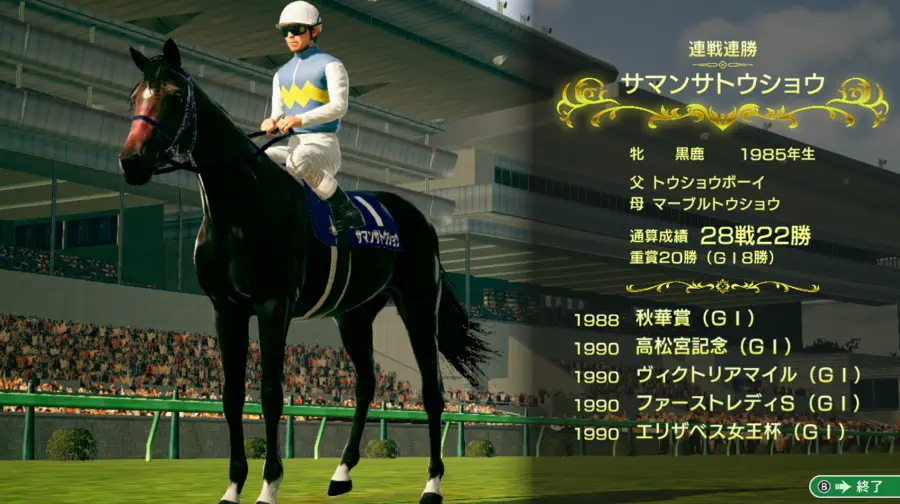
Now, speaking of 8 G1 wins and horses in Samantha Tosho's niche,
Daiichi Ruby had her Classic year. I need to emphasize here: Daiichi
Ruby is really strong in sprints and short miles, and I took
advantage of that. After entering her in some G3s and G2s to qualify her
for the Oka Sho, which she won easily, I decided to send her to race
abroad. Her distance aptitude can maybe be upgraded to 2000
meters with a lucky training, but I figured I'd keep it simple and stick
to what she's good at. I tried running her in the European Mile Triple
Crown but some of the competition there was just a bit too strong to
pull out a win so I just took her out of the races she would've lost and
gave her a bit more time to rest and train. That said though, she
managed to win the French 1000 Guineas, the Coronation Stakes, the
Rothschild Prize, Sprinters Stakes, Queen Elizabeth 2 Stakes (the
English one, not the Queen Elizabeth 2 Cup), Breeders' Cup Mile, and the
Hong Kong Sprint. Extremely good horse, that's 8 G1 wins in her first
year, and I don't expect that to slow down any in 1991 or 1992.
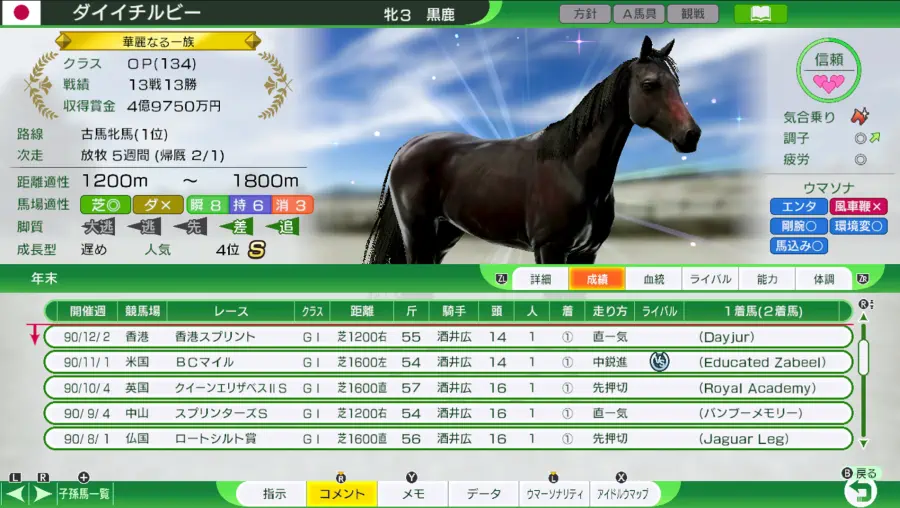
Haku Taisei exceeded my expectations a bit. He racked up 7 G3 wins,
two G2 wins, won NHK Mile, and while he lost Tenno Autumn, that was to
Oguri Cap. He didn't fall off like I was expecting from his growth rate
and he's been putting in some really good work.
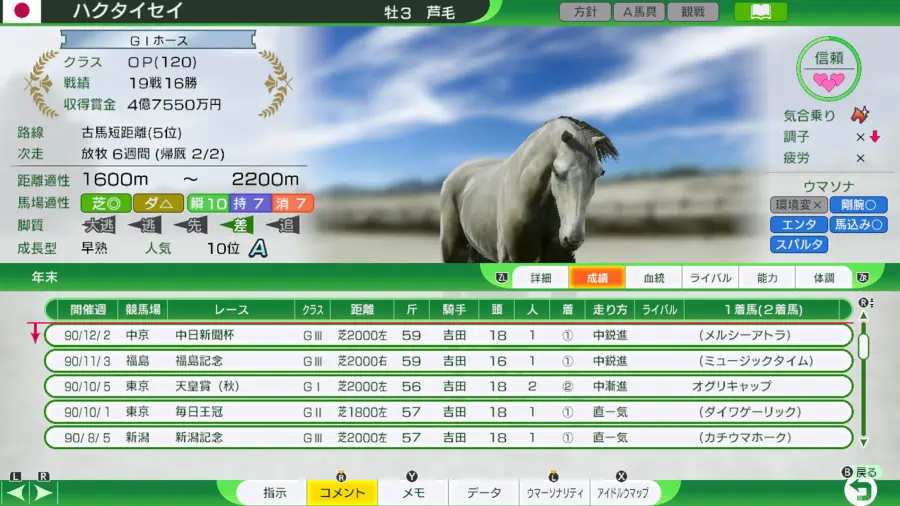
Mejiro McQueen got going at the start of the year and performed about
as well as you'd expect of one of the greatest to ever do it. He won a
G3, a G2, and then the Triple Crown. In-between the Japan Derby and
Kikuka-Sho he won the German Derby, the Großer Preis von Berlin, and the
English St. Leger.
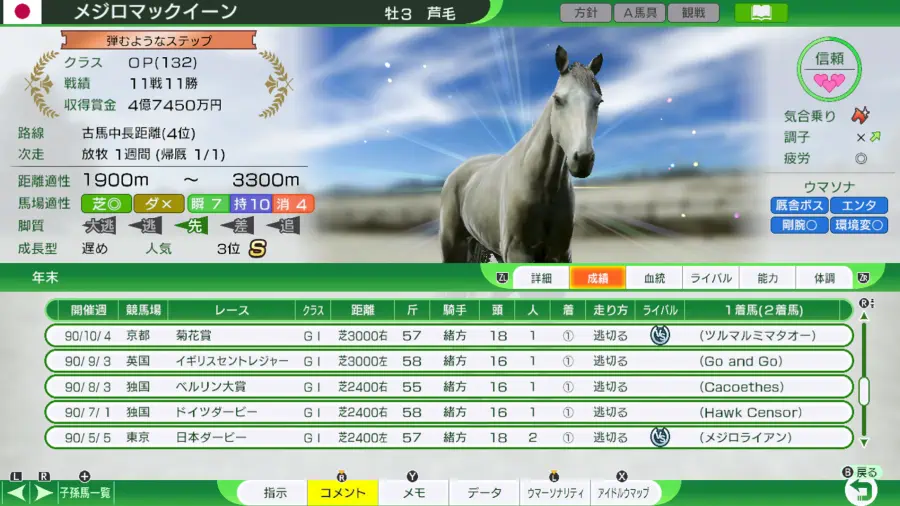
Ines Fujin gave me some more trouble than I expected out of a
real-life Derby winner. He picked up a couple of G2 and G3 wins, but
lost to Haku Taisei, both Mejiro McQueen and Mejiro Ryan, and struggled
to get on the board in the weaker overseas races I'd entered him in. He
seems to really be more of a G3 kind of horse than his real life G1 wins
would indicate.
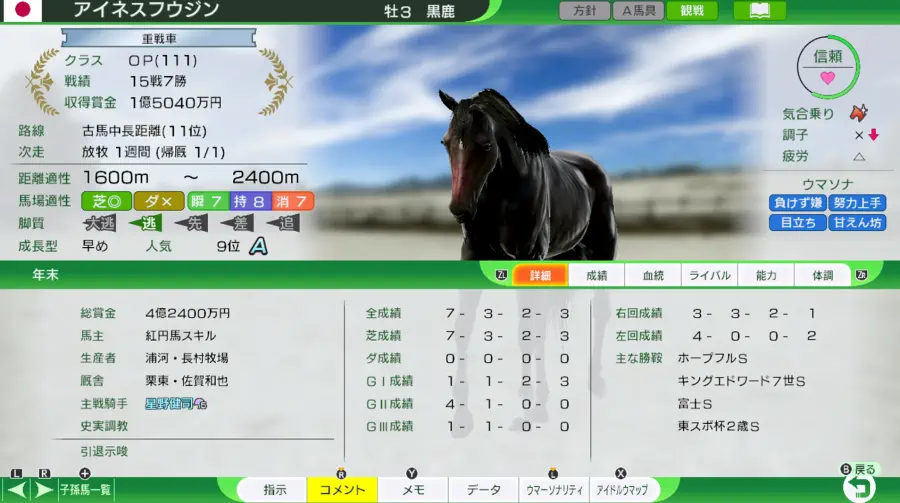
Trying to find a place to slot Daitaku Helios in was a real pain.
He's a good horse but I have so many other sprint and mile and medium
horses running around that the only place I could find a win for him was
to run him in some dirt races, since he isn't completely useless on
dirt. He picked up a couple of G3s, the G2 Centaur Stakes, a third-place
finish in the Sprinters Stakes, a second-place finish in Champions Cup,
and a first-place finish in Mile Championship Nanbun Hai. It's going to
take some work to get him where he needs to be, though at least he's not
slated to hit his prime until next year.
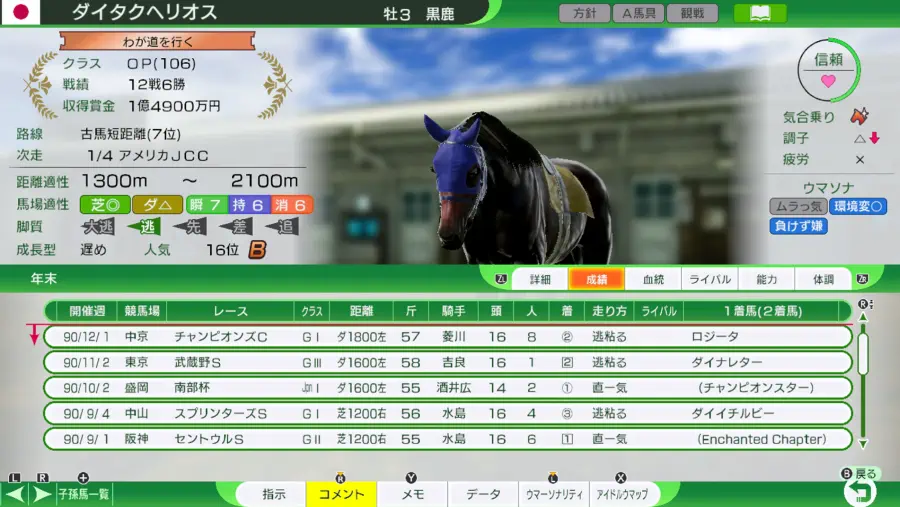
Nice Nature debuted near the end of the year and, since I know Tokai
Teio is coming up and likely to really overshadow Natie here, I wanted
to make sure he got a G1 win before then to open up my options a bit.
Thankfully, Nice Nature is actually really solid and picked up Hopeful
Stakes without any trouble. I won't run him in the Classics because I
don't think there's a lot of point to doing that when Tokai Teio exists
and is going to win the Triple Crown, but there should be some other
places he can shine. I'm not sure where, exactly, since Teio's going to
be tearing up the mediums, McQueen's going to be tearing up the longs,
and Daiichi Ruby's going to be tearing up the sprints and miles. It's
going to be hard to find places to play to Natie's strength, but I do
want to find them. Having a G1 win under his belt opens up the
international field as an option so that's probably where I'm going to
find them. Also he should be able to clear NHK Mile pretty easily.
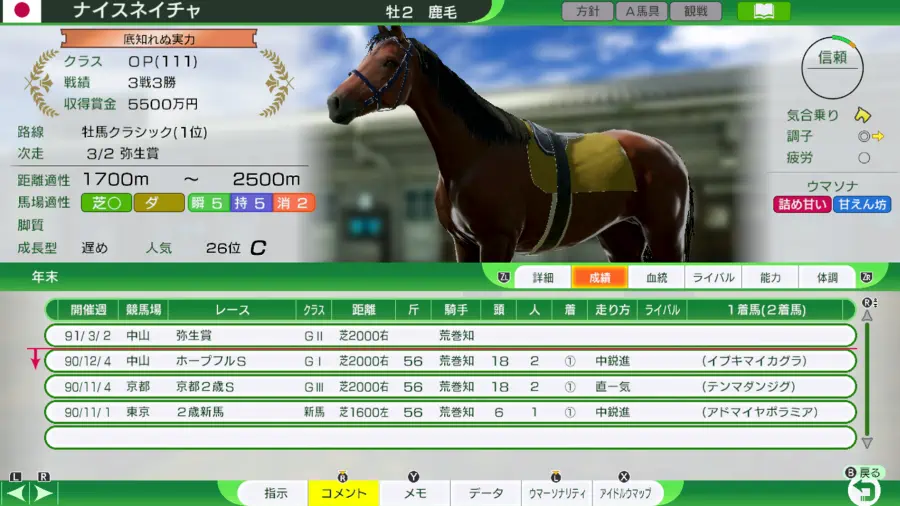
Over in the Tiara track, Agnes Flora did pretty well. After losing
the Oka Sho to Daiichi Ruby she picked up the Japanese Oaks, the Del Mar
Oaks, the Shuka Sho, the Matriarch Stakes, and finished out the year
with a win at the American Oaks. I think I retired her after that.
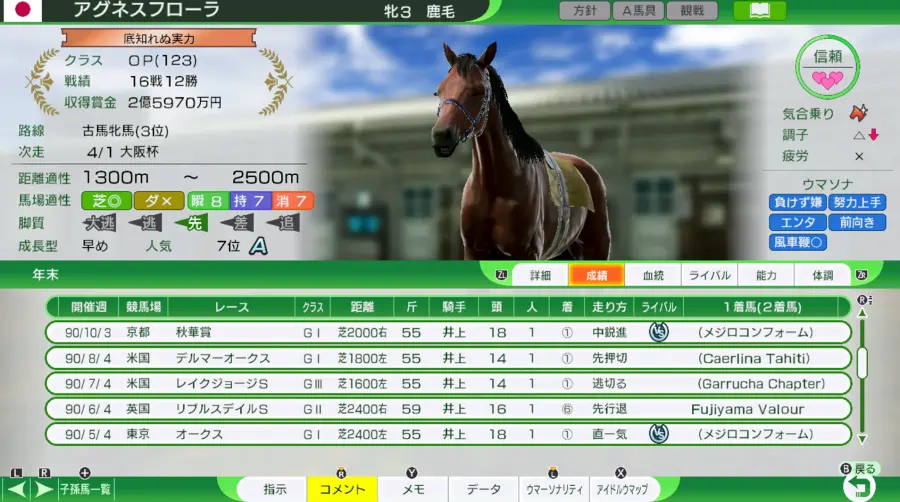
Micro Forbes, one of my generic foals by Mint Gaia and Maruzensky,
debuted and got off to a pretty decent start. Three G3 wins, a G2 win,
and a second-place finish at Asahi Hai Futurity. He's got a precocious
growth rate though so I'm not expecting a ton out of him.
Chiflada Neon, a foal by Saddler's Wells and one of Nasuno Chigusa's
less-successful children, Mitsuko Eminence, had his classic year and.
Well he's not good but he won a couple of Listed-class races,
an open, and a Jpn-III, which is decent. I don't have the highest hopes
for him but he's not past his peak yet, at least.
Campaign Girl picked up a couple of races. She seems to excel at
2600m, specifically. I retired her at the end of the year.
Next, my European horses:
Chain Mosborough picked up a couple of G1s but was otherwise up and
down through the year.
Foot Charisma won a G3 and a G2 and then placed on the board in a lot
of races but couldn't pick up many wins anywhere.
Tyrda Kaname was a similar story. Won a G3 and a G2, but struggled to
get on the board. The rest of the horses in Europe didn't even get that
far.
My American horses were a lot better:
Sunday Silence picked up the Hong Kong Triple Crown, the Arc, another
win at the Breeders Cup Classic, the Hong Kong Cup, and a few other G1s.
I think this was when he retired in real life so I plan on doing that
now.
Triggery Val continued racking up G1 wins. He's up to 20 now.
Speed Vine continued putting up solid results, and she mainly just
lost due to being in some of the same races as Sunday Silence and Easy
Goer.
I Know Parking wasn't as strong as those three but he picked up a G1
in the American Turf Stakes and ran up the score elsewhere, winning two
G3s and four G2s. He's alright.
Short Slum is almost good enough to win a G1, but not quite.
He's had four finishes in the top 3 but couldn't ever quite pull out a
win.
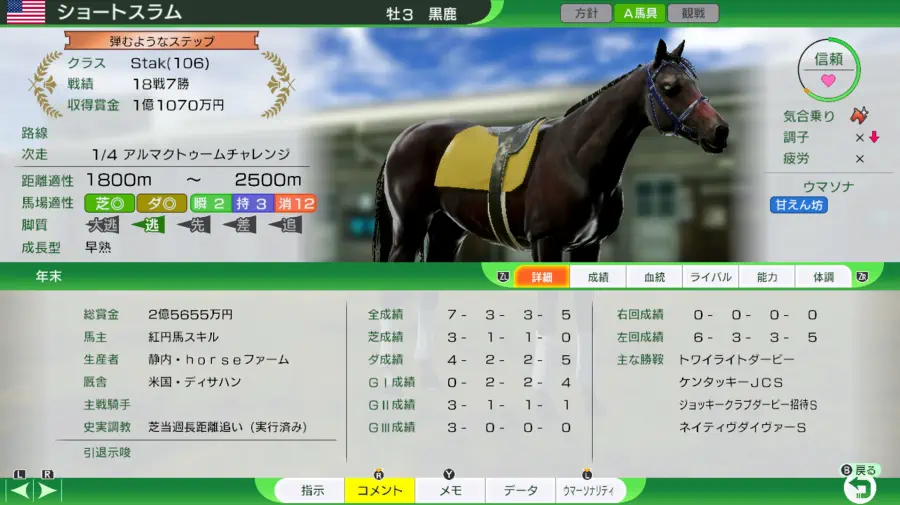
Travel Crane, a generic colt by Wishing Well and Silver Hawk, debuted
and placed second in BC Juvenile Turf and won a G3.
Over in the club, Super Creek continued winning major races and
generally tearing up the longs.
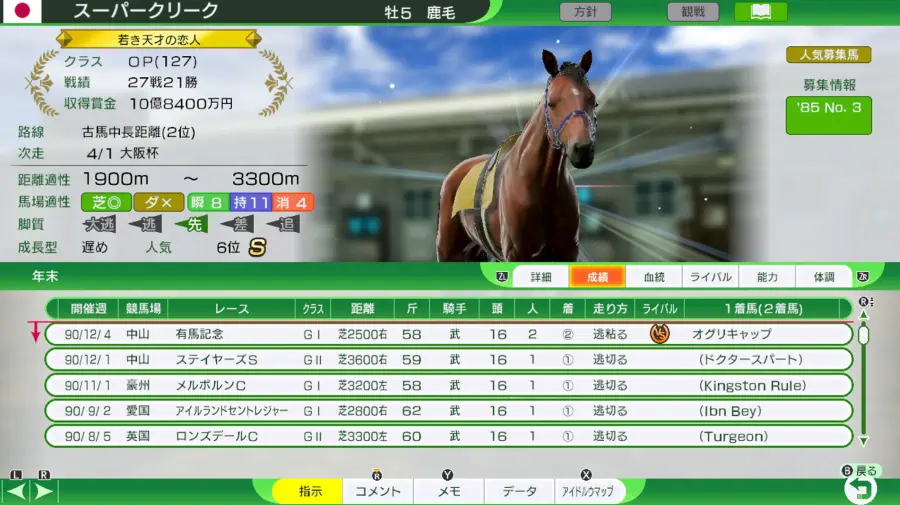
Bamboo Memory's gotten it together a bit more, though he loses G1s to
the horses I have more direct control over.
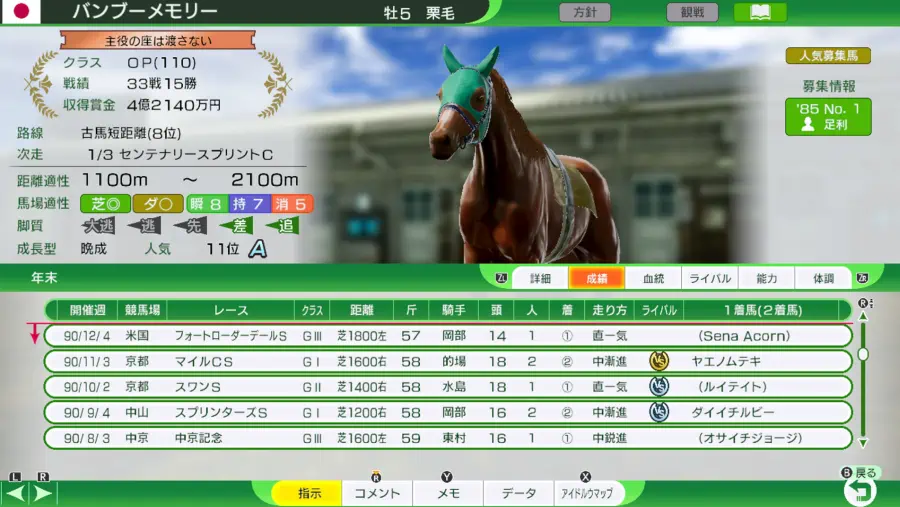
Mejiro Palmer's been struggling more than I expected. He's at the
3-win class now though, maybe he'll start pulling it together in year
4.
Mejiro Ryan's been doing pretty well, winning a fair few G3s and G2s,
and he's gotten a second-place finish in a G1.
Tokai Teio debuted and I mostly left the scheduling to the club, and
they decided not to run him in too many of the 2-year-old races. It's
Teio though. There's not a lot of concern about him so he'll be taking
the Triple Crown pretty effortlessly.
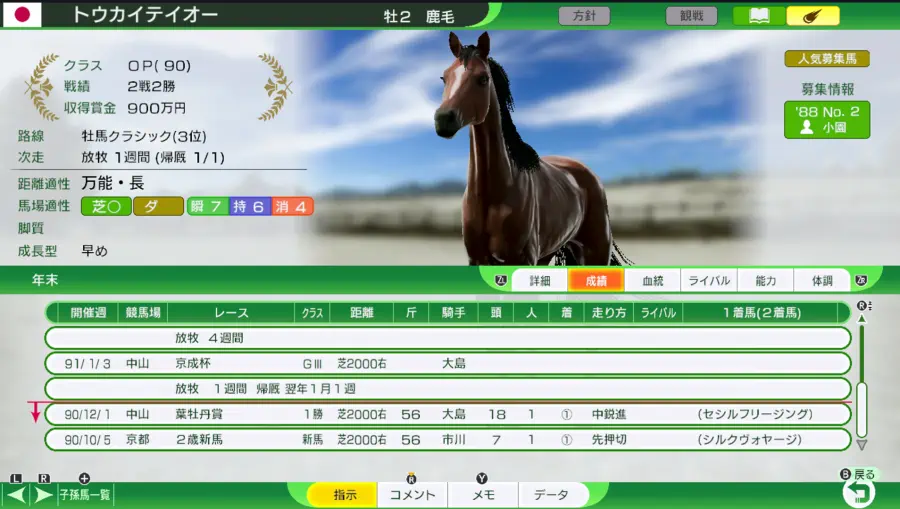
Now let's cover some of the upcoming notable horses in the farm set
to debut or have their classic year in 1991.

It's a bit slimmer than the last few years, but Nishino Flower and
Bakushin are all-time great sprinters, Teio would have won all three
legs of the Triple Crown if he hadn't broken his leg, Mihono Bourbon
could conceivably become a Triple Crown winner, and Nice Nature is a
good horse that happens to exist in an era where every distance has some
all-time genetic freaks.
The rest of my foals are generics who range from mediocre to "I set
it to auto for a few years to get a peek at what's going on and I think
one of them nearly won the American Triple Crown?"
1991
in progress